
Understanding an Audio Visual Quote: The 2026 Guide to Decoding Event Production Costs
- Shanaka Tennekoon
- 2 minutes ago
- 12 min read

Why does one event proposal look like a bargain while the other feels like a ransom note, even when the equipment lists seem identical? You've likely stared at a spreadsheet of pixel pitches and lumen counts, feeling the weight of stakeholder expectations and the fear of a screen flickering to black mid-keynote. It's an intense, high-stakes environment where technical jargon often obscures the true value of the production. Mastering the art of understanding an audio visual quote is about more than just checking prices; it's about securing the technical foundation of your event to ensure maximum impact without hidden surprises.
We've built this 2026 guide to help you strip away the complexity and focus on what actually drives results. We agree that the pressure to balance a tight budget with a flawless delivery is constant, so we're showing you exactly how to decode these documents. You'll learn how to decipher technical specifications, why investing in expert labour is your best insurance policy, and how to spot the gaps that lead to on-the-day stress. We're providing a clear checklist to compare providers, giving you the technical peace of mind and confidence to deliver a flawless live experience.
Table of Contents
The Anatomy of a Professional AV Quote
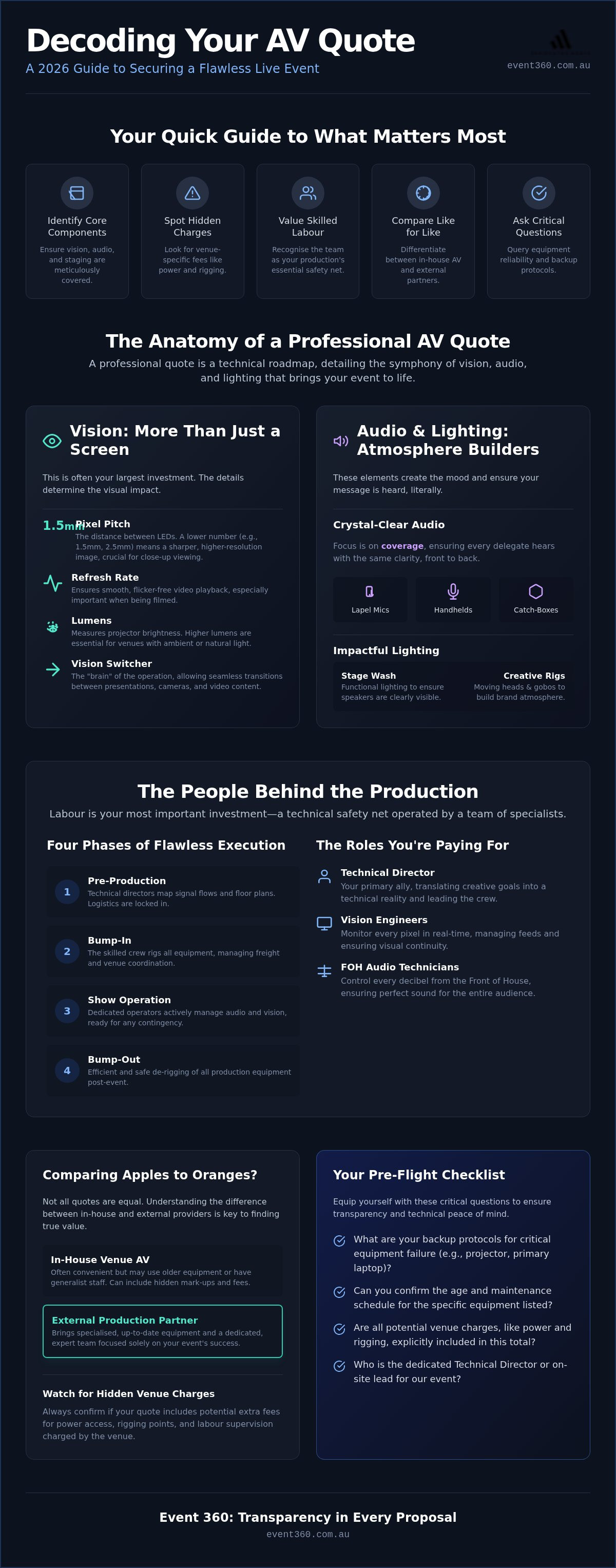
A professional AV quote is far more than a simple price list. It serves as a technical roadmap, meticulously detailing how your creative vision transforms into a tangible reality. When you're understanding an audio visual quote, it's helpful to first grasp what audiovisual (AV) means in a modern production context. It isn't just about plugging in a few speakers; it's a coordinated symphony of vision, audio, lighting, and staging. By 2026, this definition has expanded to include data and high-speed connectivity as core pillars, ensuring that hybrid elements and live streams remain rock-solid throughout the event.
Don't be tempted to skim over "Miscellaneous" or "Consumables" line items. These often include critical components like gaffer tape, specialised cabling, and high-capacity batteries. While they seem small, they're the physical glue holding the production together. Without them, the most expensive LED wall is just a heavy ornament. These items represent the meticulous attention to detail that separates a flawless execution from a technical headache.
Vision: More Than Just a Screen
Vision is often the most significant investment on your quote. When you see "pixel pitch" mentioned for LED walls, it refers to the distance between the centre of each LED cluster. A lower number, such as 1.5mm or 2.5mm, provides a much sharper image for close-up viewing. Refresh rates are equally vital; they ensure that video playback looks smooth and flicker-free on camera. If your quote includes projection, pay attention to the "lumens". This measures brightness, which is essential if your venue has natural light or high-intensity stage lighting. Finally, the vision switcher acts as the central "brain", allowing for seamless transitions between presentations, live cameras, and video content.
Audio and Lighting: The Atmosphere Builders
Crystal-clear sound is non-negotiable for a successful MICE event. A professional quote focuses on "coverage" rather than just the total number of speakers. This ensures every delegate, whether at the front or the very back of the room, hears every word with the same clarity. Your microphone choices also impact the event's flow. Lapels offer hands-free movement for keynotes, while handhelds are reliable for fast-paced Q&A sessions. Catch-boxes add a dynamic, interactive element to the room, encouraging audience participation.
Lighting serves two masters: function and feeling. A standard stage wash ensures your speakers are visible to the audience and cameras alike, preventing them from appearing as shadows on screen. Creative lighting rigs, featuring moving heads or textured "gobos", transform a sterile conference room into an inspiring environment that reflects your brand's energy and ambition.
Decoding Labour and Logistics in the Australian Market
Labour is the single most important line item on your proposal, yet it is often the most misunderstood. While it's easy to focus on the cost of a high-resolution LED wall, that equipment is effectively a dormant pile of silicon without a skilled team to rig, program, and operate it. When you are understanding an audio visual quote, you are essentially investing in a technical safety net. In the Australian market, this involves a complex web of logistics, from managing national freight to coordinating specialised crews who understand the unique requirements of our major convention centres. The "invisible" value of a production team lies in their ability to anticipate problems before they reach the stage.
Your project moves through four distinct phases: pre-production, bump-in, show-op, and bump-out. Pre-production is where the technical roadmap is built. It involves hours spent by technical directors mapping out signal flows and floor plans so nothing is left to chance. Freight and transport for national events also add layers of complexity. Moving delicate vision gear across the country requires specialised road cases and climate-controlled logistics to ensure everything arrives in perfect working order. These logistical components ensure that your event starts on time and stays on track, regardless of the venue's location.
The Roles You Are Paying For
A Technical Director acts as your primary ally, translating your creative goals into technical execution. They lead a team of vision engineers and Front of House (FOH) audio technicians who monitor every decibel and pixel in real-time. High-stakes corporate events don't allow for "set and forget" setups. A dedicated operator stays at the console throughout the show, ready to adjust levels or switch backup feeds instantly if a presenter's laptop fails. When you partner with an Australian AV specialist, you are securing the expertise of professionals who handle the pressure of live production so you don't have to.
Bump-in and Bump-out Logistics
Venue access times dictate the rhythm of your budget. If a venue only allows a four-hour window for a massive LED installation, you'll see a spike in labour costs as we deploy a larger crew to meet the deadline. Similarly, "strike" fees for late-night or weekend bump-outs are standard in Australia, often involving minimum call-out periods for operators and riggers. Rigging is particularly critical; only certified professionals should ever hang equipment over an audience. This isn't just about compliance; it's about the absolute safety of your delegates and the structural integrity of the entire production. Understanding these timings helps you negotiate better venue access and avoid unexpected overtime charges.
Comparing Quotes: How to Spot the "Apples to Oranges" Trap
When you're faced with two proposals that vary significantly in price, the bottom line rarely tells the whole story. Understanding an audio visual quote requires looking beneath the surface at the quality and age of the hardware provided. A "5-metre LED wall" on one quote might be a brand-new, high-refresh-rate panel, while another could be five-year-old stock with visible seams and dead pixels. Tier 1 equipment from manufacturers like Barco or Meyer Sound carries a premium because these units are engineered for reliability in high-pressure environments. Cheaper alternatives often lack the processing power to handle complex creative content without stuttering or colour shifts.
Venue "in-house" AV providers often rely on the convenience of being on-site, but their equipment might be permanently installed and less flexible for bespoke designs. External production partners bring a tailored approach, selecting specific kit for your event's unique goals. They are also more likely to include "hidden" essentials that in-house teams might overlook, such as primary and secondary power distribution. This ensures that a tripped circuit in the venue's catering wing doesn't result in a total blackout for your keynote. Modern quotes should also reflect creative content support, ensuring your slides and videos are optimised for the specific aspect ratios of your screens.
Equipment Quality and Redundancy
High-end production is defined by what happens when things go wrong. Does your quote include a redundant vision switcher or a secondary audio console? Redundancy is the insurance policy for live technical failure. If a primary unit fails, a redundant system takes over instantly, often without the audience even noticing. While this adds a line item to your budget, it removes the catastrophic risk of a dead screen or silent microphones during your most critical moments. Investing in Tier 1 gear is a commitment to the technical security of your event.
The Hybrid and Live Streaming Variable
By 2026, hybrid functionality is no longer an optional add-on; it's a core expectation. You must clarify who is responsible for the venue's internet bandwidth and whether those costs are included in your proposal. A broadcast-grade feed for remote presenters requires more than a simple web link; it needs dedicated capture cards and low-latency encoding hardware. For a deeper dive into these technicalities, explore our guide on Mastering the Digital Stage: Professional Live Streaming Services for Australian Events. Understanding an audio visual quote in the digital age means ensuring your remote audience receives the same high-energy experience as those in the room.
Red Flags and Questions to Ask Your AV Provider
Navigating the final stages of a procurement process requires a sharp eye and an assertive approach. When you're understanding an audio visual quote, the most revealing insights often come from the questions you ask before the contract is signed. Do not assume that a low bottom line includes every component needed to actually turn the lights on. Start by asking if the quote is inclusive of all power and rigging fees charged by the venue. Many Australian venues levy separate, significant charges for three-phase power or access to house rigging points. If these aren't clearly accounted for in your AV proposal, they will inevitably appear as a nasty surprise on your final venue invoice.
You also need to probe the technical resilience of the proposed setup. Ask your provider exactly what the backup plan is if the primary vision source fails. A professional partner will have a redundant media server or a seamless switcher ready to take over instantly. Next, clarify the overtime triggers. If your rehearsal runs 30 minutes late, does it trigger a new four-hour minimum call for the entire crew? Finally, ensure the quote includes content management and formatting. LED walls often utilise custom aspect ratios that differ from standard widescreen. You need to know if the AV team will organise your slides and videos to fit the canvas, or if you're expected to provide pixel-perfect assets yourself.
Spotting the "Too Good to be True" Quote
A major red flag is the "Dry Hire" quote masquerading as a "Full Service" proposal. This occurs when a provider quotes for the hardware but drastically underestimates the labour hours required for a safe, polished execution. If the labour line looks suspiciously thin, you're likely looking at a setup where the crew will rush the build or lack the capacity to manage the show-op properly. This leads to massive on-the-day variations when extra technicians are inevitably required to fix preventable issues. For a more detailed breakdown of what to look for in a high-quality partner, refer to our AV Hire Australia: The 2026 Buyer’s Guide for Flawless Event Production.
Demand a technical floor plan and a 3D render based on the quote provided. This visual proof ensures that the equipment listed actually fits the room and meets your sightline requirements. It transforms a list of gear into a verified plan of action. If a provider cannot or will not provide these documents, it suggests a lack of pre-production rigour that could jeopardise your event. If you are ready to move beyond guesswork and secure a technically sound event, contact us for a transparent production proposal that covers every detail from the first cable to the final strike.
Why Event 360 Prioritises Transparency in Every Proposal
We believe that understanding an audio visual quote should be the easiest part of your event planning journey. Our "No Surprises" philosophy is built on the foundation of radical transparency, ensuring that every line item reflects a genuine requirement for your event's success. We don't just provide a list of equipment; we deliver a comprehensive technical blueprint that integrates creative content with technical mastery. This holistic approach ensures that your vision isn't lost in translation between the creative phase and the live execution.
Operating on a national scale gives us a unique advantage in the MICE sector. We combine this broad reach with deep, localised knowledge of Australia's premier convention centres and event spaces. We already know the power limitations, rigging points, and loading dock quirks of the venues you're considering. This expertise allows us to pre-emptively address the venue costs discussed earlier, providing you with a proposal that is both accurate and achievable from the very first draft. We take pride in being the reassuring partner who manages the intricate details on your behalf.
The Value of a Production Partner
Choosing a production partner is about moving beyond simple "equipment hire" to focus on total event success. It's about securing a dedicated ally who is as invested in your event's impact as you are. At Event 360, we commit to using only Tier 1 technology and certified technical labour. This ensures that your production is backed by the most reliable hardware and the most skilled operators in the industry. To see how this commitment transforms the delegate experience, explore the guide to audio visual production for impactful events. We manage the technical complexity so you can focus on your audience.
Ready to Plan Your Next Event?
The best way to ensure you receive a "fair dinkum" quote the first time is to provide a clear, detailed technical brief. Tell us about your audience size, your creative goals, and any potential digital or hybrid requirements. This clarity allows our technical consultants to build a proposal that fits your budget without compromising on quality or safety. We're here to guide you through every phase of the process, from initial concept to the final strike. If you're ready to secure total peace of mind for your next live production, reach out to our team today to start the conversation. Let's transform your next event into a seamless, high-energy experience that your stakeholders will celebrate.
Secure Your Vision for 2026 and Beyond
Mastering the art of understanding an audio visual quote transforms you from a passive buyer into a strategic event producer. You've now got the tools to look past the bottom line and identify the technical security that high-end LED solutions and expert labour provide. By prioritising transparency and asking the hard questions about venue fees and backup systems, you eliminate the friction that often plagues live productions. It's about moving from uncertainty to total technical peace of mind.
As MICE and corporate specialists with national Australian coverage, we're ready to partner with you to deliver a flawless execution. Our team combines technical mastery with creative content to ensure your event has maximum impact. Request a Transparent AV Quote for Your Next Event to experience the Event 360 difference. We manage the intricate details so you can focus on making a lasting connection with your audience. Let's build something extraordinary together.
Frequently Asked Questions
Why is there such a large price difference between AV quotes?
Variation usually stems from equipment age, brand quality, and the level of technical labour included. A cheaper quote might use older hardware or lack a redundant vision switcher to handle failures. Higher-priced proposals often include a dedicated technical director and Tier 1 gear, which acts as a vital insurance policy for your brand. Understanding an audio visual quote requires looking at these reliability factors rather than just comparing the final bottom line.
What are "ancillary fees" in an audio visual proposal?
Ancillary fees cover the essential but often overlooked components like gaffer tape, specialised cabling, and high-capacity batteries. They also include venue-specific charges such as three-phase power connectivity and rigging point access fees. While these items seem small, they're the physical glue holding the production together. Without them, even the most expensive LED wall cannot function. Always check if these are bundled or listed separately to avoid unexpected on-the-day variations in your final invoice.
Do I need to pay for technical labour if the venue says they are "plug and play"?
Yes, because "plug and play" rarely accounts for the dynamic needs of a high-stakes corporate event. Venue systems are often fixed and lack the flexibility for bespoke creative content or live streaming integration. Professional technical labour provides an operator who monitors audio levels and switches vision feeds in real-time. This prevents technical glitches from disrupting your keynote and ensures the production meets the high standards your stakeholders expect for a professional MICE event.
What is the difference between a "Day Rate" and a "Show Rate" for equipment?
A Day Rate is the cost of hiring a piece of equipment for a 24-hour period, while a Show Rate is a flat fee for the duration of the event. Show Rates often provide better value for multi-day conferences. Understanding an audio visual quote means checking if the provider has applied multi-day discounts. These discounts reflect that the gear is already on-site, which reduces the logistical burden and transport costs for the production company.
Should GST be included in my initial AV budget estimate?
You should always account for the 10% Goods and Services Tax (GST) in your total budget planning. Most professional AV quotes in Australia list prices as Ex GST, with the tax added at the bottom of the summary page. Failing to include this in your internal stakeholder report can lead to a significant 10% shortfall. Always verify that the final figure includes all statutory taxes to ensure your event funding is completely accurate.
How do I know if the LED wall quoted is high enough quality for my audience?
Check the pixel pitch and the refresh rate specified in the proposal. For a typical corporate audience sitting within five metres of the stage, a pixel pitch of 2.5mm or lower is recommended for crisp image quality. High refresh rates, typically above 3840Hz, ensure that the screen looks smooth on camera and doesn't flicker during live streams. Always ask for a 3D render to see how the screen actually fits the venue and audience sightlines.
What happens if my event runs over the scheduled time on the quote?
Overrunning often triggers additional labour charges, as technical crews in Australia operate under strict award rates with minimum call-out periods. If a rehearsal or show extends beyond the quoted hours, you may incur overtime fees or Rate B late-night charges. It's best to build a 30-minute buffer into your initial schedule to avoid these surprises. This proactive approach helps you manage costs and ensures the technical team remains focused on a flawless delivery.
Can I remove certain line items to save money without ruining the show?
You can often trim creative highlights or secondary monitors, but you should never cut redundancy or essential labour. Removing a backup vision switcher or reducing the crew size might save money upfront, but it significantly increases the risk of a technical blackout. Discuss your budget pressures with your production partner. They can help you identify nice-to-have items that can be removed without compromising the core stability or the professional impact of your live event.


Comments