
The Ultimate Event Production Planning Timeline: A Checklist for 2026
- Shanaka Tennekoon
- 2 days ago
- 12 min read

What if the success of your 2026 event isn't decided by the keynote speaker, but by a technical decision you made six months before the doors even opened? It's a high-stakes environment where a single lead time oversight can lead to budget blowouts or, worse, a total technical failure on the day. We understand the pressure of coordinating complex LED wall customisation while trying to keep equipment hire costs under control. You need more than just a calendar; you need a robust event production planning timeline that puts technical mastery at the heart of your strategy.
We agree that nothing kills the energy of a live production faster than preventable friction. That's why we've built this guide to help you master your logistics with a comprehensive technical production timeline designed to ensure a flawless experience from first concept to final bump-out. You'll gain a clear, actionable checklist that ensures no technical detail is missed, allowing for efficient budget allocation and absolute peace of mind. We're walking you through every critical phase, from early creative content development to the final onsite execution.
Table of Contents
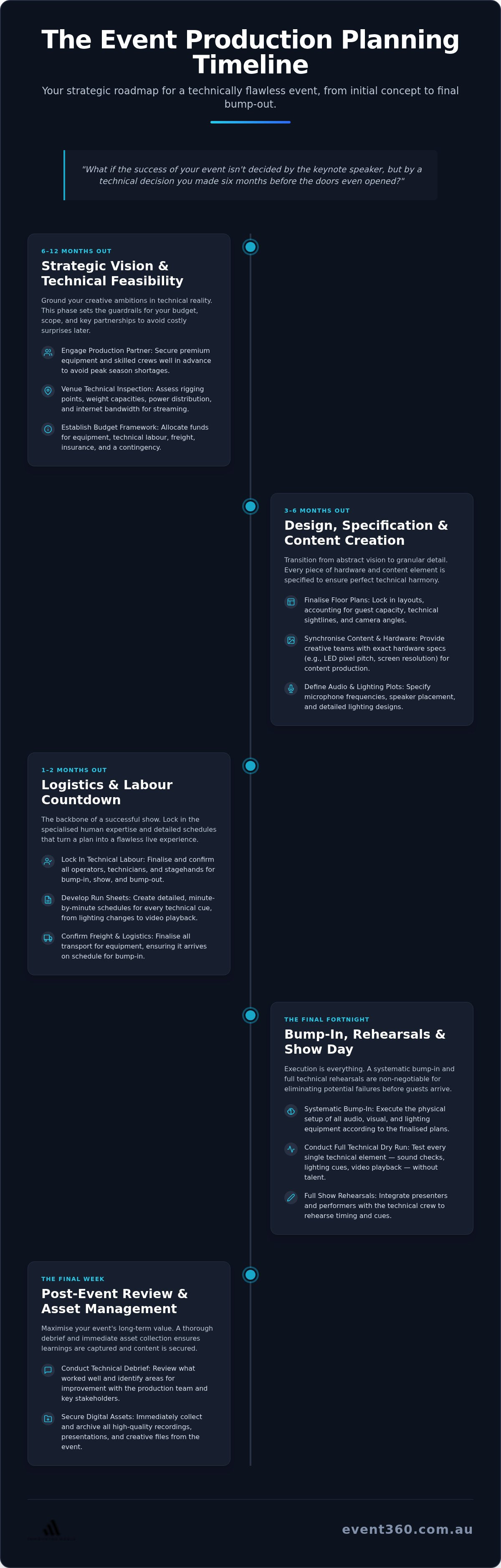
Phase 1: Strategic Vision and Technical Feasibility (6–12 Months Out)
Phase 2: Design, Specification, and Content Creation (3–6 Months Out)
Phase 3: The Logistics and Labour Countdown (1–2 Months Out)
Phase 4: Bump-in, Rehearsals, and Show Day (The Final Fortnight)
Phase 5: Post-Event Review and Asset Management (The Final Week)
Phase 1: Strategic Vision and Technical Feasibility (6–12 Months Out)
Success in 2026 starts with a clear-eyed look at what's actually possible. You can't leave technical feasibility to chance when you're months out from the big day. This initial phase is about setting the guardrails for your creative ambition. Whether you're planning a national roadshow across multiple states or a high-impact bespoke product launch, defining the scale early within your event production planning timeline prevents "scope creep" from eroding your budget later. It's the time to dream big but ground those dreams in technical reality.
Engaging a production partner during this window is non-negotiable. Peak event seasons in Australia see high-end gear and skilled technical crews booked out months in advance. By identifying your ally now, you ensure that the specific hardware and expertise required for your vision are locked in. Don't just look at the floor space during your initial walk-through. Look up. Assessing rigging points and weight capacities early determines if your lighting rig can actually hang where you need it. Similarly, verifying dedicated power circuits prevents the nightmare of a blown fuse during a high-stakes presentation.
Defining Your Technical Scope
Your event's impact relies on choosing the right tools for the job. You need to determine if your goals require sophisticated audio visual production or if a more streamlined approach fits the brief. This is the time to decide on "hero" elements that will define the attendee experience. Will a massive LED wall serve as your visual centrepiece? Or does the venue's architecture lend itself to complex projection mapping? If you're aiming for a national reach, you must evaluate live streaming requirements early. This includes conducting site inspections to verify technical infrastructure:
Internet bandwidth and dedicated upload speeds for seamless live streaming.
Rigging point locations, heights, and certified weight capacities.
Dedicated power distribution specifically for AV racks and LED walls.
The Production Budget Framework
A realistic technical budget is about more than just equipment hire rates. It's the engine room of your event production planning timeline. You must allocate funds for the "invisible" costs that often surprise organisers. Technical labour is the backbone of any show; you're paying for the mastery of operators who ensure your sound is crisp and your vision is seamless. Factor in freight, insurance, and a healthy contingency for those inevitable last-minute creative pivots. In this context, production ROI is the delicate balance between high-level guest engagement and absolute technical reliability. Investing in a seasoned crew and reliable gear now saves you from the expensive chaos of a technical failure later.
Phase 2: Design, Specification, and Content Creation (3–6 Months Out)
While many organisers focus on invitations and catering during this window, the technical heavy lifting begins now. This is the stage where your event production planning timeline shifts from abstract vision to granular specification. You're no longer just talking about a stage; you're defining the exact pixel pitch of your screens and the specific frequencies of your wireless microphones. Precision at this point eliminates the friction that often leads to last-minute panic. It's about ensuring every piece of hardware and every byte of data works in perfect harmony.
Finalising your floor plan is the priority. You must account for more than just guest capacity. Technical sightlines are paramount, especially if you're managing a hybrid event architecture with multiple camera angles. If you're hosting remote speakers, this is the time to lock in your platform logistics and conduct preliminary connection tests. You want to ensure that the transition between a live presenter and a remote contributor is seamless, keeping the energy high for both the room and the digital audience.
Hardware vs. Content Synchronisation
Content is king, but only if it fits the crown. Every video, motion graphic, and presentation slide must be designed for the specific resolution of your chosen hardware. If you've secured a high-end led wall hire, your creative team needs the exact pixel dimensions today, not the week before the event. Legacy files and standard 16:9 powerpoints often look stretched or pixelated on modern custom displays. We recommend setting strict deadlines for speaker presentations now. This allows your technical team enough time to format, test, and troubleshoot every asset before it hits the big screen. For those looking to push boundaries, exploring bespoke creative content solutions early ensures your visuals are as sharp as your strategy.
The Lighting and Sound Blueprint
Your lighting and sound plots are the emotional heart of the production. A well-designed lighting plot does more than just illuminate the stage; it enhances your branding and guides the audience's focus. However, it must be carefully balanced to avoid interfering with camera sightlines, a common pitfall in hybrid events. On the audio side, you need a blueprint that specifies clear audio zones. This ensures the CEO's whisper is as crystal clear in the back row as it is in the front. Brief your technical team on any "show-stopper" moments now. Whether it's a dramatic reveal or a high-energy award sequence, these cues require precision programming that cannot be rushed during the final event production planning timeline countdown.
Phase 3: The Logistics and Labour Countdown (1–2 Months Out)
The transition from design to delivery is the most critical pivot point in your event production planning timeline. You've dreamt up the vision and specified the gear; now you must orchestrate the people and the parts. This stage is about removing ambiguity. If a task isn't assigned to a specific person with a specific deadline, it doesn't exist. We focus on hardening the logistics to ensure that when the gear arrives onsite, the team is ready to hit the ground running. It's the time to lock in your specialists and ensure every asset is verified for the big screen.
The Master Run Sheet Development
Your run sheet is the pulse of the event. It's far more than a simple schedule; it's a minute-by-minute technical command document. Every lighting change, video transition, and microphone activation must be documented. We recommend building in generous "buffer time" between segments to account for speaker changeovers or spontaneous audience interactions. For those utilising live streaming services, the run sheet must clearly distinguish between in-room cues and digital-only content. This ensures your online audience remains engaged during physical room resets.
Effective technical run sheets should include:
Specific technical cues for audio, vision, and lighting operators.
Designated transition periods for physical stage resets or furniture moves.
Clear ownership for every technical task to eliminate confusion during high-pressure moments.
Technical Labour and Support Planning
Specialised technical labour is the backbone of any robust event production planning timeline. You need more than just a crew; you need expert vision switchers, audio engineers, and lighting designers who understand the creative intent. Organise briefing calls with your onsite technical lead to walk through the visual flow and emotional beats of the show. In Australia, safety is paramount. You must verify that all crew members hold the necessary certifications for rigging and electrical work to meet local compliance standards. We also suggest appointing a dedicated "content wrangler." This person acts as the gatekeeper for all media, managing last-minute slide updates and ensuring every file is ready for its cue.
Logistics extend to the physical movement of gear. Large-scale LED wall installations require precise freight scheduling to avoid venue access conflicts. Simultaneously, submit all final creative assets for a "pre-flight" check. Testing your content on the actual production hardware now prevents resolution issues or playback glitches on show day. This proactive approach turns potential crises into mere footnotes in a successful production.
Phase 4: Bump-in, Rehearsals, and Show Day (The Final Fortnight)
The final fortnight is where your meticulous event production planning timeline transforms from a digital document into a physical reality. This is the high-stakes window where months of preparation meet the venue floor. It begins with the "Bump-in," a systematic and often fast-paced installation of all audio visual components, lighting rigs, and staging. This isn't just about moving boxes. It's about precision calibration. Our technical teams spend these hours ensuring every LED panel is seamless, every microphone is frequency-coordinated, and every lighting fixture is focused to the millimetre.
Once the hardware is live, we move into the technical "dry run." This is a critical step often overlooked by less experienced producers. We test every transition, video playback, and lighting cue without speakers on stage. It allows the technical crew to find the rhythm of the show and identify potential friction points in the script. Simultaneously, we perform a final stress test of the venue's internet connection and our streaming encoders. In a world where hybrid connectivity is expected, your digital "pipe" must be bulletproof before the first guest arrives.
The Art of the Rehearsal
Speaker rehearsals are about more than just checking volume levels. They are about building confidence. We use this time to familiarise your presenters with the stage layout, the feel of the microphones, and the placement of confidence monitors. Every video and transition should be run through at least twice during these sessions. We also test our failover systems. If a primary playback laptop freezes or a microphone battery fails, the team must be able to switch to a redundant system instantly without the audience noticing. For hybrid events, we rehearse the hand-offs between onsite and remote speakers to eliminate those awkward silences that can derail a session's momentum.
Show Day Execution
On show day, the atmosphere should be one of "calm in the storm." The production team serves as your dedicated ally, removing technical friction so you can focus on your guests. We establish a clear "comms" channel between the show caller and every technical operator, ensuring cues are hit with absolute timing. Reliability is our primary metric here. We also ensure that the av hire return logistics are pre-planned. A swift, organised bump-out is just as important as the installation, ensuring the venue is cleared efficiently and all assets are accounted for.
Ready to see your vision come to life with technical precision? Partner with Event 360 for your next high-stakes production.
Phase 5: Post-Event Review and Asset Management (The Final Week)
Once the final guest departs and the trucks are loaded, the final week of your event production planning timeline begins. This is where you transform a successful show into a lasting legacy. It's about more than just settling bills; it's a strategic period to capture data, secure content, and refine your processes for the next iteration. A professional production doesn't just end; it's meticulously archived to ensure the momentum you've built isn't lost. We believe the post-event phase is the secret to building a repeatable, high-impact event series.
Transparency is the cornerstone of this final stage. Reviewing final invoices against the initial technical scope ensures there are no surprises and that your budget was allocated effectively. It's also the time to confirm the safe return of all hired equipment. In the fast-paced environment of a bump-out, having a checklist for gear return prevents additional hire fees and closes the loop on your logistics. This disciplined approach to the "final week" provides the peace of mind that every detail, from the first cable to the last invoice, has been handled with professional precision.
The Technical Debrief
We recommend sitting down with your production partner for a deep dive into the show's technical mechanics. This is the time to analyse audience engagement data from your streaming platforms. Did viewers drop off during the keynote? Was the digital chat most active during the live Q&A? Understanding these patterns informs your future content design and technical choices. We also discuss any hardware hurdles faced during the event. If a specific venue layout challenged the wireless signal, we document how the team mitigated it on the fly. Proactive debriefing ensures every technical challenge becomes a blueprint for future success. Continuous improvement is the only way to stay ahead in the high-stakes world of live production.
Asset Handover and Archiving
Your digital assets are the lifeblood of your post-event marketing and on-demand strategy. Ensure all raw footage and edited highlights are delivered in the correct formats for social media, website embeds, and internal archives. We also focus on archiving the "Show File." This includes storing a copy of the final run sheet, stage designs, and lighting plots as a template for the following year. This level of organisation removes friction when you start the next event production planning timeline cycle. By preserving these technical blueprints, you aren't just starting from scratch next time; you're building on a proven foundation of success.
Take Command of Your 2026 Event Production
Mastering your event logistics requires more than a simple checklist; it demands a technical-first mindset where every cue is calculated and every lead time respected. By following this structured event production planning timeline, you've moved from abstract vision to a robust, actionable strategy. You now have the framework to secure high-end LED wall and streaming hardware while ensuring your creative content is pixel-perfect. Remember, the most successful productions are those where the technical details are managed with proactive precision, allowing the creative energy to take centre stage without the fear of failure.
We are ready to act as your dedicated ally in this high-stakes environment. With our national technical expertise and bespoke MICE production solutions, we remove the friction that often plagues complex logistics. Don't leave your 2026 vision to chance. Partner with Event 360 for your next flawlessly produced event and experience the peace of mind that comes from working with authoritative experts. Your journey to a seamless, high-impact production starts with a single, confident decision today. Let's create something extraordinary together.
Frequently Asked Questions
How far in advance should I book my event production company?
You should aim to book your production partner at least 6 to 12 months in advance. This is particularly vital during peak Australian event seasons to secure high-end gear and specialised technical crews. Early engagement allows you to bake technical feasibility into your initial concepts. By locking in a partner early in your event production planning timeline, you avoid equipment shortages and ensure your vision is achievable within your budget.
What is the difference between a bump-in and a rehearsal?
A bump-in is the physical installation and calibration of hardware, whereas a rehearsal is the practice of the event's content and flow. During bump-in, our technicians focus on rigging, cable management, and LED wall alignment. Rehearsals occur once the gear is live, allowing speakers to familiarise themselves with the stage and the technical crew to practice every transition. Both are distinct, essential phases that ensure a friction-free show day for everyone involved.
Do I really need a full day for technical rehearsals?
We strongly recommend a full day for technical rehearsals for any complex or high-stakes production. This dedicated window allows for a "dry run" of every video, lighting cue, and audio transition without the pressure of an audience. It's the only way to stress-test your failover systems and ensure the technical team is perfectly synced with the show caller. Cutting this time short often leads to avoidable glitches during the live performance.
When is the deadline for submitting final presentation slides?
Final presentation slides should be submitted at least 14 days before the event. This lead time is necessary for our content wranglers to perform a pre-flight check on the actual production hardware. We verify aspect ratios, font compatibility, and video playback stability. Submitting assets late in the event production planning timeline increases the risk of resolution issues or playback errors that cannot be easily fixed during the high-pressure bump-in phase.
What are the most common technical delays in an event timeline?
The most common delays stem from insufficient venue access times and late content submissions. If the bump-in window is too tight, technicians cannot properly calibrate complex systems like LED walls or multi-camera streaming rigs. Additionally, last-minute slide changes often cause a bottleneck in the control booth. Ensuring your timeline includes generous buffers for freight delivery and technical troubleshooting is the best way to maintain momentum and keep the schedule on track.
How does a hybrid event change the planning timeline?
A hybrid event adds a parallel digital timeline that requires early platform selection and robust connectivity testing. You must factor in additional lead times for remote speaker rehearsals and digital-only content creation. The planning process becomes more complex as you're essentially managing two distinct audiences. This requires a more granular run sheet that accounts for digital hand-offs and ensures the online experience is as polished as the one in the room.
Can I plan a large-scale event production in under three months?
While it's possible to produce an event in under three months, it significantly increases the risk of equipment shortages and higher costs. Short lead times often mean you're limited to whatever gear is left in the warehouse rather than the best tools for the job. You'll also face higher freight and labour premiums. If you're on a tight schedule, we recommend simplifying the technical scope to ensure reliability remains the top priority.
What technical site requirements should I check before booking a venue?
You must verify the venue's dedicated power capacity, rigging point certifications, and internet upload speeds for streaming. Many organisers overlook the importance of a clear loading dock path for large equipment like LED panels. Check for ceiling heights and any physical obstructions that might interfere with sightlines or lighting plots. Confirming these technical specs during the site inspection phase prevents expensive workarounds or compromised production quality later in the project.


Comments