
2026 Australian Guide: Seamless Live Streaming Tech

Your ultra-fast NBN business fibre connection is a brilliant foundation, but it's the hidden architecture of your signal chain that determines whether your broadcast thrives or fails. In the high-stakes world of live production, relying on speed alone is a gamble that rarely pays off when hundreds of remote attendees are watching. We understand the sheer anxiety of a stream dropping during a critical keynote, or the confusion that sets in when trying to decipher the technical requirements for seamless live streaming amidst a sea of industry jargon. It's a complex balancing act to maintain perfect audio levels between an in-room speaker and a remote panellist while ensuring your video remains crisp and uninterrupted.
This guide cuts through the noise to give you total confidence in your streaming infrastructure. You'll master the essential hardware, connectivity protocols, and redundancy standards required to deliver a broadcast-quality experience without a single glitch. We'll walk you through a foolproof technical checklist, covering everything from cellular bonding and SRT protocols to the latest 2026 Australian broadcast standards; transforming your next event into a polished, professional success that keeps your audience engaged from the first frame to the final fade.
Table of Contents
Mission-Critical Connectivity: Solving the Upload Bottleneck
Your internet connection is the literal lifeline of your broadcast. While many event planners focus on download speeds, professional producers know that upload capacity is the only metric that truly matters. To meet the technical requirements for seamless live streaming, you must prioritise a dedicated, symmetrical connection that isn't shared with the venue's guest Wi-Fi. This ensures your data packets have a clear, high-speed lane to reach your audience without fighting for space against hundreds of smartphones in the room.
Understanding Bandwidth and Bitrate Requirements
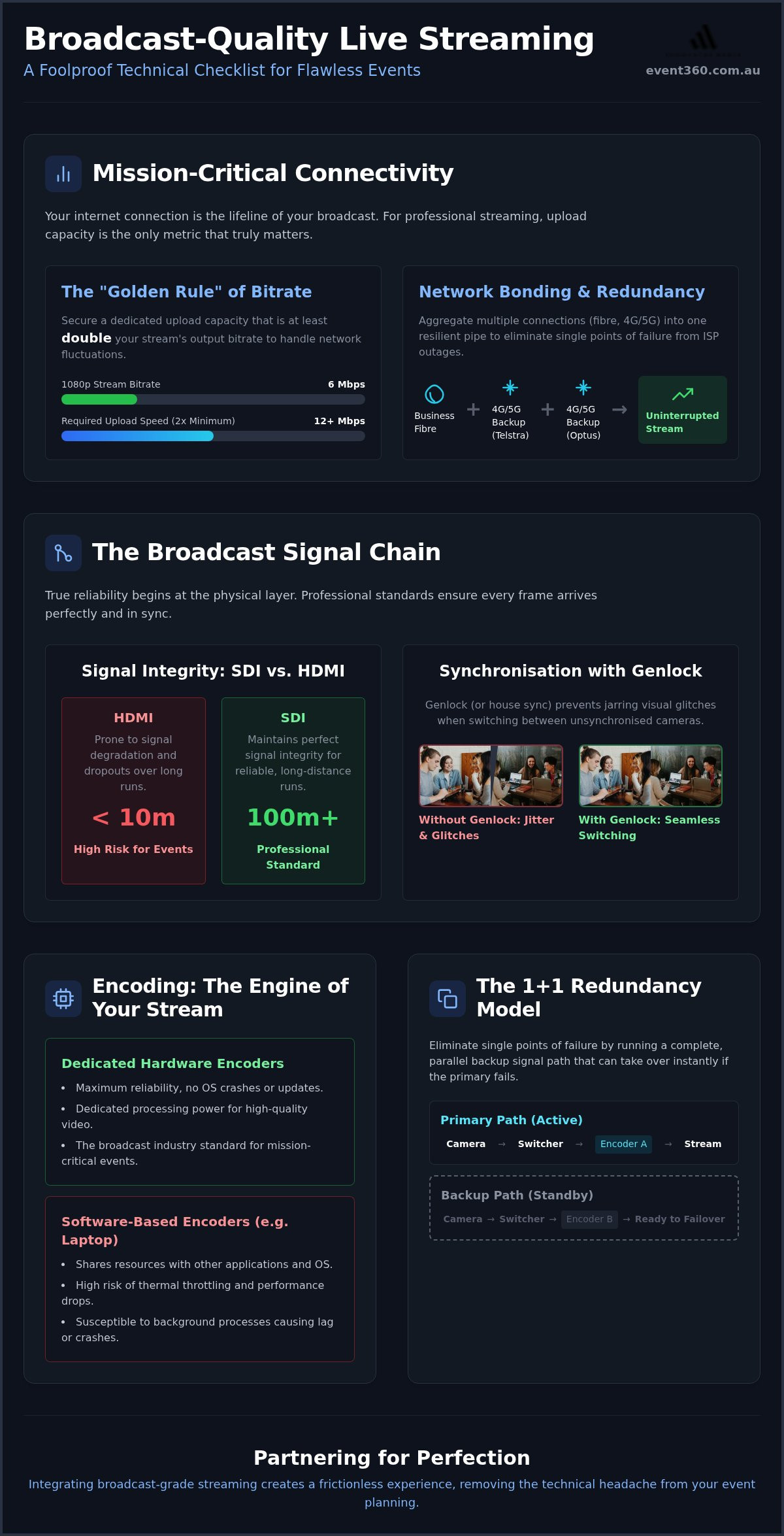
Corporate environments usually demand 1080p60 for crisp motion, which typically requires a bitrate between 4 Mbps and 9 Mbps. If you're stepping up to 4K, that requirement jumps to 20 Mbps or higher. The "Golden Rule" of live production is simple: always secure a dedicated upload capacity that is at least twice your total output bitrate. If you're pushing a 6 Mbps stream, you need a minimum of 12 Mbps of stable, uncontested upload to account for fluctuations in network performance.
Relying on "Best Effort" NBN connections is a significant risk for high-stakes broadcasts. These consumer-grade plans are subject to local congestion, meaning your available bandwidth can plummet exactly when you need it most. For mission-critical events, we recommend business-grade fibre where the upload speeds are guaranteed and backed by a service level agreement. This reliability removes the friction from your production and provides the peace of mind necessary to focus on your content.
Network Bonding and ISP Redundancy
Wired Ethernet is the non-negotiable standard for professional streaming. Wi-Fi is far too susceptible to radio frequency interference and signal drops in crowded event spaces. However, even a wired connection can fail if the local exchange has an outage. This is where network bonding becomes essential. Network bonding is the process of aggregating multiple data connections to ensure uninterrupted signal flow.
By using specialised hardware, we combine a primary fibre line with secondary 4G or 5G links from different carriers, such as Telstra and Optus. This creates a single, resilient pipe that can survive a total ISP failure without the viewers ever noticing. This setup is particularly important when delivering content via HTTP Live Streaming (HLS), as the adaptive nature of the protocol relies on a consistent data flow to maintain the highest possible quality for every attendee. If one connection drops, the bonding encoder seamlessly redistributes the data across the remaining active links in real time.
The Broadcast Signal Chain: Capture and Processing Standards
True reliability begins at the physical layer. While HDMI is a staple for home offices, professional environments demand Serial Digital Interface (SDI) to maintain signal integrity. SDI cables support stable runs of up to 100 metres without signal degradation, providing the robust foundation required to meet the technical requirements for seamless live streaming. This standard eliminates the flickering and total signal dropouts often associated with long HDMI runs in large event spaces. To ensure every frame arrives in perfect sync, we employ "Genlock" or house sync. This synchronisation prevents the jarring visual glitches that occur when a vision switcher transitions between cameras that aren't perfectly aligned in time.
Visual Requirements: Professional Camera Chains
Selecting your capture arsenal requires a strategic balance of aesthetics and logistics. Manned broadcast cameras offer the fluid, responsive movement needed for high-energy keynotes, while PTZ (Pan-Tilt-Zoom) units provide a discreet footprint for panel discussions and tight spaces. A hardware vision switcher acts as the brain of this operation, allowing for instantaneous transitions and complex picture-in-picture layouts without the processing lag of software-based solutions. We also meticulously match colour profiles across all units; ensuring your brand identity remains consistent whether the shot is a wide stage view or a tight presenter close-up.
Audio Engineering for the Digital Audience
Audio is frequently the most overlooked element of the technical requirements for seamless live streaming. The mix your audience hears at home must be entirely separate from the house sound in the room. Stream audio requires specific EQ and heavier compression to remain intelligible and punchy on laptops and mobile devices. For a deeper look at how data is managed during this process, you can explore this comprehensive guide to video encoding.
We address "Hybrid Echo" through sophisticated mix-minus routing. This prevents remote speakers from hearing their own voice delayed back through the stream, which can instantly derail the flow of a presentation. Integrating creative content like lower-third name straps and animated stings adds that final layer of broadcast polish. Our technical directors monitor these signal levels in real-time, providing the grounded reliability you need for a high-stakes production. If you want to elevate your next broadcast, consider our Live Streaming and Hybrid Event Solutions to ensure every detail is managed with precision.
Encoding Hardware: The Engine of Your Live Stream
Reliability isn't just a goal; it's the result of choosing the right engine for your broadcast. While software encoders offer flexibility, they are inherently tied to a computer's operating system and CPU performance. For high-stakes productions, dedicated hardware appliances are the superior choice because they are built for a single purpose: encoding video. This specialisation is a core part of the technical requirements for seamless live streaming, as it removes the risk of "blue screen" crashes or background updates interrupting your feed. By using hardware, you ensure that every ounce of processing power is dedicated to maintaining a stable, high-quality signal.
Choosing the right codec is equally vital for balancing quality and accessibility. H.264 remains the industry standard for universal device compatibility, ensuring your stream plays on everything from an old tablet to a modern smart TV. However, H.265 (HEVC) is increasingly popular for 4K broadcasts because it delivers superior image quality at lower bitrates. To guarantee zero downtime, we deploy a high-availability setup featuring both a primary and a backup encoder. Both units ingest the same signal and push to the cloud simultaneously, allowing for an instantaneous switch if one path encounters an error. This redundancy, combined with cloud-based transcoding, allows you to reach YouTube, LinkedIn, and your internal portals at once without taxing your local upload bandwidth.
Dedicated Hardware Appliances
Professional hardware encoders are rugged, rack-mounted units designed for the rigours of live production. Unlike laptops, they feature robust cooling systems and don't suffer from the CPU-instability risks that plague software-only setups. We always pair our encoder racks with an Uninterruptible Power Supply (UPS). This critical fail-safe protects the equipment from venue power surges and provides a battery bridge during brief outages. Modern appliances also include remote management features, enabling our technicians to monitor stream health and adjust settings from an off-site control centre, providing an extra layer of expert oversight.
Platform Selection and RTMP Configuration
Security is a top priority for corporate events, which is why we move beyond public links. We use custom RTMP keys and encrypted streams to ensure your private data stays within your organisation. RTMP (Real-Time Messaging Protocol) is the standard method for transmitting video data from an encoder to a hosting platform. When configuring your stream, we help you choose between low-latency and standard-latency settings. If your event relies on real-time interaction and Q&A, low-latency is essential. If the priority is absolute stability and high-definition visual polish, standard-latency provides a larger buffer to protect against network fluctuations, ensuring the technical requirements for seamless live streaming are met with precision.
Redundancy and Fail-safes: Eliminating Single Points of Failure
Professional live production is essentially the art of planning for the impossible. To meet the technical requirements for seamless live streaming, we employ the "1+1 Redundancy Model". This means we deploy two of everything: two cameras for every primary angle, two vision switchers, and two independent encoders. If a single piece of hardware fails, the system is designed to stay online. Modern vision switchers now feature automatic failover capabilities, transitioning to a secondary source in milliseconds so the audience remains unaware of any technical hitch. This level of preparation removes the friction from high-stakes environments and provides the peace of mind you need to focus on your presentation.
Power management is another often overlooked single point of failure. We ensure the technical hub is on a dedicated circuit, completely separate from high-draw equipment like catering ovens or coffee machines. Even then, every critical device is backed by a UPS to bridge the gap until a generator or secondary circuit can be engaged. For the ultimate safety net, we prepare an "Emergency Slate". This pre-recorded loop or static graphic is ready to trigger instantly if the live signal drops, maintaining a professional front while our team resolves the issue. This proactive approach ensures your brand remains polished even under pressure.
Signal Path Redundancy
A robust stream requires more than just one path to the internet. We implement a secondary internet path, often using a different technology like a dedicated 5G slice, which activates automatically if the primary fibre fails. Our dual-output encoders send signals to two geographically diverse ingest points in the cloud. This protects the broadcast against regional data centre outages. Simultaneously, we always capture a high-resolution master recording on-site. This local copy ensures that even in the event of a total network collapse, you still have a broadcast-quality file ready for on-demand viewing immediately after the session.
Technical Labour and Human Fail-safes
Hardware is only half the battle; the human element is the final fail-safe. A dedicated Stream Engineer monitors the return feed constantly, checking for frame drops or audio sync issues that a vision mixer might miss. We use professional "Comms" headsets to maintain a direct line between the vision mixer, the floor manager, and the stream engineer. To ensure total reliability, we perform a 4-hour "Burn-in" test before the doors open. This stress test pushes the system to its limits, identifying potential heat or signal issues long before the first guest arrives, ensuring all technical requirements for seamless live streaming are met. If you want to ensure your next keynote is protected by this level of technical mastery, explore our Live Streaming and Hybrid Event Solutions.
Partnering for Perfection: The Event 360 Advantage
Event 360 Pty Ltd specialises in transforming complex logistics into effortless experiences. We understand that managing the technical requirements for seamless live streaming is a burden you shouldn't have to carry alone. Our team provides the grounded reliability of technical expertise across all Australian venues, ensuring national consistency for your roadshows and national conferences. By combining high-end LED wall hire with broadcast-grade streaming, we create a visual impact that resonates as much with your remote audience as it does with those in the room. We take the complexity so you can take the credit.
Our technical labour is the backbone of your success. We move quickly from identifying your event goals to presenting a structured, logical solution that removes friction. This project management mindset is essential for handling the intricate details of a high-stakes broadcast. From the initial concept to the final execution, we position ourselves as your dedicated ally. We don't just provide equipment; we provide the peace of mind that comes from knowing every signal path and power circuit has been meticulously planned and tested by specialists who understand the Australian market conditions.
Custom Live Streaming Packages
We don't believe in a one-size-fits-all approach. Every corporate conference has a unique scale, and our equipment hire packages reflect that reality. Whether you're scaling from a simple single-camera webinar to a multi-day hybrid exhibition, we tailor the hardware and signal chains to match your specific needs. Our "can-do" attitude means we solve the intricate details of cable runs, signal latency, and encoding bitrates behind the scenes. This proactive approach allows you to stay focused on your message while we handle the heavy lifting of the technical requirements for seamless live streaming.
Seamless Hybrid Integration
Bridging the gap between a physical stage and a digital audience requires more than just a camera feed. It demands a holistic workflow where interactive elements like real-time Q&A and live polling are woven into our live streaming services. This integration ensures that remote attendees feel like active participants rather than passive observers. Our technical directors manage these interactive layers in real-time, ensuring a polished and professional presentation from the first frame to the final fade. Reach out and book your technical consultation with the Event 360 Pty Ltd team today to secure your next event's success.
Secure Your Digital Stage with Technical Mastery
Mastering the technical requirements for seamless live streaming is about more than just fast internet; it's about building a resilient architecture where every component has a backup. By prioritising dedicated hardware encoders over software, securing symmetrical upload bandwidth, and implementing the 1+1 redundancy model, you eliminate the friction that leads to broadcast failure. These standards ensure your message reaches your audience with the clarity and impact it deserves, regardless of their location.
As specialists in MICE event production, Event 360 provides national Australian service coverage with comprehensive technical redundancy protocols built into every project. We handle the complex logistics and signal integrity, giving you the peace of mind to focus on your creative vision. Whether you're planning a national roadshow or a high-stakes hybrid conference, our team is your dedicated ally in the high-pressure environment of live production.
Don't leave your broadcast to chance. Enquire about our professional live streaming services today and let's transform your next event into a polished, glitch-free success. We're ready to help you deliver a broadcast that truly inspires.
Frequently Asked Questions
What is the minimum internet speed required for a seamless live stream?
You need a minimum upload speed of 3 to 6 Mbps for a standard 1080p High Definition stream. For 4K broadcasts or high-motion content, we recommend at least 20 Mbps of dedicated capacity. It's vital to remember that these figures represent the required bitrate for the stream itself. To ensure stability, your total available bandwidth should ideally be double your output bitrate to account for network fluctuations.
Do I need a dedicated internet line for my event, or can I use the venue Wi-Fi?
A dedicated, hardwired internet line is essential for professional production. Venue Wi-Fi is inherently unreliable because it's shared with guests and subject to radio frequency interference in crowded rooms. Relying on wireless signals is one of the biggest risks to meeting the technical requirements for seamless live streaming. We always recommend a dedicated fibre connection or a bonded cellular setup to guarantee your signal has a clear, uncontested path.
What is the difference between a hardware and a software encoder?
Hardware encoders are dedicated appliances built for the sole purpose of processing video signals. They offer superior reliability because they don't share resources with background apps or operating system updates. Software encoders are applications that run on standard computers. While they're cost-effective, they're prone to CPU instability and crashes. For mission-critical broadcasts, we utilise hardware encoders to ensure a consistent, high-quality output for your audience.
How do I prevent the audio from echoing during a hybrid event?
Preventing "Hybrid Echo" requires a specific audio routing technique called "mix-minus." This involves sending a custom audio mix to your remote speakers that includes everything except their own voice. Without this, the remote speaker hears themselves on a delay, which makes natural conversation impossible. Our technicians use digital consoles to manage these separate mixes, ensuring crystal-clear communication between the physical stage and your digital attendees.
What happens if the internet cuts out during my live stream?
We mitigate this risk through multi-layered redundancy and cellular bonding. If your primary fibre connection fails, our systems automatically switch to a secondary 5G or 4G link in milliseconds. If a total network outage occurs, we can trigger a pre-recorded emergency slate or graphic to maintain a professional look while we restore the signal. We also record a high-resolution master on-site so you have a perfect copy for immediate on-demand viewing.
Can I stream to multiple platforms like YouTube and LinkedIn at the same time?
Yes, we use cloud-based transcoding to push your broadcast to multiple destinations simultaneously. This allows you to reach audiences on YouTube, LinkedIn, and private corporate portals without requiring extra upload bandwidth at the venue. We send one high-quality master stream to a secure cloud server, which then redistributes the signal to every platform you choose. This approach is a core part of the technical requirements for seamless live streaming across diverse digital environments.
What technical staff are required to manage a professional live stream?
A professional broadcast requires a specialised team to ensure every element works in harmony. This typically includes a Vision Mixer to manage camera transitions, an Audio Engineer to balance the stream-specific mix, and a dedicated Stream Engineer. The Stream Engineer focuses exclusively on encoder health and bandwidth monitoring. This team works together using professional comms to manage the complex logistics, giving you the peace of mind to focus on your content.
Why is SDI preferred over HDMI for professional event production?
SDI is the industry standard because it supports stable cable runs of up to 100 metres and features a locking BNC connector. HDMI is designed for home use and often suffers from signal degradation or physical disconnection over distances longer than 10 metres. In a large event space, SDI provides the grounded reliability needed to maintain signal integrity across the entire venue. It ensures your high-definition video arrives at the switcher without flickering or dropouts.
Comments