
Working with a Venue’s In-House AV Team: Practical Guide

What if the smoothest event day starts by treating the venue’s AV team as a partner, not a rival? Working with a venue's in-house AV team can give you valuable room-specific knowledge, but it is not always clear what the AV package covers, who operates each element or where external production support fits.
Those details matter. When responsibilities overlap, teams can duplicate work or clash. If a technical limitation surfaces late, you may need to make rushed changes to the event plan. The solution is to align your event goals with the venue’s capabilities early, then assign clear ownership for every technical requirement.
This guide explains how to clarify what is included, confirm who supplies, operates and approves each element, and identify gaps before you lock in the plan. You’ll also learn how an external production partner can coordinate with venue staff, make use of their knowledge of the space and support a more controlled show-day workflow. With the right questions and clear communication, you can move from uncertainty to a production plan everyone understands.
Table of Contents
Working with a venue’s in-house AV team starts with the event brief
Clarify AV roles, equipment and show-day decisions before production begins
Compare in-house AV, external production and a combined approach
Use this step-by-step process to coordinate AV teams before event day
Bring in an AV production partner when the agreed brief needs more
Working with a venue’s in-house AV team starts with the event brief
You want to respect the venue team’s knowledge of its rooms and systems while still delivering the creative vision and technical quality your event needs. Start with a shared brief. In-house AV scope varies between venues, so do not assume a listed package covers every requirement or that equipment hire includes an operator. Confirm what is included, what is excluded and any conditions that could affect delivery.
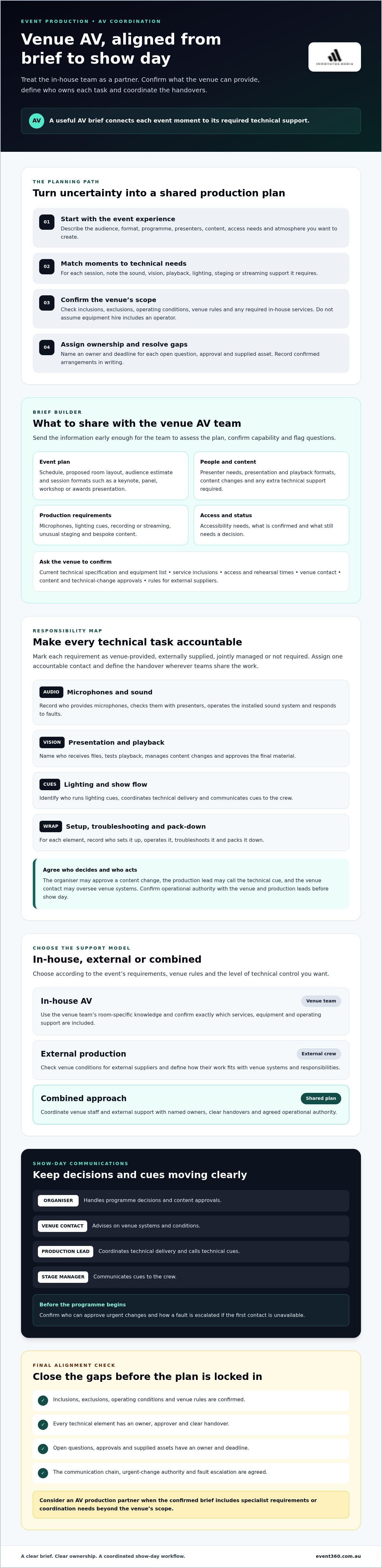
Build the brief around the experience you want to create: audience size, event format, programme, presenters, content, access needs and atmosphere. Then connect each moment to the support it requires. A keynote might need a lectern microphone, presentation playback and a lighting cue. A panel discussion may need several microphones and a different stage layout. A useful AV brief connects each event moment to its required technical support.
The term Audiovisual (AV) covers sound and visual elements used together in settings such as presentations and live events. For an organiser, the practical task is to translate the programme into clear requirements the venue team can confirm, question or help refine.
What should you send the venue AV team first?
Share the event schedule, proposed room layout and audience estimate as early as practical. Identify each session format, such as a keynote, panel, workshop or awards presentation, and note how presenters will use the space. Include presentation and playback formats, microphone needs, lighting cues, and any recording or streaming requirements.
Flag accessibility needs, presenters who may need extra technical support, and anything outside a standard presentation, such as unusual staging or bespoke content. For each item, note what is confirmed and what still needs a decision. This helps the team assess the brief before assumptions become part of the plan.
Which venue details should you confirm before planning?
Ask for the current technical specification and equipment list for your booked space, along with a clear breakdown of service inclusions. Confirm access times, whether rehearsal time is available, who your venue contact is and how technical changes or content are approved. Check venue-specific rules, required in-house services and any conditions for external suppliers directly with the venue.
Record restrictions and agreed arrangements in writing. If a requirement is unclear, assign someone to confirm it and add the answer to the brief. That shared document becomes the starting point for working with a venue's in-house AV team, helping everyone plan from the same information.
Clarify AV roles, equipment and show-day decisions before production begins
A shared brief sets the direction; clear ownership keeps the production moving. An AV responsibility matrix names the owner and approver for each production task, so venue staff and any external crew can work together without duplicating effort or leaving gaps.
List each requirement and mark it as venue-provided, externally supplied, jointly managed or not required. Separate the venue’s installed systems and services from event-specific production needs, then assign one accountable contact for each workstream. For example, the venue may operate its installed sound system while an external production lead coordinates show cues. Record who supplies, sets up, operates, approves, troubleshoots and packs down each element.
How do you divide responsibilities without duplicating work?
Make each allocation specific. For audio, name who provides microphones, checks them with presenters and responds to faults. For vision, identify who receives presentation files, tests playback and manages changes. Do the same for lighting and streaming, including who runs cues and who confirms the final content. Where both teams contribute, define the handover instead of listing both as responsible.
Agree who has final operational authority during the programme. The organiser may approve a content change, while the production lead calls the technical cue and the venue contact oversees venue systems. Confirm this arrangement with the venue and all production leads before show day.
What should the show-day communication plan include?
Set a simple communication chain: the organiser handles programme decisions, the venue contact advises on venue systems and conditions, the production lead coordinates technical delivery, and the stage manager communicates cues to the crew. Confirm who can approve urgent changes and how a fault is escalated if the first contact is unavailable.
Give relevant crew the same final running sheet, contact list, cue references and escalation steps. Include the process for late schedule changes, presenter support and content replacements. For example, specify who receives an updated slide deck and who confirms it is ready to play. Shared industry safety standards can also inform professional event planning, but confirm site-specific requirements with the venue rather than assuming one team’s process applies to another.
Clear technical planning and onsite coordination can help align shared responsibilities. If your brief needs additional production support, event AV production support is one option to discuss with venue staff.
Compare in-house AV, external production and a combined approach
There is no single model that suits every event. Choose based on how well the confirmed services match your brief, any venue conditions, the production’s complexity, the level of technical control you need and how much coordination your team can manage. Working with a venue's in-house AV team may be the simplest fit when its confirmed scope and systems cover your requirements. Extra production support may be more suitable when the brief calls for additional creative, technical or content capabilities.
AV roles can vary between venues and suppliers. This overview of key AV roles can help explain why it is worth confirming who will deliver each part of your event.
When can the venue’s in-house AV team be the right fit?
In-house AV can suit a programme that fits the venue’s confirmed equipment, services and operating conditions. Check what the team will operate, whether support is available for rehearsals and how familiar its staff are with your booked space. Do not assume that a capability on a list includes an operator, rehearsal support or every production requirement. Compare the confirmed inclusions with your brief before settling on this model.
When does a combined AV team make sense?
A combined approach can bring together the venue’s room-specific knowledge and external support for requirements such as LED walls, creative content or hybrid delivery. Before confirming it, ask both teams to identify system connections, technical dependencies and ownership boundaries. Assign one lead to coordinate decisions so the organiser is not left relaying conflicting instructions. For broader production-planning context, read this guide to professional audio visual production.
Use this step-by-step process to coordinate AV teams before event day
Turn the agreed brief into a working timeline. Give every open technical question, approval and supplied asset a named owner and due date. Resolve technical ownership before finalising the running sheet and crew calls. This way, the schedule reflects what the teams have agreed they can deliver.
Initial enquiry: Send the venue your event brief and ask for its current technical information, service scope and relevant conditions. Note unanswered questions and assign someone to follow up.
Scope and responsibilities: Confirm which team supplies, sets up and operates each element, who approves content or changes, and how technical issues will be handled. Check any requirements for external suppliers with the venue.
Joint technical meeting: Bring together the organiser, venue contact and relevant production leads when room systems, shared responsibilities or technical dependencies need discussion. Review the layout, equipment positions, and power and connectivity requirements.
Technical sign-off: Record agreed arrangements, outstanding decisions and deadlines in a shared action list. Update the running sheet once responsibilities and key cues are settled.
Rehearsal and live delivery: Provide final presentation files and cue information in the venue’s requested format and by its stated deadline. Test essential content and connections during the agreed rehearsal or technical check, then use the current running sheet during the programme.
Pack-down: Confirm who is responsible for each item, when pack-down can happen and whether any venue checks or handovers are needed. Close out the agreed plan with the relevant contacts.
What belongs in a joint technical meeting?
Walk through the room layout and equipment positions with the relevant venue contacts. Discuss power and connectivity needs, then trace key show moments: presenter transitions, playback, lighting changes and any live-stream elements. Keep the conversation focused on decisions that affect delivery. Capture each decision, unresolved question, responsible contact and due date in a shared action list.
How do you prepare for rehearsal and live delivery?
Follow the venue’s instructions for file formats and submission deadlines, and make sure the right person confirms when updated content is ready. Use the rehearsal or technical check to test essential playback and connections, not just to review the running order. Keep the latest running sheet and contact plan accessible to the people delivering the event, and clearly identify how to communicate an urgent change.
Strong technical planning and onsite coordination can bring the moving parts together. If your event needs additional production support, you can discuss your AV production requirements with Event 360.
Bring in an AV production partner when the agreed brief needs more
Once you’ve compared the venue’s confirmed scope with your event brief, the gaps become clearer. An external AV production partner may be worth considering if the venue cannot cover a required technical element, your programme calls for specialist production or your team needs extra coordination across multiple systems. The aim is not to displace venue staff. Their knowledge of the room can help an external team plan a solution that fits the space and works with its systems.
Event 360 may be a suitable production partner when your brief needs technical planning, AV production, LED walls or live streaming and hybrid delivery. Its team can work alongside venue staff. Confirm venue-specific rules, access arrangements, required services and external supplier conditions directly with the venue before finalising plans.
What should you brief an external production team on?
Share the event objectives, programme, venue technical information and the in-house AV responsibilities already agreed. Be clear about what the venue is supplying and operating, and where you need additional support. Include the audience experience you’re aiming for, not just a list of equipment.
Specify any requirements for sound, lighting, visual displays, creative content, streaming or onsite technical support. Ask the production team to identify dependencies, decisions and venue approvals that need attention before confirming the production plan. For hybrid or streamed events, include professional live streaming services in your planning discussions.
How can you keep the venue and production partner aligned?
Introduce the key contacts early and agree how they’ll share technical questions, decisions and updates. Give everyone access to one current version of the schedule, equipment scope, cue information and action list. When a change is made, identify who updates the shared documents and who confirms that the venue and production team have received it.
Keep the venue involved in discussions about its systems and room conditions, while asking the production partner to flag how additional requirements can integrate with the agreed setup. That shared approach supports clear handovers and a more controlled event-day workflow.
Ready to explore the next step? Share your event brief and the venue’s agreed AV scope with Event 360 to discuss suitable technical planning or production support.
Set your event up for a confident show day
Successful working with a venue's in-house AV team starts with a brief everyone can use. Confirm what the venue provides, agree who owns each technical task and keep decisions, cues and deadlines visible to the people delivering the event. If the plan calls for support beyond the venue’s scope, bring in an external production partner early and coordinate with venue staff around the room’s requirements.
Event 360 provides technical planning and onsite coordination for events across Australia. Its capabilities include AV production, LED wall solutions and live-streaming or hybrid event support, helping organisers align additional production needs with the agreed venue plan.
Have an event coming up? Share your event brief with Event 360 to discuss suitable production support. With clear responsibilities and the right people aligned, you can move into event day ready to deliver your vision with confidence.
Frequently Asked Questions
Can I bring an external AV company into a venue with an in-house team?
Sometimes, but confirm the venue’s requirements before appointing an external supplier. Ask whether outside AV providers are permitted, whether particular services must be supplied in-house and what conditions apply to access or connecting with venue systems. Share the proposed scope with the venue and external team so they can identify restrictions or technical dependencies early. Do not assume the venue’s preferred arrangement applies to every space or event.
What should I ask a venue’s in-house AV team before booking?
Ask for the current technical specification and equipment list for the space, plus a clear explanation of what the AV service includes and excludes. Confirm who operates the equipment, what rehearsal support is available, relevant access arrangements, approval processes and any conditions for external suppliers. Check whether the listed capabilities match your programme, including presenter support, playback, lighting cues, recording or streaming. Request key details in writing.
Who is responsible for AV on the day when two teams are involved?
Responsibility should be agreed in advance, not assumed on the day. Name an accountable production lead and venue contact, then specify who supplies, operates and troubleshoots each system. For example, venue staff may oversee installed room systems while an external team operates event-specific production. Agree who approves programme changes, who calls technical cues and how urgent issues are escalated. Give both teams the same current running sheet and contact plan.
Is a venue’s in-house AV team enough for a hybrid event?
It can be, if the venue confirms that its services cover the needs of both in-room and remote attendees. Ask specifically about the audio, visuals, streaming, remote contributors and technical support required by your programme. Confirm who operates each element and how the online experience will be checked during rehearsal. Do not assume that standard presentation AV includes hybrid delivery. If the brief extends beyond the confirmed scope, consider discussing additional production support.
How do I prevent the venue AV team and external crew from duplicating work?
Working with a venue's in-house AV team and an external crew is clearer when every task has one named owner. List each requirement and mark it as venue-provided, externally supplied, jointly managed or not required. For shared tasks, define the handover, approver and technical contact. Cover setup, operation, content changes, cues and troubleshooting. Keep one current equipment scope and action list, and make sure both teams know how updates will be shared.
When should I hold a technical meeting with the venue AV team?
Hold a joint technical meeting once you have the event brief and the venue’s technical information, especially if an external team is involved or the production depends on venue systems. Meet before finalising the running sheet and crew calls. Review the room layout, equipment positions, power and connectivity needs, key cues, playback and any streaming elements. Record decisions, open questions, owners and due dates so agreed actions do not get lost.
What information does an external AV production partner need from the venue?
Share the venue’s current technical specification, equipment list, confirmed service scope and relevant room layout. Include details the venue confirms about access, rehearsal arrangements, operating conditions, approvals and external supplier requirements. The production partner also needs to know who operates venue systems and how those systems may connect with event-specific production. Confirm these details directly with the venue, then pass on updates so planning reflects the actual booked space.


Comments