
How to Save Money on Conference AV Without Compromising the Experience

The lowest conference AV quote isn’t always the best value. If you’re working out how to save money on conference AV, it can be tempting to cut equipment or crew. But unclear inclusions, venue requirements and technical gaps can turn an apparent saving into a stressful event-day problem.
A better approach is to match the AV scope to the programme and audience before comparing prices. A keynote, panel discussion and hybrid session each have different needs for sound, visibility and technical support. Define those needs early, then compare proposals based on what they include, what they assume and what your venue requires, not just the headline figure.
This guide takes you through a practical process for setting an AV scope, reviewing quotes and finding savings that won’t compromise the audience experience. You’ll see where equipment choices may be flexible, why reliable audio and skilled support matter, and how early technical planning can help avoid unnecessary changes. With clear priorities and a tailored approach, you can make each AV decision count.
Table of Contents
How to save money on conference AV starts with the right event scope
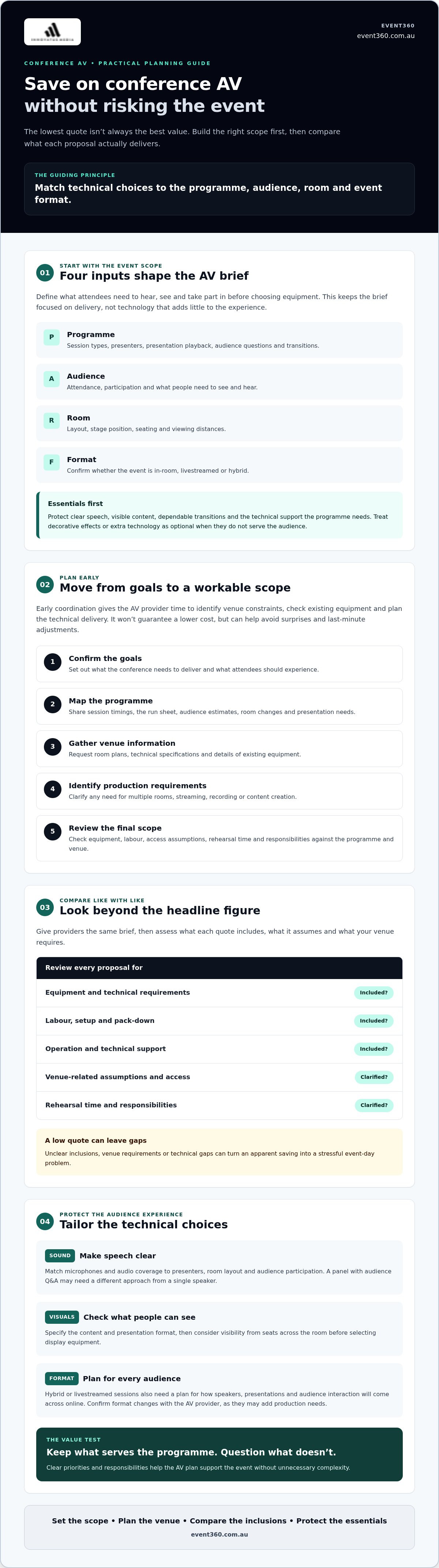
Set the outcome before choosing the equipment. Start with what attendees need to hear, see and take part in, then build the AV scope around the programme. This keeps the conversation focused on event delivery rather than equipment that may look impressive but add little for the audience.
Build the scope from four practical inputs: the programme, audience size, room layout and delivery format. Note which sessions need presentations, panels, audience questions or room changes, and whether people will attend in person, online or both. An overview of Event management places audiovisual production within the wider work of planning, budgeting and negotiation. AV decisions should connect to the event’s overall goals.
Programme: Identify session types, presenters, presentation playback and transitions.
Audience: Consider attendance, audience participation and what people need to see and hear.
Room: Record the layout, stage position, seating and viewing distances.
Format: Confirm whether the event is in-room, livestreamed or hybrid.
Next, separate essentials from enhancements. Clear speech, visible content and dependable transitions support the experience. Decorative effects or additional technology may be optional if they don’t serve the programme. A clear scope lets providers quote against the same audience, room, format and delivery needs, making proposals easier to compare.
Which conference AV requirements are essential?
Prioritise clear speech, sightlines, presentation playback and smooth transitions. Match microphone choices and audio coverage to the presenters, room layout and audience participation. A panel with audience Q&A may need a different approach from a single speaker. For visuals, specify the content and presentation format, then consider whether it will be visible from seats across the room before selecting display equipment.
How does the event format change the AV scope?
An in-room programme is designed around the people in the venue. A livestreamed or hybrid programme also needs a plan for remote viewers, including how speakers, presentations and audience interaction will come across online. Session types, room changes and Q&A can all affect the technical requirements. Confirm any format changes with the AV provider before finalising the scope, as they may add production needs.
When considering how to save money on conference AV, protect the moments that matter to attendees, then question enhancements that don’t support them. Tailored technical planning can connect sound, visual displays, lighting and streaming to the programme, giving each element a clear purpose.
Reduce conference AV costs by planning the venue and production early
Start production planning while the programme and venue details are still taking shape. Early coordination gives your AV provider time to identify venue constraints, check available equipment and scope the technical delivery before decisions become difficult to change. It won’t guarantee a lower cost, but it can help avoid surprises and last-minute adjustments.
Use this sequence to move from event goals to a workable technical scope:
1. Confirm the goals: Set out what the conference needs to deliver and what attendees should experience.
2. Map the programme: Share session timings, the run sheet, audience estimates, room changes and presentation needs.
3. Gather venue information: Request room plans, technical specifications and details of existing equipment.
4. Identify production requirements: Clarify whether you need multiple rooms, streaming, recording or content creation.
5. Review the final scope: Check the proposed equipment, labour, access assumptions, rehearsal time and responsibilities against the programme and venue.
Sharing these details early gives providers a consistent brief. UC San Diego’s guide to strategic event planning also links budget decisions to event goals and identifies audiovisual equipment as an expense to plan for.
What information should organisers gather before requesting AV proposals?
Prepare the event dates, session timings, audience estimates and latest run sheet. Add room plans and venue technical specifications, along with details of existing equipment and presentation formats. Be clear about streaming, recording, content creation and simultaneous or sequential sessions across multiple rooms. If details are provisional, flag them so providers can identify assumptions instead of building the proposal around an unconfirmed plan.
How can the venue affect your AV requirements?
Ask the venue about access windows, loading arrangements, rigging conditions and equipment already in each room. Confirm what’s included in the hire arrangement and whether the available equipment suits the programme. Its presence alone doesn’t establish suitability. Share the answers with your provider. Changes to access, room use or equipment can affect crew scheduling, gear movements and rehearsal time, so confirm the technical plan before those details are locked in.
Early technical coordination can reduce last-minute scope changes. That’s a useful principle for how to save money on conference AV: plan with people who understand the venue conditions and production requirements. For information about tailored conference AV production planning, explore Event 360’s production services.
Compare conference AV quotes by value, not just the bottom line
A lower headline figure can look appealing, but it may cover a narrower scope. One proposal might include show operation and rehearsal time while another lists equipment only, leaving you to clarify who will test, run and pack down the setup. Compare what each supplier will deliver, not just the total.
A fair AV comparison matches the scope, service and delivery responsibilities across every proposal. Put the quotes side by side and compare:
Equipment: What’s included, and does it suit the rooms, programme and audience?
Labour: Which technical roles are covered, and for what periods?
Setup and pack-down: Are the work and timings specified?
Operation: Who runs the equipment during sessions and manages transitions?
Testing and rehearsal: What checks or rehearsal coverage are included?
Then check assumptions, exclusions and dependencies. Does the proposal rely on venue equipment, access or technical support? Are contingency arrangements described? How will the supplier handle a changed run sheet, additional room or longer programme? Ask for unclear items to be confirmed in writing. An exclusion isn’t automatically a problem, but you need to know who will manage it and what it could mean for delivery.
What should a conference AV quote include?
Look for an itemised scope covering equipment, technical labour and onsite responsibilities. Check when setup, testing, show operation and pack-down happen, and whether rehearsal time is allowed for. If the programme changes, clarify how extra rooms, extended sessions or other adjustments will be assessed. Specifics make it easier to identify gaps before they become event-day responsibilities.
Where can organisers make sensible AV trade-offs?
Test optional elements against the audience experience. A display approach should make content legible from the seats, while lighting or staging should support communication or serve a clear purpose in the programme. If a proposal includes a visual enhancement, ask what it adds for attendees and whether a simpler approach could achieve the same result.
Be cautious about removing technical support to lower a quote. Before accepting that change, establish who will manage the equipment, transitions and troubleshooting during the event. Shifting essential work to an unprepared team can create risk rather than value.
When working out how to save money on conference AV, identify mismatched scopes first. Once each proposal covers the same delivery needs, you can judge which choices are flexible without losing sight of reliable execution.
Cut conference AV spend without putting the event at risk
Reducing production spend doesn’t have to mean accepting a flat or unreliable experience. Test each proposed cut against two questions: will attendees notice, and could it disrupt the show? An optional visual effect may matter less than clear speech, visible presentations, safe production conditions and smooth transitions. Treat each reduction as a scope decision, not simply a smaller equipment list.
Protect essential delivery first, then refine optional production elements. This helps separate creative upgrades from the technical requirements that keep the programme running as planned.
Which AV cuts are usually worth considering?
Review every element against a defined event purpose. If a visual feature doesn’t improve communication or the audience experience, ask whether a simpler approach could work. Check for equipment or visual elements that duplicate another function, or consolidate room requirements if the schedule and venue logistics genuinely allow it. Before relying on venue equipment, confirm that it’s available and suitable for your brief.
Consider impact, not just quantity. Removing an enhancement that adds little may be sensible; removing a display that makes presentation content readable across the room may undermine a session. Ask your production provider to explain how each proposed change affects the audience and programme.
Which savings can create more cost or risk later?
Less technical support or rehearsal time might reduce the planned scope, but it can also leave fewer people to manage transitions, test content or respond to a problem. Consider the trade-off before agreeing:
Reduce technical support: This may mean leaner resourcing, but confirm who takes responsibility for operation, troubleshooting and show continuity.
Reduce rehearsal or testing: This means less preparation time, with fewer opportunities to check presenters, content and transitions in context.
Neither option is automatically unsuitable. The impact depends on the programme, venue and remaining crew responsibilities. Ask the provider to explain what changes operationally instead of treating reduced coverage as a saving with no consequences.
Unresolved venue requirements and late content changes deserve the same scrutiny. Don’t assume they will disappear from the scope. Establish who will confirm the details and how changes will be handled. Technical planning and onsite coordination can help organisers understand the implications before approving a reduction.
To understand how to save money on conference AV while protecting delivery, assess every adjustment for its effect on the audience and show continuity. Discuss tailored conference AV production with Event 360 to explore how technical choices can align with your programme.
Build a conference AV budget with a production partner
A production partner can help turn budget priorities into a plan that works for the programme, venue and audience. The aim isn’t to find the lowest quote at any cost. It’s to understand what the event needs, compare complete scopes and decide where adjustments are sensible without leaving important delivery details unresolved.
Use this decision framework to keep the process focused:
Set priorities: Rank audience-critical needs, such as clear sound and visible content, ahead of optional enhancements.
Share event details: Provide the programme, venue information, room plans and presentation requirements.
Compare complete scopes: Check what each proposal includes, assumes and excludes before assessing its value.
Confirm responsibilities: Agree who coordinates technical changes, content testing, setup and show operation.
What should you ask an AV production partner?
Ask how the proposed equipment and crew address your event brief and venue conditions. Clarify who manages technical changes, tests content, coordinates setup and operates the production during the programme. Request clear assumptions, exclusions and options for adjusting the scope, so you can see what changes if a session, room or delivery requirement shifts.
How do you turn a budget into a reliable production plan?
Once priorities and responsibilities are clear, confirm the final scope against the latest programme and venue details. Set out how updates will be communicated and who needs to approve changes. This shared plan gives your team and production partner a clear reference point as the event approaches.
Tailored planning can connect sound, visual displays, lighting and streaming to the sessions that need them. For example, a programme with in-room presentations and online attendees has different requirements from one delivered solely to a live audience. Event 360’s audio visual production, MICE event expertise, live streaming and hybrid solutions, and onsite coordination may suit your brief. The right scope depends on your event; no single approach guarantees the lowest cost.
For organisers weighing supplier options, an AV hire Australia buyer’s guide can provide broader considerations. Bring the decision back to your programme, venue conditions and delivery responsibilities. That’s a practical way to apply how to save money on conference AV without losing sight of the audience experience.
Ready to put the scope into focus? Discuss your conference AV requirements with Event 360.
Make your next AV decision with confidence
The best savings come from a production scope built around the event, not from trimming essential support. Start with the audience experience, plan around the programme and venue, then compare proposals by what they include and who is responsible for delivery. This is a practical way to understand how to save money on conference AV while protecting clear sound, visible content and smooth transitions.
Event 360 provides tailored audio visual production for corporate conferences and MICE events, with technical planning and onsite coordination. Sound, visual displays, lighting, LED walls and live-streaming solutions can be considered in relation to your programme rather than treated as a one-size-fits-all package.
Ready to clarify your priorities and shape a suitable scope? Talk through your conference AV scope with Event 360. With a clear plan and the right production support, you can make considered budget choices and create an experience your audience can engage with.
Frequently Asked Questions
How can I reduce conference AV costs without compromising quality?
Match the AV scope to the programme and audience, then remove elements that don’t support a clear event outcome. To understand how to save money on conference AV, protect core needs such as clear speech, visible presentations and reliable session transitions before reviewing optional enhancements. Check every proposed reduction for its effect on attendees and show continuity, and confirm who will handle any technical responsibilities that change.
What should be included in a conference AV quote?
A conference AV quote should clearly describe the proposed equipment, technical labour and onsite responsibilities. Check whether setup, testing, operation, rehearsal and pack-down are included, and review the timings for each. Ask the provider to identify assumptions, exclusions and venue dependencies, as well as how changes such as an extra room or longer session will be handled. This makes it easier to spot scope gaps before confirming the plan.
Is it cheaper to hire conference AV equipment or use the venue’s equipment?
It depends on the venue’s arrangements and whether its equipment suits your programme. Ask what is available, what’s included in the venue agreement and whether any conditions or additional charges apply. Then compare the full cost and scope of using venue equipment with a proposal that supplies what’s needed. Consider suitability, setup, technical operation and support as well as the equipment itself, rather than assuming either option will cost less.
When should I book AV for a conference?
Start discussing AV as early as practical, once you have initial event goals and venue information to share. Early planning gives the provider time to review the programme, room specifications, access arrangements and technical requirements before the scope is finalised. You don’t need every detail locked in to begin the conversation, but flag uncertainties and update the provider as timings, rooms or presentation needs change.
Can I use the same AV setup for in-person and hybrid conference sessions?
Some parts of the setup may serve both formats, but a hybrid session has additional requirements for remote attendees. The production plan needs to consider how speakers, presentations and audience interaction will be delivered online as well as in the room. Share the session format and participation needs with your AV provider, then confirm which equipment, streaming solutions and technical support are required for each part of the programme.
Which conference AV equipment is essential?
Essential equipment depends on the room, audience and programme. Most conferences need an appropriate sound system and microphones for clear speech, plus a display approach that makes presentation content visible to attendees. Panels, audience questions, room changes or hybrid delivery may add requirements. Start with what people need to hear, see and participate in, then ask a production provider to match the technical scope to those priorities.
How do I compare conference AV suppliers fairly?
Give each supplier the same event information, then compare proposals against a consistent scope. Review equipment, labour, setup, testing, rehearsal, show operation and pack-down, alongside assumptions, exclusions and venue dependencies. Ask questions wherever responsibilities or contingency arrangements are unclear. A lower headline quote may cover less of the delivery, so assess the completeness and suitability of each proposal before weighing the total cost.


Comments