
Event AV Power Requirements: 2026 Planning Guide

What if the screen, sound and lighting are ready to go, but the venue can’t supply enough power to run them reliably? Planning the power requirements for event AV equipment takes more than adding up wattage figures. Equipment ratings, circuit capacity and how power is distributed all matter.
A combined load can be difficult to estimate, and an overloaded circuit or unexpected outage can disrupt an event. A clear plan helps you identify gaps early and get the venue and production team working from the same information.
This guide explains how to estimate AV demand from equipment specifications, what to confirm about venue supply and how to coordinate temporary distribution with your production requirements. It also covers useful questions for your venue and AV team, so you can make informed decisions and build a safer, more reliable power plan.
Table of Contents
Event AV Power: What Organisers Need to Confirm
An AV setup that draws more power than the available supply can interrupt the show, damage equipment or create safety risks. Planning power requirements for event AV equipment means checking both what the production needs and whether the venue can supply and distribute that power reliably.
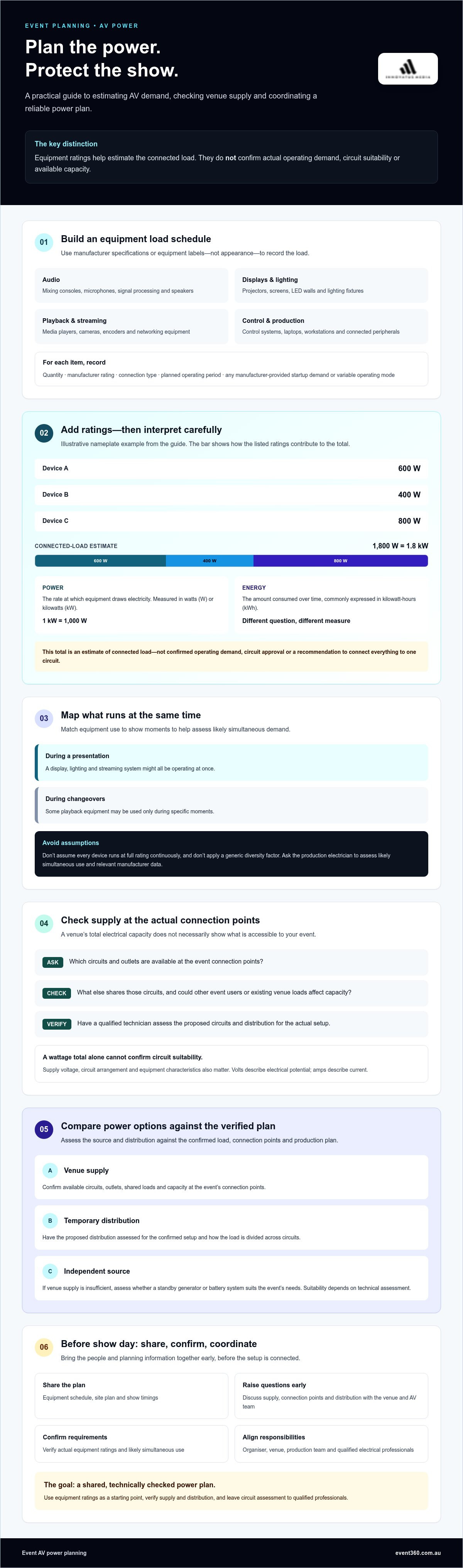
Equipment ratings are a starting point, not approval to connect everything to a circuit. Add the ratings to estimate the connected load, then have a qualified technician assess whether the proposed circuits and distribution suit the actual setup. That assessment can account for details an equipment list alone won’t confirm, including how the load is divided across circuits.
Power and energy describe different things. Power is the rate at which equipment draws electricity, measured in watts (W) or kilowatts (kW), with 1 kW equal to 1,000 W. Energy is the amount consumed over time, commonly expressed in kilowatt-hours (kWh). For event planning, power helps establish whether the system can run at a given moment; energy describes consumption across the event.
Which event AV equipment draws power?
Look beyond the headline items. Group the equipment by function so the production team can build a complete schedule:
Audio: mixing consoles, microphones, signal processing and speakers.
Displays and lighting: projectors, screens, LED walls and lighting fixtures.
Playback and streaming: media players, cameras, encoders and networking equipment.
Control and production: control systems, laptops, workstations and connected peripherals.
Check the manufacturer’s specifications or equipment label for each item’s rating. Don’t estimate from physical size. A compact device may still have a meaningful power draw, while a larger-looking item may draw less than you expect. Confirm the exact ratings with the production team.
Why venue power cannot be assumed
A venue’s total electrical capacity doesn’t necessarily tell you what’s accessible at your event’s connection points. Ask which circuits and outlets are available, what else shares them, and whether other event users or existing venue loads affect capacity. Check the production plan against those specific supply details, not a general statement about the building.
If the venue supply isn’t sufficient for the confirmed setup, the team may need to assess an independent source. Emergency power systems can include standby generators and battery systems, though suitability depends on the event’s needs and technical assessment. Align those decisions with your wider AV production plan so equipment choices and venue coordination work together.
How to Calculate Power Needs for Event AV Equipment
A useful estimate starts with an equipment schedule, then considers how the equipment will be used during the show and whether the supply is suitable. The aim is to understand both the total connected load and which devices are likely to draw power at the same time. This gives the production team a basis for confirming the power requirements for event AV equipment, without mistaking an estimate for circuit approval.
Build an equipment load schedule
List each device and record its quantity, manufacturer rating, connection type and planned operating period. Group items into audio, video, lighting, control and streaming, and include peripherals such as computers, network equipment and playback devices. Use the manufacturer’s specifications or equipment label. Note startup demands or variable operating modes only where the manufacturer provides that information.
For a simple illustrative example, imagine a schedule with three devices rated at 600 W, 400 W and 800 W. Their nameplate ratings total 1,800 W, or 1.8 kW. That is the connected-load estimate, not a confirmed operating demand or a recommendation to connect them to one circuit. The figures are illustrative only. Check the actual equipment ratings and have a qualified technician verify the proposed connection.
Estimate simultaneous demand and confirm assumptions
Map equipment use to show moments. A display, lighting and streaming system might all be operating during a presentation, while some playback gear is used only during changeovers. Don’t assume every device runs at full rating continuously, but don’t apply a generic diversity factor either. Ask the production electrician to assess likely simultaneous use and any relevant manufacturer data.
Keep the electrical units distinct. Watts and kilowatts describe power, with 1 kW equal to 1,000 W. Volts describe electrical potential, while amps describe current. A wattage total alone can’t confirm whether a circuit is suitable. Supply voltage, circuit arrangement and equipment characteristics also matter. Have a qualified technician make that assessment rather than turning a load estimate into a connection plan yourself.
List: capture every device, quantity and rating.
Group: organise equipment by function and proposed circuit.
Schedule: mark what runs together during key show moments.
Verify: confirm circuit suitability and assumptions with the production electrician.
A load schedule informs planning, but it doesn’t replace circuit verification. For a general reference on managing electrical safety at events, the UK Health and Safety Executive outlines considerations for temporary event electrical systems. Check Australian requirements with the appropriate local professionals. If you’re shaping the equipment plan as well as the schedule, Event 360’s AV production planning can be part of that conversation.
Venue supply, temporary distribution or generator: compare event power options
Once the production load is estimated, match it to a suitable source and workable distribution plan. Venue mains may suit the production when the required supply is available at accessible connection points. Temporary distribution organises power from a confirmed source to equipment locations. A generator may be considered when venue supply or the event location calls for an alternative. None of these options removes the need to verify the load and electrical setup.
When venue mains may suit the production
Ask venue contacts for details of the supply available to your event, including circuits, phase, capacity, access points and restrictions. Check whether other event systems, building operations or neighbouring users share the proposed supply. A venue’s overall capacity doesn’t confirm what can be safely used at a particular connection point. A competent technical person should check suitability against the actual production plan.
When temporary distribution or generators need consideration
Temporary distribution can organise power from a suitable, confirmed source to the areas where AV equipment will operate. Its layout and equipment must match the verified loads and connection points. Distribution can help manage where power goes, but it doesn’t increase the capacity of an inadequate source.
Consider a generator if venue supply is insufficient or the event location requires another source. The decision needs a technical assessment of the generator and production demand, as well as practical planning for noise, placement, fuel, access and contingency arrangements. These factors can affect audience experience, site operations and the ability to keep the production running.
Backup power is a separate resilience decision. It may help maintain selected equipment if the primary source is interrupted, but it isn’t an automatic substitute for adequate supply during normal operation. Decide what needs backup, how it will be connected and how changeover would work with the relevant technical professionals.
Venue supply: Confirm the specific capacity and connection points available to the event.
Temporary distribution: Plan how power will be delivered from the confirmed source to production areas.
Generator supply: Assess whether an alternative source is suitable, including site and operating constraints.
Backup: Identify what should remain available during an interruption, separately from the main supply plan.
For a broader view of the equipment and production decisions that shape power requirements for event AV equipment, see the AV equipment hire planning guide. Align the equipment schedule, venue information and distribution plan early, then have the specific arrangement checked before show day.
Event AV power checklist: what to verify before show day
Turn the power plan into clear tasks before bump-in. Check the power requirements for event AV equipment against the venue’s actual supply, agree who is responsible for each technical check, and share the latest production information with everyone involved. A clear handover helps surface gaps while there’s still time to address them.
Questions to ask the venue and production team
Start with the supply at the locations where equipment will operate, not just the venue’s overall capacity. Ask who can confirm the details and how the event’s power plan needs to be approved. Then align access, cable routes and responsibilities with the production team.
Equipment: Is the equipment schedule current, with ratings, quantities and operating periods included?
Supply: What circuits, connection points and capacity are available in each production area, and who will verify them?
Shared loads: Are other event systems, venue operations or users drawing from the proposed supply?
Site logistics: What are the access times, cable routes and venue restrictions? Are any routes or connections subject to approval?
Responsibilities: Who provides distribution equipment and technical labour, who tests the setup, and who should be contacted if an issue arises onsite?
Give the venue and AV team the same equipment schedule, site plan and show timings. Update them as changes are confirmed, particularly if equipment locations or the run sheet shift. Shared, current information makes it easier to coordinate the technical plan with the venue’s arrangements.
Safety, standards and contingency checks
Before the event, ask a qualified electrician or production technician to verify the proposed setup, including the suitability of circuits, connections and distribution. Electrical standards and work requirements depend on the installation and circumstances. AS/NZS 3000 may be relevant, but don’t assume how it applies to your temporary event setup. Ask a qualified local professional to confirm the current requirements.
Confirm who approves the electrical plan and who carries out technical checks.
Agree what the team should do if a circuit trips, equipment faults or supply is interrupted.
Identify who can assess an issue and how the organiser, venue and production team will communicate.
Clarify whether any essential systems need a separate contingency arrangement.
These checks support a considered plan, but they can’t promise uninterrupted operation. Event 360’s AV production planning and onsite coordination can help connect the technical brief with venue requirements. Discuss your event AV requirements as part of that planning conversation.
How an event AV production partner manages power planning
Power planning works best as part of production design, not as a last-minute check. An AV production partner can translate the event brief into equipment choices and a technical plan, then coordinate with the organiser, venue and relevant electrical professionals to confirm what the site can support. This links creative decisions with practical requirements before they become show-day surprises.
From event brief to verified technical plan
Planning starts with the event’s audience, format, content, venue and show flow. A keynote, concert and hybrid event have different production needs, and those choices shape the equipment schedule. LED walls, lighting, sound and streaming equipment all contribute to the overall load and may operate at different points in the programme.
Once the proposed equipment and its use are mapped out, the production team can document questions about ratings, locations, timing and venue connections. The organiser and venue can help fill information gaps, while a qualified electrical professional checks the proposed supply and distribution. A clear plan gives each team a shared reference and makes changes easier to assess.
Event 360 provides tailored AV production that can bring technical planning together with equipment installation and onsite coordination. Its production work includes sound, visual displays, lighting, LED walls, live streaming and hybrid event solutions. The appropriate scope depends on the event brief and can be discussed with the team, including how the power requirements for event AV equipment will be confirmed with the venue and qualified professionals.
What to provide when requesting production support
Start with the information already available. You don’t need every technical detail finalised before an initial planning conversation, but a useful brief helps the team identify what still needs confirming.
Event details: dates, format, venue, expected audience size and any hybrid or streaming requirements.
Programme: a preliminary run sheet showing presentations, performances, changeovers and other key show moments.
Venue information: site plans, technical documents, access details and known power supply information.
Production priorities: content, display, lighting and audio needs, plus any must-have equipment or locations.
Coordination questions: ask how technical planning, equipment, installation and onsite support will be arranged, and who will verify electrical suitability.
From there, the organiser, production team, venue and qualified electrical professionals can work through responsibilities and outstanding checks together. A joined-up plan helps keep the creative vision moving while giving technical details the attention they need. Talk with Event 360 about your event and share the brief to begin the conversation.
Plan power early and keep your production on track
Reliable event power starts with a clear picture of what the production needs and what the venue can supply. Build an equipment schedule from manufacturer ratings, consider which devices will run together, and have a qualified professional verify circuit suitability. Then coordinate connection points, distribution and responsibilities with the venue and production team.
Adding equipment ratings gives you a connected-load estimate, not confirmation that the supply is suitable. Check the power requirements for event AV equipment against the actual venue setup and the event run sheet. A documented plan helps everyone identify missing information before show day.
Event 360 provides tailored AV production and technical planning, with equipment, installation and onsite technical support. Its solutions span sound, lighting, LED walls, live streaming and hybrid events, bringing creative choices and practical coordination into the same conversation.
Ready to bring the details together? Talk with Event 360 about your event AV requirements and start shaping a production plan that fits your event.
Frequently Asked Questions
How do you calculate power requirements for event AV equipment?
List every device, its quantity and manufacturer-rated power, then group items by function and record when each will operate. Add the ratings to estimate connected load, then identify which equipment runs at the same time during key show moments. Share the schedule and venue supply information with the production team. A qualified electrical professional must verify the proposed circuits and distribution before connection.
How much power does event AV equipment use?
There’s no single figure. Demand depends on the equipment, quantities and how the production operates. A small presentation with a display and audio system will have different needs from a production with LED walls, lighting and live streaming. Check each item’s manufacturer rating or equipment label, including connected control and computer equipment. Treat the combined ratings as an estimate, then have the actual setup assessed against the available supply.
Can event AV equipment run from a standard power outlet?
Sometimes, but only if a qualified technical person confirms the outlet and circuit can support the equipment safely. Check the devices’ ratings, what else is connected to that circuit and whether the equipment’s connection requirements are compatible. Don’t assume an available outlet is suitable just because a plug fits. Larger or more complex productions may need planned distribution from verified supply points rather than relying on nearby outlets.
What is the difference between connected load and demand load?
Connected load is the combined nameplate rating of all equipment planned for connection. Demand load is the power expected to be drawn during operation, considering which devices run together and their operating modes. The figures can differ, but don’t reduce the estimate using a generic diversity factor. Have the production electrician assess show timings and manufacturer information, then verify that the supply and circuits suit the plan.
Does an event LED wall need a dedicated power circuit?
Not automatically. The answer depends on the specific LED wall, its manufacturer ratings, the proposed configuration and what else shares the supply. Give the production team the wall’s technical details and intended location, then ask a qualified electrical professional to confirm circuit requirements and distribution. Don’t decide based on the screen’s size alone or connect it to a circuit without verifying capacity and suitability.
When should an event use a generator for AV equipment?
Consider a generator if the venue can’t provide suitable supply at the required locations or the event site needs an alternative source. A qualified professional should assess the generator against the verified production load and planned distribution. Factor in practical site needs such as placement, noise, fuel and access, along with a contingency plan. A generator isn’t a substitute for checking that the complete setup is appropriate for the event.
Who is responsible for confirming event power requirements?
The organiser should coordinate the information and decisions, but power suitability needs confirmation from the venue and qualified electrical professionals. The venue can provide details about available supply and connection points; the AV production team can document equipment, locations and operating times. Share the equipment schedule, site plan and show timings with everyone involved, and agree who verifies circuits, distribution, testing and onsite escalation.


Comments