%20(1).png)
2026 Conference AV Checklist: Guide for Flawless Events

Updated: Sep 5
In 2026, the success of your keynote isn't measured by the number of microphones on stage, but by the seamless orchestration of technology that makes the hardware disappear. We understand that the pressure to deliver a flawless event is immense. You've likely felt that familiar prickle of anxiety over a potential "black screen" moment or the confusion of managing complex hybrid requirements while trying to justify every cent of your A$ budget to stakeholders. It's a high-stakes environment where even a minor technical glitch can overshadow months of meticulous planning.
Master your event logistics with this expert-vetted conference audio visual checklist 2026. We've designed this guide to help you achieve complete peace of mind, ensuring high-impact visuals and crystal-clear audio for every delegate, whether they're in the room or joining from across Australia. We'll walk you through a fail-safe technical plan that covers everything from the latest high-definition LED wall solutions to AI-powered PTZ camera integration. This guide transforms your technical setup into a powerful tool for engagement rather than a source of friction, moving you logically from initial concepts to a polished final execution.
Table of Contents
Technical Venue Audit: Assessing the Foundation
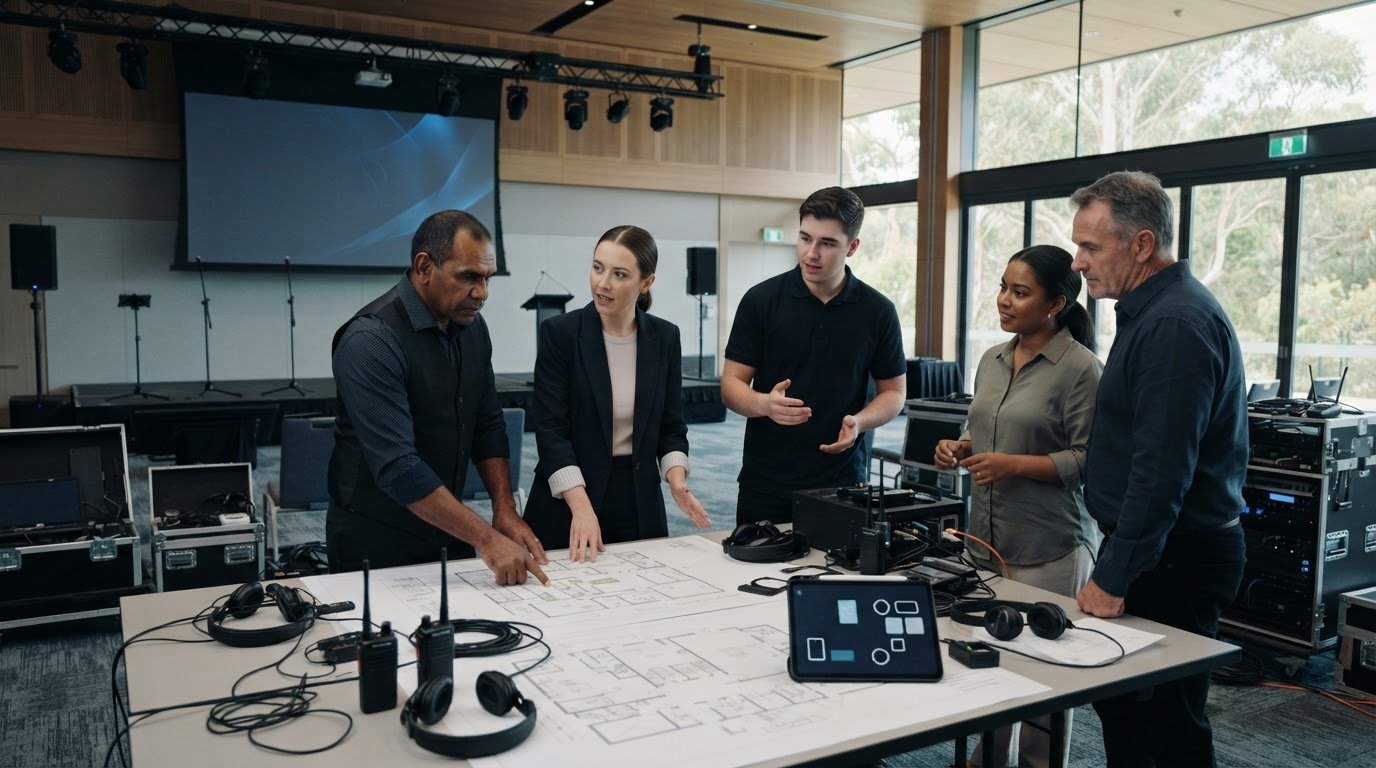
Securing a stunning venue is only the first step. To guarantee a high-impact production, you must validate that the physical space can support your creative vision. This phase of your conference audio visual checklist 2026 focuses on the infrastructure that delegates never see but always rely on. A meticulous site inspection identifies technical bottlenecks before they become live-event crises. We look for everything from hidden structural columns that block sightlines to inadequate power circuits that won't handle modern lighting rigs. You need to approach the venue with a project management mindset, ensuring every technical requirement is met long before the first guest arrives.
Venue Power and Connectivity Audit
Confirm the total amperage available and the exact location of distribution boards. Modern productions are power-hungry; high-definition LED walls and complex lighting arrays often require 3-phase power to operate safely and consistently. Don't assume the venue has this capacity. You must verify it early to avoid the last-minute cost of bringing in external generators. Connectivity is equally critical for the 2026 event landscape. Test the upload and download speeds using a dedicated hardline rather than relying on shared guest Wi-Fi. For hybrid event broadcasting, you require a stable, high-speed connection that can handle low-latency streaming without a hiccup. Scan the main plenary hall for potential signal interference zones where wireless microphones or presenter remotes might drop out. Identifying these dead zones early allows us to position receivers strategically, removing friction for your speakers.
Spatial Logistics and Rigging
Review floor plans with a critical eye to ensure clear sightlines for every delegate in the room. Ceiling heights are often the deciding factor for visual impact; a low ceiling restricts the size of your LED wall and limits the effectiveness of your stage lighting. Verify the weight-bearing capacities for all overhead truss and rigging points. Safety is paramount when suspending heavy lighting arrays or audio clusters above an audience. Beyond the physical structure, you must organise the bump-in and bump-out schedule to align perfectly with venue access windows. A tight schedule requires precision timing to ensure the technical labour team can set up, test, and calibrate every piece of equipment. We manage these intricate details to provide you with complete peace of mind, transforming a complex logistics puzzle into a seamless, professional experience for your stakeholders. For major events where freight delivery or high foot traffic impacts local infrastructure, professional coordination from Acquired Awareness Traffic Management ensures safety and compliance are maintained outside the venue walls.
Audio is the invisible thread that holds your event together. While a blurry screen is a distraction, poor audio is a deal-breaker. If your delegates can't hear the speaker clearly, they'll disengage within minutes. Your conference audio visual checklist 2026 must prioritise a sophisticated sound strategy that accounts for both the physical room and the digital broadcast. We leverage digital mixing consoles to manage complex audio feeds with surgical precision, allowing for instant adjustments during high-pressure transitions. In 2026, we also implement AI-powered noise cancellation. This technology identifies and eliminates ambient room hum or air-conditioning echo in real-time, leaving only the crisp, natural voice of your presenter.
Achieving uniform sound distribution is a technical art form. We design speaker layouts that avoid "hot spots" near the stage while ensuring those at the very back of the hall don't miss a syllable. This requires a project management mindset to map the acoustic profile of the venue during the initial site visit. By choosing a partner who understands audio visual production at a granular level, you remove the friction of technical uncertainty and provide your audience with a truly immersive experience.
Microphone Selection for Presenters
Matching the right microphone to the presenter's style is vital for their confidence. Roaming speakers benefit from lapel microphones, while high-energy presenters who move their heads frequently require the stability of a headset to maintain a consistent audio level. For audience engagement, catch-boxes transform Q&A sessions into a dynamic, interactive experience. We prioritise high-quality wireless systems with active frequency management to avoid dropouts in Australia's increasingly crowded radio spectrum. Always include a backup wired microphone at the lectern for mission-critical keynotes. Digital signal processing (DSP) is then used to normalise vocal levels, ensuring a soft-spoken CEO and a boisterous keynote speaker are heard with equal clarity.
Sound Reinforcement and Foldback
Visual Dominance: Choosing Between LED Walls and Projection
Visuals are the heartbeat of your brand's story. In the high-stakes environment of live production, the choice of display technology defines the delegate experience from the moment they enter the room. As you refine your conference audio visual checklist 2026, deciding between high-definition LED walls and traditional projection is a pivotal moment that influences both your budget and your event's final impact. LED walls have become the superior alternative to projection for 2026 because they offer vibrant, high-contrast branding that remains crisp even in venues flooded with natural Australian sunlight.
LED Wall Solutions vs. Projectors
Ambient light is the traditional enemy of projection. If your plenary hall has floor-to-ceiling windows, an LED wall is your best ally. These screens are self-emitting, meaning they don't lose clarity when the house lights are up for note-taking. You also need to consider pixel pitch; this is the distance between the centre of two pixels. For a front row seated close to the stage, a fine pixel pitch of 2.6mm ensures images look smooth rather than "blocky". For more technical depth on making this choice, explore our LED wall hire 2026 buyer’s guide.
Dynamic Creative Content

The 2026 Hybrid Toolkit: Bridging the Digital Divide
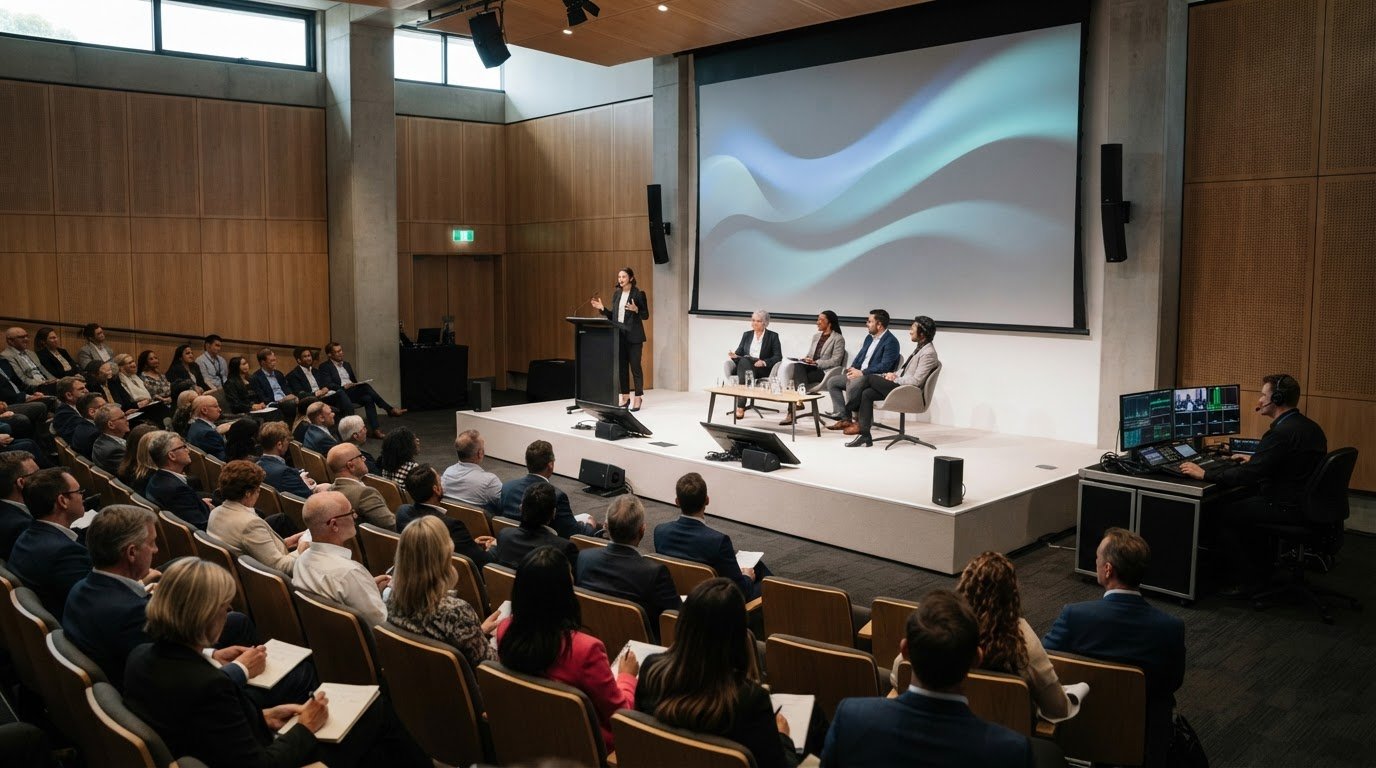
Hybrid events in 2026 demand more than a static webcam at the back of the room. They require a sophisticated digital ecosystem that treats remote guests as equal participants. Deploying AI-powered PTZ cameras with auto-framing is now a mandatory item on any comprehensive conference audio visual checklist 2026. These cameras use intelligent algorithms to track presenters naturally as they move across the stage, ensuring remote viewers feel the energy of the keynote without the jarring transitions of manual switching. Low-latency streaming is the backbone of this experience, allowing for real-time interaction that removes the awkward delays that often kill digital engagement. We establish a dedicated stream-monitoring station on-site to manage the broadcast quality, ensuring every pixel delivered to the home screen is as sharp as the one on the venue wall.
Live Streaming and Broadcasting
A single camera angle is a recipe for digital fatigue. We utilise multi-camera setups, including wide shots and tight close-ups, to provide a dynamic, broadcast-quality experience that keeps remote delegates focused. For a deep dive into the technical specifications required for a flawless broadcast, see our guide on professional live streaming services. Redundancy is our baseline, not an optional extra. We always include secondary internet connections via bonded cellular or satellite and backup encoders. This dual-path approach ensures your stream remains live even if the primary venue line encounters a sudden fault, providing you with absolute peace of mind.
Remote Audience Interaction
Bridging the digital divide means making your remote guests visible and audible to those in the room. We often use the high-definition LED walls mentioned in previous sections as a digital gallery, bringing the faces of remote participants onto the main stage during interactive sessions. This visual presence creates a powerful sense of unity between the two audiences. High-quality return audio is equally vital; remote speakers must be able to hear the room and their fellow panellists clearly to avoid the frustration of overlapping dialogue. We implement live Q&A tools that aggregate questions from both physical and digital rooms into a single, moderated feed, ensuring the most relevant queries reach the stage.
Ready to deliver a world-class hybrid experience? Partner with us for expert live streaming and hybrid event solutions that connect your audience across Australia and beyond.
Onsite Execution: Why Technical Labour is Non-Negotiable
The most advanced LED wall or AI-powered camera system is merely expensive furniture without the expertise to drive it. In the high-stakes environment of live production, technical labour is the ultimate insurance policy for your reputation. This final stage of your conference audio visual checklist 2026 shifts the focus from equipment lists to the specialist partners who bring your vision to life. You need a dedicated technical director who doesn't just watch the clock, but actively orchestrates the production timeline to ensure every transition is seamless and every cue is hit with precision.
The Role of the Technical Production Team
Onsite support manages the complex, invisible interplay between sound, light, and vision. These aren't just equipment operators; they're problem solvers with a "can-do" attitude who thrive under the pressure of a live audience. Whether it's a last-minute slide change or a sudden radio frequency conflict, skilled AV technicians provide the rapid troubleshooting required to keep the show moving without the audience ever noticing a hitch. For a deeper look at the service levels you should expect from your production partner, consult our AV hire Australia buyer’s guide. This partnership approach ensures you aren't just hiring gear, but securing a dedicated ally for your event's success.
Rehearsals and Show-Calling
Anxiety is the enemy of a great performance, and we eliminate it by scheduling a full technical rehearsal with every presenter before the doors open. This includes rigorous mic checks and slide reviews to ensure every video plays perfectly and every animation triggers exactly as intended. Our teams use dedicated intercom systems to maintain constant, clear communication between the stage manager and the tech booth. Professional show-calling transforms a simple sequence of slides into a polished, rhythmic production by timing every audio and visual cue to the millisecond. This level of coordination removes friction for the speakers, allowing them to focus entirely on delivering their message.
Elevate Your Production Standards for 2026
Success in the high-stakes world of live production isn't found in a single piece of hardware, but in the seamless integration of every technical element. By following this conference audio visual checklist 2026, you've established a robust framework that prioritises clear communication, visual dominance, and hybrid accessibility. From the initial venue audit to the precision of the final show-call, each step moves you closer to an event that inspires trust and captivates your audience. You now have the tools to remove friction and transform complex logistics into a polished, professional journey.
Our specialist MICE production team at Event 360 Pty Ltd is ready to act as your dedicated ally, providing high-energy, results-driven technical support across the country. With national Australian service coverage and a "can-do" attitude, we manage the intricate details that guarantee peace of mind. Don't leave your keynote to chance when you can partner with experts who thrive on complexity and precision. Orchestrate your next flawless event with Event 360 Pty Ltd and let's create something extraordinary together.
Frequently Asked Questions
What AV equipment is absolutely essential for a conference in 2026?
High-definition LED wall solutions, digital mixing consoles, wireless microphone systems, and AI-powered PTZ cameras are foundational. You also need redundant internet encoders and professional lighting arrays to ensure presenters are framed perfectly for both in-room and remote audiences. This hardware forms the core of any comprehensive conference audio visual checklist 2026, allowing for a flawless technical execution that inspires trust in your stakeholders.
Should I choose an LED wall or a projector for my corporate event?
Choose an LED wall if your venue has natural light or if you want high-contrast, vibrant branding that doesn't require dimming the house lights. While traditional projection offers a cinematic feel in dark rooms, LED walls provide superior brightness and scalability for modern corporate environments. They allow delegates to take notes comfortably while maintaining a clear view of the presentation, removing the friction of poor visibility.
How much does professional audio visual hire typically cost for a conference?
Costs vary significantly based on the scale of your production, the specific equipment required, and the level of technical labour needed. A small seminar requires a different budget than a multi-day national conference with LED walls and live streaming. We recommend requesting a tailored quote that reflects your specific creative vision and technical requirements to ensure you get the best value for your A$ investment without compromising on quality.
What are the technical requirements for a successful hybrid event?
Successful hybrid integration requires a low-latency streaming platform, multi-camera setups with auto-framing, and a dedicated, high-speed internet line. It also depends on high-quality return audio so remote speakers can hear the room without feedback. It's about creating a unified experience where digital and physical audiences can interact in real-time through moderated Q&A tools and digital gallery displays, bridging the gap between both worlds seamlessly.
Why is professional technical labour better than using in-house venue AV?
Professional technical labour provides a dedicated team solely focused on your specific production goals rather than the venue's general operations. Our specialist MICE production team acts as your partner, offering deep technical mastery and a can-do attitude. This level of personalised support ensures rapid troubleshooting and a polished execution that in-house teams, often managing multiple events simultaneously, simply cannot match in a high-stakes environment.
What is the best way to avoid technical glitches during a live presentation?
Rigorous technical rehearsals and hardware redundancy are the most effective ways to eliminate glitches. Conduct full mic checks and slide reviews with every speaker before the doors open. We also utilise backup encoders for streaming and secondary wired microphones at the lectern. Having a seasoned technical director onsite allows for immediate intervention if any unforeseen issues arise, providing you with complete peace of mind throughout the live event.
How far in advance should I book my AV production partner?
Secure your AV partner at least six to twelve months before your event date. Early engagement allows for a more thorough technical venue audit and better integration of creative content into the hardware setup. Booking early also ensures you have access to the latest equipment and the most experienced technical labour, which is essential during peak conference seasons across Australia when high-end resources are in high demand.
Do I need a dedicated internet line for live streaming my conference?
Yes, a dedicated hardline is essential to guarantee a stable broadcast without interference from guest Wi-Fi usage. Shared connections are prone to bandwidth fluctuations that can cause your stream to lag or drop out entirely. We always recommend a secondary backup connection, such as bonded cellular, to ensure your digital audience remains connected even if the primary venue line fails, maintaining the momentum of your presentation.
Comments