
AV for Audience Engagement: 2026 Event Producer's Guide

Audiovisual technology is not mere stage dressing; it's the sensory engine that dictates whether your delegates lean in or check out. Every producer has watched an audience succumb to screen fatigue during a keynote, battling muddled acoustics and uninspired visuals that quietly drain the room's energy. Deploying strategic AV solutions to improve audience engagement transforms these passive spectators into active participants, turning routine presentations into high-calibre live experiences.
You already know that capturing attention across modern corporate events requires far more than basic projection screens and standard podium mics. Delegates expect dynamic visual environments, crystal-clear audio choreography, and interactive touchpoints that keep them connected from opening remarks to final applause. In this guide, you'll discover how tailored technical production bridges the gap between the stage and the floor, elevates brand prestige, and drives measurable participation. Here is your operational framework for orchestrating live event technology that commands focus and delivers undeniable impact.
Table of Contents
The Sensory Science: Why Strategic AV Solutions Drive Real Audience Engagement
Core Visual Technologies: Transforming Passive Viewers into Active Participants
Interactive and Hybrid Audio Visual Systems That Connect Audiences
Technical Choreography: Evaluating Your Venue, Acoustics, and Sightlines
Execution Strategy: Partnering with a Full-Service Production Specialist
The Sensory Science: Why Strategic AV Solutions Drive Real Audience Engagement
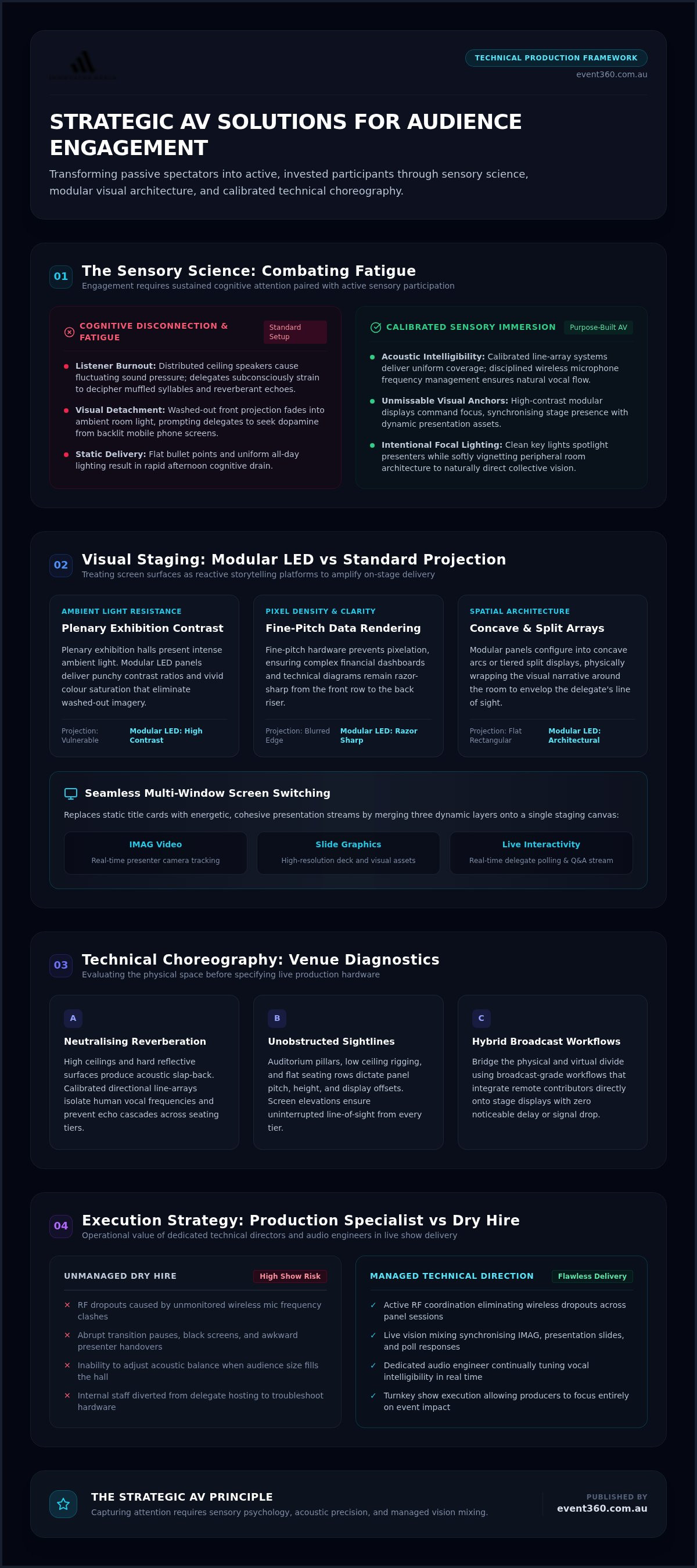
Audience engagement is not a polite head nod from the front row. In professional live production, engagement represents sustained cognitive attention paired with active sensory participation. When event producers implement purpose-built AV solutions to improve audience engagement, they tap directly into sensory psychology. Strategic technical production transforms passive spectators from tired observers into emotionally invested contributors who retain key messages and respond actively to on-stage talent.
Acoustic Precision and the Battle Against Listener Fatigue
Listener fatigue is the silent killer of afternoon conference sessions. When an auditorium relies on distorted, distributed ceiling speakers, sound pressure levels fluctuate wildly across the room. Attendee brains are forced to work overtime, subconsciously filling in muffled syllables and filtering out reverberant reflections. This constant mental effort triggers cognitive burnout well before the keynote finishes.
Replacing inadequate venue setups with calibrated line-array systems ensures uniform acoustic coverage, specifically tuned for human vocal intelligibility. Combining this acoustic precision with disciplined wireless microphone frequency management creates a consistent, natural conversational flow across panel discussions. Delegates stop straining to decipher sentences; instead, they absorb ideas effortlessly.
Visual Hierarchy and Dynamic Focal Architecture
Visual dynamics govern where delegates direct their eyes, how rapidly they process complex data, and how long they retain core concepts. When a plenary session relies on washed-out, low-contrast projection, visual stimuli fade into ambient room light. The human brain quickly loses interest, prompting delegates to seek dopamine from their backlit mobile phone screens.
High-contrast, finely pitched modular screens establish an unmissable visual anchor. Much like modern narrative techniques in transmedia storytelling where content bridges multiple touchpoints to sustain emotional investment, dynamic live staging synchronises messaging across diverse visual assets. Pairing crisp visual backdrops with intentional theatrical lighting reinforces this focus. By illuminating presenters with clean key lights while softly vignetting peripheral room architecture, technical directors subtly guide collective vision, ensuring the entire audience remains locked onto what matters most.
Core Visual Technologies: Transforming Passive Viewers into Active Participants
Static title cards and flat bullet points guarantee visual detachment. Dynamic visual displays, by contrast, create an immersive canvas that amplifies on-stage delivery. As outlined by PCMA research into modern digital event and engagement strategy, creating multi-dimensional sensory experiences directly drives return on engagement across live environments. Deploying purposeful AV solutions to improve audience engagement means treating screen surfaces as reactive storytelling platforms. Seamless multi-window switching merges real-time camera tracking (IMAG), presentation graphics, and live attendee polling into an energetic, cohesive presentation stream.
Modular LED Walls Versus Projection Systems
Plenary exhibition halls present serious ambient light challenges that standard front projection cannot overcome. Modular LED displays solve this issue entirely by delivering punchy contrast ratios, vivid colour saturation, and pristine sightline clarity across any seating tier. Exploring our LED wall hire buyer’s guide reveals how fine-pitch hardware prevents pixelation, ensuring complex financial dashboards and technical diagrams remain razor-sharp from the front row to the back riser. Additionally, modular panels can be configured into concave arcs or tiered split displays, physically wrapping the visual narrative around the room to envelop the delegate's line of sight.
Dynamic Stage Lighting That Directs Energy and Focus
Lighting should never remain static throughout an entire business day. Adapting stage illumination directly orchestrates audience arousal and mental focus across changing presentation styles:
Colour Temperature Transitions: Crisp, cool-white key lighting (5600K) commands alert attention during dense keynote data drops, while transitions to warmer tones (3200K) cultivate intimacy for fireside chats and collaborative Q&A.
Programmable Profile Spotlights: Automated moving fixtures frame presenter movement precisely, providing visual cues that guide the room through narrative shifts.
Immersive Ambient Washes: Softly washing room perimeters in synchronised hues visually connects the audience floor to the main stage, breaking down the barrier between talent and spectator.
When you combine modular panels with calibrated lighting rigs, you establish an agile environment that reacts instantly to presentation beats. Explore our comprehensive guide to audio visual production for impactful events to see how unified visual integration elevates stage presence. For planners seeking complete technical direction, partnering with the specialists at Event 360 ensures your stage lighting, custom creative content, and screen surfaces operate in perfect harmony.
Interactive and Hybrid Audio Visual Systems That Connect Audiences
Hybrid event formats collapse the moment remote attendees feel relegated to passive fly-on-the-wall observers. When digital delegates are restricted to a one-way webcam stream, their attention instantly fragments across browser tabs and incoming emails. Implementing real-time AV solutions to improve audience engagement demands a unified communication pipeline that binds physical rooms and virtual spaces into a single, cohesive dialogue.
Integrating In-Room Audience Response Systems into the Screen Mix
Live audience response systems turn mobile devices from attention-stealing distractions into powerful engagement tools. Hardware vision switchers route real-time delegate data directly into the active screen mix without latency. Rather than relying on static presentation decks, producers introduce dynamic participation layers:
Instant Polling Displays: Live attendee voting tallies animate immediately on main LED backdrops, allowing keynote speakers to pivot their remarks based on room sentiment.
Dynamic Moderated Q&A: Curated delegate questions appear simultaneously on downstage confidence monitors for presenters and on auxiliary displays for attendees, fostering transparent two-way dialogue.
Interactive Word Clouds: Delegate inputs populate organic visual displays in real time, illustrating collective consensus during strategic workshops.
These responsive visual layers sustain cognitive energy throughout long plenary sessions, turning passive listening into a collaborative exercise.
Two-Way Interactive Hybrid Event Architecture
Fusing in-person and digital audiences requires robust, broadcast-grade engineering. Low-latency pipelines ensure remote panellists can converse naturally with on-stage presenters, completely eliminating awkward pauses and cross-talk. Dedicated mix-minus audio routing is critical here; by sending remote contributors a tailored audio feed that excludes their own voice, engineers prevent distracting echo loops from disrupting the live auditorium.
Positioning dedicated virtual audience reaction monitors along the stage apron allows keynote speakers to see remote reactions in real time, restoring the human feedback loop often lost in hybrid environments. When virtual attendees appear directly alongside in-person contributors on physical stage displays, the divide disappears entirely. For an in-depth breakdown of multi-camera switching, secure streaming feeds, and remote speaker management, explore our comprehensive guide to professional live streaming services.
Technical Choreography: Evaluating Your Venue, Acoustics, and Sightlines
Rigging high-end hardware into an unsuitable architectural space guarantees compromised delivery. Even the most sophisticated gear fails when room physics work against you. Deploying calibrated AV solutions to improve audience engagement requires evaluating the raw physical environment long before load-in day. Reviewing standard national staging practices in our event production solutions guide will help you align technical specifications with unique venue layouts.
Acoustic Audits and Sound Mapping for Challenging Spaces
Cavernous plenary spaces featuring polished concrete floors, glass perimeters, and exposed ceiling trusses generate brutal slap-back reflections. Acoustic sound mapping simulates speaker dispersion against these reflective surfaces, identifying dead zones and flutter echoes before rigging line arrays. Rather than driving excessive volume from the main stage, technical directors position time-aligned delay speaker stacks down the length of deep rooms. This technique ensures consistent vocal sound pressure levels without blasting delegates seated in front rows. For adjoining breakout spaces separated by demountable partitions, acoustic baffling and precise directional speaker zoning stop distracting noise bleed between concurrent presentations.
Sightline Geometry and Spatial Floorplan Design
Display placement relies on strict geometric calculation rather than visual guesswork. Proper sightline engineering eliminates attendee neck strain and ensures complete message retention across flat or raked seating:
Distance-to-Screen Calculations: Screen height dictates readability. Ensuring text height meets standard visual ratios allows delegates in the furthest row to read complex data sets without squinting.
Platform Elevations and Off-Centre Sightlines: Elevating stage decks to appropriate heights keeps presenters visible over seated crowds. In wide or obstructed spaces, strategically positioned side-of-stage relay monitors maintain clear views around architectural pillars.
Clean Stagecraft and Cable Management: Low-profile modular staging and concealed cable looms eliminate visual clutter, focusing delegate attention solely on the presenter and active graphics.
Eliminating physical friction between the audience, the presenter, and the visual display keeps attendees locked into the agenda. Ready to assess your venue's technical capabilities? Partner with Event 360 for end-to-end technical direction to turn complex architectural challenges into high-impact staging environments.
Execution Strategy: Partnering with a Full-Service Production Specialist
Dry-hiring gear without dedicated technical crew transfers massive operational risk directly onto your event team. Sophisticated hardware alone cannot rescue a presentation if a video switcher drops a signal or a live microphone feeds back across the ballroom. Realising the true potential of AV solutions to improve audience engagement requires an integrated production team executing behind the console. Reviewing equipment procurement best practices in our buyer’s guide for flawless event production demonstrates why piecemeal equipment hire introduces unnecessary live delivery risks.
The Crucial Role of Onsite Technical Labor and Show Direction
Flawless presentation delivery depends on disciplined human choreography. A dedicated show caller and technical director serve as the nerve centre of your event, orchestrating lighting states, video transitions, speaker walk-up stings, and live polling cues with split-second precision. Behind the sound console, an attentive audio engineer actively balances dynamic range across panel discussions, eliminating feedback rings and catching subtle volume shifts instantly. Behind the scenes, experienced technicians manage power distribution, test backup signal pathways, and rectify unforeseen software conflicts without the audience ever noticing.
From Concept to Flawless Live Execution
Eliminating delivery friction demands a rigorous, phased pre-production process long before the first flight case arrives on site:
Site Audits and CAD Staging Models: Inspecting structural rigging points, calculating electrical loads, and drafting exact scale models ensure zero spatial surprises during bump-in.
Custom Creative Content Integration: Producing branded motion loops and animated stingers tailored specifically to modular stage surfaces reinforces message retention and visual energy.
Cue-to-Cue Technical Rehearsals: Guiding speakers through practical stage walk-throughs synchronises clicker timing, confidence monitor layouts, and microphone discipline.
This structured progression turns intricate logistics into effortless stage delivery. As a national technical production specialist, Event 360 delivers end-to-end audio visual production, modular LED wall hire, creative content development, and hybrid live streaming for corporate conferences and MICE gatherings across Australia. Partnering with a dedicated production ally gives you the peace of mind to focus entirely on your stakeholders, knowing your technical execution is fully managed from first brief to final wrap.
Elevate Your Live Stage Impact in 2026 and Beyond
Delivering unforgettable corporate gatherings requires moving beyond passive staging. When you combine calibrated line-array audio to eliminate listener fatigue, vibrant modular LED backdrops for visual punch, and low-latency hybrid routing, your event commands total room attention. Deploying intelligent AV solutions to improve audience engagement turns everyday plenary sessions into dynamic sensory experiences where attendees feel actively connected to every moment.
Achieving this level of technical polish demands true end-to-end collaboration. Event 360 delivers complete technical production management for corporate conferences and MICE gatherings nationwide. Backed by modular LED walls, calibrated audio systems, and intelligent lighting fixtures, our dedicated onsite technical directors, show callers, and sound engineers eliminate live delivery risks entirely. Ready to captivate your delegates and elevate your brand prestige? Partner with Event 360 for flawless event production and bring your creative vision to life with complete confidence.
Frequently Asked Questions
How do professional AV solutions directly improve audience engagement at business events?
Professional technical production stimulates cognitive focus and emotional connection by synchronising crystal-clear sound, dynamic lighting, and responsive visual media. Implementing targeted AV solutions to improve audience engagement removes sensory barriers like muddy speech or washed-out projection. When delegates can clearly see, hear, and interact with on-stage content without straining, their attention stays anchored to the presentation, resulting in higher information retention and active participation.
What is the advantage of modular LED walls over traditional projectors for attendee focus?
Modular LED walls deliver superior brightness, rich colour contrast, and razor-sharp clarity that resist ambient room light in bright exhibition halls. Projectors often suffer from washed-out imagery when overhead lights remain on for note-taking. LED displays ensure detailed infographics, live camera tracking, and text slides remain instantly readable from every seat, preventing attendee visual fatigue and keeping eyes locked forward.
How can audio visual technology prevent afternoon attendee fatigue during full-day conferences?
Acoustic fatigue occurs when delegates exert constant mental energy trying to understand muffled speech through uneven sound systems. Calibrated line-array speakers distribute uniform vocal volume across the entire room, eliminating loud hot spots near the stage and dead zones at the back. When combined with dynamic colour temperature lighting shifts between keynotes and panels, sound reinforcement keeps delegates mentally fresh through long afternoon tracks.
What technical AV infrastructure is required to make hybrid attendees feel fully included?
True hybrid inclusion requires broadcast-grade video pipelines, real-time polling integration, and low-latency two-way audio. Dedicated mix-minus audio configurations prevent distracting echo loops for remote contributors speaking into the auditorium. Positioning dedicated digital reaction screens and remote attendee video tiles directly within the physical stage environment ensures virtual participants interact naturally with in-room presenters rather than sitting as passive broadcast observers.
Why is hiring dedicated technical crew safer than relying on in-house venue equipment alone?
Dedicated production specialists focus entirely on your show flow rather than managing broad venue logistics. Experienced technical directors, show callers, and live audio engineers run cue-to-cue rehearsals, monitor wireless radio frequencies, and troubleshoot software hiccups behind the scenes. This dedicated oversight eliminates live show risks, ensuring presenter transitions, video playback, and live microphone cues fire without awkward delays or technical hitches.
How does dynamic stage lighting influence audience attention during keynote presentations?
Intelligent lighting shapes the room's energy by directing delegate gaze precisely where action occurs. Crisp, focused key lights highlight presenter facial expressions, creating an immediate personal connection across large halls. Adjusting lighting temperatures signals programme transitions, shifting from alert, cool-white focus during data-heavy addresses to warmer, relaxed ambient washes during conversational panel discussions.
What steps should event organisers take during a technical site inspection to verify room acoustics?
Organisers should evaluate physical surface materials, ceiling heights, and background noise levels before confirming equipment specifications. Hard architectural boundaries like polished floors, concrete pillars, and expansive glass walls create slap-back reverberation that ruins vocal clarity. Identifying these acoustic challenges early allows audio engineers to specify directional delay speakers and acoustic baffling, ensuring pristine speech comprehension throughout the room.


Comments