
Mastering Touring AV Logistics: 2026 Australian Guide

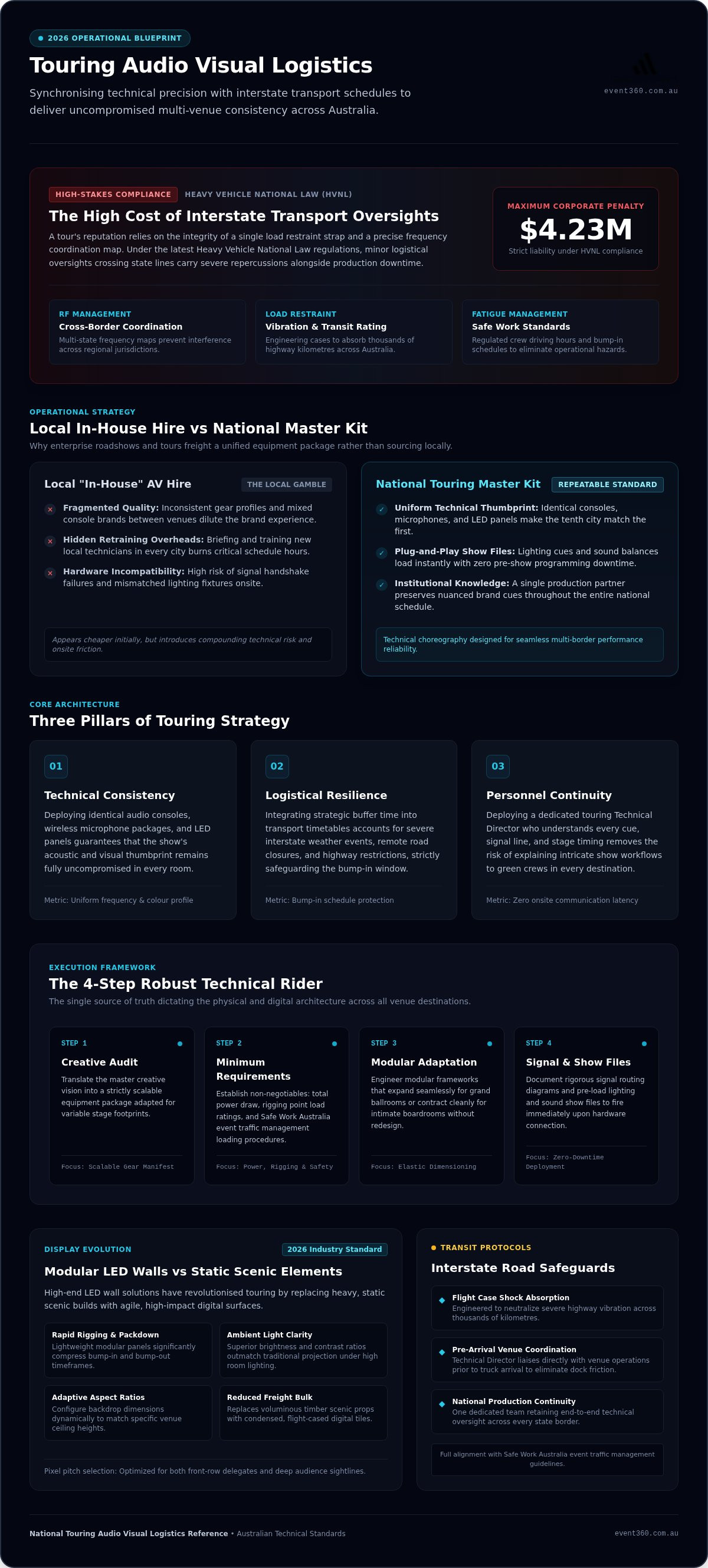
Your entire tour's reputation rests on the integrity of a single load restraint strap and the precision of a frequency coordination map. It's a high-stakes environment where a minor oversight in touring audio visual logistics can lead to damaged gear or a $4.23 million corporate penalty under the latest Heavy Vehicle National Law. You've likely felt that familiar knot in your stomach as equipment crosses state lines, fearing that the pristine technical quality you achieved at the tour's opening night won't survive the thousands of kilometres in transit to the next destination.
We understand that consistency is your greatest challenge. You want every audience to experience the same immersive impact, regardless of the venue's quirks or the distance travelled. This guide provides the blueprint to synchronise technical precision with complex transport schedules for a flawless national tour. You'll learn how to implement a repeatable logistical framework that ensures uniform audio and visual quality while eliminating hidden freight costs and technical glitches. We'll break down the 2026 standards for RF management, load restraint, and crew fatigue to keep your production moving with absolute confidence.
Table of Contents
What is Touring Audio Visual Logistics?
Touring audio visual logistics is the high-precision art of moving a complex technical ecosystem across multiple borders without losing a single beat of the performance. It's far more than just hiring a truck; it's the synchronised movement of elite technical equipment, specialist crew, and creative assets to deliver a repeatable experience. Whether you're staging a national MICE roadshow or a high-energy concert, the goal is to make the tenth city look and sound exactly like the first.
One-off events allow you to design for a single environment, but touring requires a radical focus on freight durability and modularity. You have to account for the mechanical vibrations of thousands of kilometres on Australian highways and the varying power capacities of different stages. This is why mastering your technical rider specifications is essential. It acts as the blueprint that bridges the gap between your creative vision and the physical constraints of every venue on the schedule, ensuring your gear survives the journey and performs on arrival.
By 2026, high-end LED wall solutions have become the standard for mobile productions. These modular systems have revolutionised touring audio visual logistics by replacing heavy, static scenic elements with lightweight, high-impact digital backgrounds. They're easier to pack, faster to rig, and provide a uniform visual impact that adapts to different room sizes instantly, removing the friction of traditional set builds.
The Difference Between Local Hire and National Touring
Relying on local "in-house" AV providers in every city is a gamble that often results in a disjointed brand experience. While it might seem cheaper on paper, the hidden costs of retraining local crews and troubleshooting incompatible gear quickly add up. Freighting a master kit ensures your production remains uncompromised and professional. Touring logistics is the technical choreography of a brand’s physical presence.
Key Pillars of a Successful Touring Strategy
Success relies on three non-negotiable elements that provide peace of mind for event organisers:
Technical consistency: Using the same consoles, microphones, and LED panels ensures the show’s technical thumbprint stays identical across every venue.
Logistical resilience: Building strategic buffer time into transport schedules accounts for road closures or weather delays, protecting your bump-in window.
Personnel continuity: Deploying a touring technical director who understands every cue removes the risk of explaining complex show flows to a new team in every city.
Developing a Robust Technical Rider for Multi-Venue Success
Your technical rider is the absolute bible for your tour. It’s the single source of truth that ensures touring audio visual logistics remain seamless across every kilometre. A well-crafted rider doesn't just list gear; it dictates the physical and digital architecture of your brand’s presence. Without it, you’re not touring; you’re just hoping for the best in every city.
Creating this document requires a disciplined, four-step approach. First, you must audit the creative vision and translate it into a scalable equipment list. Second, define your "Minimum Technical Requirements." This includes non-negotiables like power draw, rigging point load ratings, and loading dock access. To keep your team safe and compliant, always reference the Safe Work Australia event traffic management guidelines when documenting vehicle arrival and loading procedures. Third, build a modular gear list that can expand for a ballroom or contract for a boardroom. Finally, document your signal flow and "Show File" management. This ensures that when your lighting and audio consoles arrive, they’re ready to fire with zero downtime.
Choosing Modular LED Wall Solutions for Touring
Modern tours are moving away from traditional projection. LED walls offer superior brightness and custom aspect ratios that projectors simply can't match in high-ambient light environments. By choosing modular panels, you can adapt your backdrop to fit the specific height and width of any stage. When considering led wall hire, select a pixel pitch that maintains clarity for both front-row corporate delegates and distant concert attendees. This modularity is the secret to maintaining a high-end "look" while managing the weight constraints of interstate freight.
Audio and Lighting: Scalability is Key
Acoustic environments vary wildly between venues. Your rider should specify audio systems, such as line arrays, that can be tuned to different room shapes to ensure every seat is the best seat in the house. For lighting, prioritise multi-functional fixtures. These "hybrid" units combine beam, spot, and wash capabilities, which significantly reduces the total fixture count and freight costs. We use 3D rendering tools to pre-visualise the rider in every venue on the schedule, allowing us to identify potential rigging clashes before the truck even leaves the warehouse. If you want to see how we reconcile these technical details for national tours, explore our approach at event360.com.au.
Managing Interstate Freight and Equipment Protection
Australia’s geography presents a brutal test for even the most robust production gear. Moving a high-end kit across vast distances between distant capital cities involves more than just booking a semi-trailer; it requires a deep understanding of touring audio visual logistics to combat mechanical stress. The vibration factor on long-haul routes can rattle internal components loose, while extreme thermal shifts in the back of a pantech can affect delicate LED processors and optical sensors. Precision is your only defence against the tyranny of distance.
Safe transit starts with a Master Pack List that accounts for both volume and weight distribution. We calculate axle loads to comply with National Heavy Vehicle Regulator (NHVR) standards, ensuring every road case is secured to withstand specific acceleration forces, such as 0.8g forward and 0.5g lateral. To ensure site safety during these high-pressure transitions, Event 360 Pty Ltd adheres to national workplace health and safety event construction and bump-in guidance to manage risk and rigging protocols. This level of planning prevents equipment migration inside the truck, which is the leading cause of transit damage.
Use this protection checklist for every interstate leg:
Utilise shock-mounted racks for all digital consoles and playback servers.
Verify that all cases meet ATA Spec 300 Category 1 standards for long-haul durability.
Apply desiccant packs in cases containing sensitive optics to manage humidity shifts.
Ensure every load restraint strap is rated and inspected before the doors close.
The Art of the Road Case
Standard cases won't cut it for a national tour. Event 360 Pty Ltd uses custom CNC-cut high-density foam inserts that cradle equipment with zero internal movement. Efficiency is boosted by colour-coding cases by department: blue for Audio, yellow for LX, and red for Vision. This allows local crews to push gear to the correct stage zones instantly. A well-packed truck is the first step to a flawless show.
Freight Scheduling and Contingency Planning
Timing is everything when your bump-in window is non-negotiable. Event 360 Pty Ltd employs the double-drive rule, aiming for the transport to arrive 24 hours before the technical crew. This provides a vital buffer for road closures or mechanical delays. In 2026, real-time GPS tracking and telematics are standard, giving us live visibility of the kit’s location and the G-forces it's experiencing. Once on-site, we coordinate dead-case storage with the venue to ensure empty boxes don't clutter the loading dock or fire exits during the performance.
Seamless Bump-in and Venue Technical Coordination
Bump-in is the critical junction where planning becomes reality. It's the high-stakes window where touring audio visual logistics transition from a spreadsheet to a physical experience. Success during this phase depends on the Technical Director, who acts as the primary liaison between the touring production and the venue’s house staff. This coordination begins weeks before the truck arrives, confirming loading dock clearances, freight lift weight capacities, and specific "dark time" windows for lighting focuses.
Venue reconciliation is the essential process of adapting your standardised touring rig to the unique architectural reality of each room. No two ballrooms or convention centres are identical; power distribution points shift, and ceiling heights fluctuate. We pre-calculate these variables during the planning phase, allowing us to adjust LED wall ground-support systems or modify line array trim heights instantly. This ensures the show’s visual and sonic impact remains uniform, even when the venue’s footprint suggests otherwise.
Safety and compliance are the bedrock of a professional tour. Managing Work Health and Safety (WHS) requirements involves navigating different jurisdictional nuances across the country. We ensure all touring and local crew hold the necessary High Risk Work Licences (HRWL) for rigging and that every Safe Work Method Statement (SWMS) is meticulously updated for each specific site. This proactive approach removes friction and protects both the brand and the personnel on-site.
The Production Schedule: Minute-by-Minute
Efficiency in a tight bump-in window relies on a granular run sheet. This schedule dictates the exact power-up sequence to prevent surging venue breakers and coordinates the handover between the freight team and the technical crew. Managing the overlap with local technical labour is vital; we provide clear, assertive direction to ensure local hands are utilised effectively for cable runs and set assembly. For a broader look at managing complex event environments, explore our guide to audio visual production.
Troubleshooting in Real Time
We operate under a strict "Spare Kit" philosophy, carrying 10% more cabling, signal processors, and power supplies than the technical rider requires. This redundancy is your insurance policy when you’re operating in locations far from a technical warehouse. Our crew uses networked digital intercom systems to maintain constant communication during the build, moving through a rigorous checklist in the final 60-minute countdown before doors open. If you’re looking for a partner who can manage these intricate technical details with absolute precision, reach out to Event 360 to secure your tour’s success.
Partnering with a National Technical Production Team
Hiring a different AV company in every city is the fastest way to dilute your brand’s impact. While it might appear convenient to use local venue suppliers, you lose the institutional knowledge that makes a production truly sing. A single national partner like Event 360 Pty Ltd ensures that the technical crew who built the show in the first city are the same ones executing it in the last. They understand your cues, your brand’s specific colour palette, and the exact timing of every transition. This continuity transforms a fragmented series of events into a cohesive national tour.
Managing the intricate web of touring audio visual logistics involves more than just gear; it’s about navigating the administrative complexities of national labour. We handle the negotiation of onsite support fees and local crewing awards on your behalf, removing the friction of multiple invoices and conflicting contracts. This eliminates the risk of technical drift, where the show slowly changes as different local technicians interpret your rider in different ways. Our turnkey approach allows you to focus on your delegates and stakeholders while we manage the heavy lifting of technical coordination. By centralising your production, you ensure that the "look and feel" of your event remains uncompromised across thousands of kilometres of transit.
Confidence Through Technical Mastery
Our project management style is built on assertive, proactive communication. We don't just wait for problems to arise; we anticipate them through rigorous pre-visualisation and site audits. When a venue presents a unique challenge, like restricted rigging access or unconventional power layouts, our "can-do" attitude ensures the creative vision remains uncompromised. This mastery is what allows us to deliver high-end LED wall solutions and concert-grade audio consistently, regardless of the venue's limitations. We view ourselves as your dedicated ally in the high-stakes environment of live production. For those seeking comprehensive national service insights, our guide on audio visual australia provides a deeper dive into our production capabilities.
Booking Your Next National Tour
The most successful tours are won in the planning phase, often starting six months before the first bump-in. Early engagement allows us to secure prime transport slots and refine the technical rider to its most efficient form. When requesting a quote, look for a partner that offers end-to-end management rather than just a list of equipment for hire. This ensures that freight, labour, and technical design are all synchronised under one roof. Logistics is a creative discipline, and we invite you to partner with Event 360 Pty Ltd to turn your next national roadshow into a flawless technical triumph.
Securing Technical Excellence for Your National Tour
Mastering touring audio visual logistics requires more than just high-end equipment; it demands a disciplined fusion of technical mastery and logistical resilience. By prioritising a modular technical rider and rigorous freight protection, you ensure your creative vision survives the thousands of kilometres between Australian venues. You've seen how a repeatable framework removes friction, turning the uncertainty of interstate transit into a predictable, high-impact success.
Event 360 Pty Ltd brings specialised MICE and concert production expertise to every stage, providing national coverage with consistent technical labour that knows your show inside out. Our high-end modular LED wall solutions offer the ultimate flexibility, ensuring a uniform visual impact regardless of the room's constraints. We take the heavy lifting off your shoulders, delivering a turnkey experience that lets you focus on your audience. Organise your next flawless national tour with Event 360 Pty Ltd and experience the peace of mind that comes with professional partnership. Your next big performance is waiting, and we're ready to make it legendary.
Frequently Asked Questions
What is the most important document for touring audio visual logistics?
The technical rider is the most critical document for successful touring audio visual logistics. It acts as the production's "bible," detailing everything from power draw and rigging points to signal flow and console show files. Without this comprehensive blueprint, you risk technical friction in every new city. A well-maintained rider ensures that venue managers and local crews understand exactly what is required before the first truck even hits the loading dock.
How do I ensure my LED wall looks the same in every venue during a tour?
Consistency is achieved by touring with a single modular LED wall kit and a unified processing rack. This hardware continuity ensures that pixel pitch and colour calibration remain identical across every venue. We use 3D pre-visualisation tools to adapt the modular panels to different stage dimensions while keeping the creative content perfectly framed. By maintaining the same technical thumbprint, your brand's visual impact remains uncompromised regardless of the room’s unique architectural quirks.
Is it cheaper to hire AV gear locally or freight a touring kit across Australia?
While local hire might appear cheaper on paper, freighting a master kit is usually the superior investment for national tours. Local sourcing often leads to inconsistent gear quality and requires constant retraining of technicians on your specific show cues. Freighting your own equipment guarantees technical reliability and brand uniformity. This approach leverages the institutional knowledge of your touring crew, which significantly reduces the risk of expensive technical glitches and onsite troubleshooting delays.
How much time should I allow for "bump-in" on a multi-city tour?
You should generally allow for a minimum 24-hour buffer between the equipment arrival and the technical crew's call time. This "Double-Drive" rule accounts for potential transit delays across Australia's vast distances. The actual bump-in window depends on the complexity of your rig, but we typically schedule four to six hours for venue reconciliation and technical calibration. This ensures all systems are "show ready" with ample time for final sound checks and lighting focuses.
What happens if equipment is damaged during interstate transport?
We manage transit risks through a strict "Spare Kit" philosophy and robust insurance coverage. Every tour leaves the warehouse with at least 10% more cabling, signal processors, and power supplies than the rider specifies. If a critical component is damaged during interstate transport, our technicians swap it out instantly from the touring inventory. Real-time GPS tracking and G-force telematics also allow us to monitor the kit’s condition throughout the journey across the country.
Do I need to hire local AV technicians if I have a touring production team?
A hybrid staffing model is the most efficient approach for national productions. You need a core touring team of technical directors and operators to maintain the show's cues and creative integrity. However, we also utilise local technical labour for the "heavy lifting" during bump-in and bump-out. This strategy balances the need for personnel continuity with the cost-efficiency of using local hands for non-specialised tasks like cable runs and set assembly.
How do I manage power requirements for a large AV rig in older Australian venues?
Managing power in older venues requires a proactive site audit and a detailed technical rider. We specify our exact power draw and distribution requirements well in advance to ensure the venue’s infrastructure can handle the load. If the house power is insufficient, we coordinate temporary distribution units or independent generators that comply with AS/NZS 3002:2021 standards. This meticulous planning prevents tripped breakers and ensures your high-end LED walls and audio rigs run flawlessly.
Can I include live streaming as part of a touring AV package?
Live streaming is easily integrated into a modern touring package as a hybrid event solution. We design the technical workflow to handle both the in-room experience and the digital broadcast simultaneously. This involves touring with dedicated encoders and cameras that plug directly into the master vision system. By including live streaming in your touring audio visual logistics, you can expand your audience reach globally while maintaining the same professional production standards.


Comments