
Comparing Australian AV Quotes: 2026 Event Success

Updated: Sep 6
The lowest price on a production tender is often the most expensive mistake a project manager can make. While a smaller bottom line looks great on a spreadsheet, it frequently masks critical gaps in technical labour or equipment redundancy that invite disaster when the house lights go down. You've likely felt the frustration of comparing quotes from Australian AV companies only to find yourself lost in a sea of conflicting line items and vague "bump-in" schedules. It's a high-pressure balancing act to satisfy stakeholders who demand world-class quality while simultaneously pushing to trim the budget.
We're going to change that by showing you exactly how to strip back the jargon to reveal the true value of a proposal. This article provides a definitive framework for "apples-to-apples" analysis, empowering you to justify premium production choices to your board with absolute confidence. We will break down the hidden complexities of modern event tech, helping you spot technical risks before they become surprise "day-of" invoices. By the end of this guide, you'll have the tools to ensure your 2026 event runs with the precision and impact your brand deserves.
Table of Contents
The Landscape of Comparing Quotes from Australian AV Companies
Selecting a production partner in 2026 isn't just about ticking boxes on a kit list. It's about securing the integrity of your brand's message in a high-stakes environment. While comparing quotes from Australian AV companies, the bottom-line figure often acts as a distraction from the actual operational reality. A "cheap" quote usually signals that a provider is cutting corners on technical labour or redundancy systems. These are the very elements that prevent a total blackout during your CEO's keynote. In the Australian market, the difference between success and a technical nightmare often lives in the fine print of a proposal.
Technical production has evolved into a core marketing asset. In 2026, attendees expect immersive LED walls and spatial audio that feels like a cinematic experience. If your quote treats AV as a utility rather than a creative driver, you're likely looking at a "dry hire" list rather than a managed production proposal. A dry hire is just a list of gear; a managed proposal is a commitment to a flawless outcome. This distinction is vital when drafting your Request for Proposal (RFP), as it ensures you aren't just hiring boxes, but a team of specialists dedicated to your success. Defining the "Value-to-Risk" ratio is the smartest way to evaluate a bid. It's the calculation of how much brand damage a small saving might cause if the primary screen fails mid-presentation.
The Three Pillars of a Professional Proposal
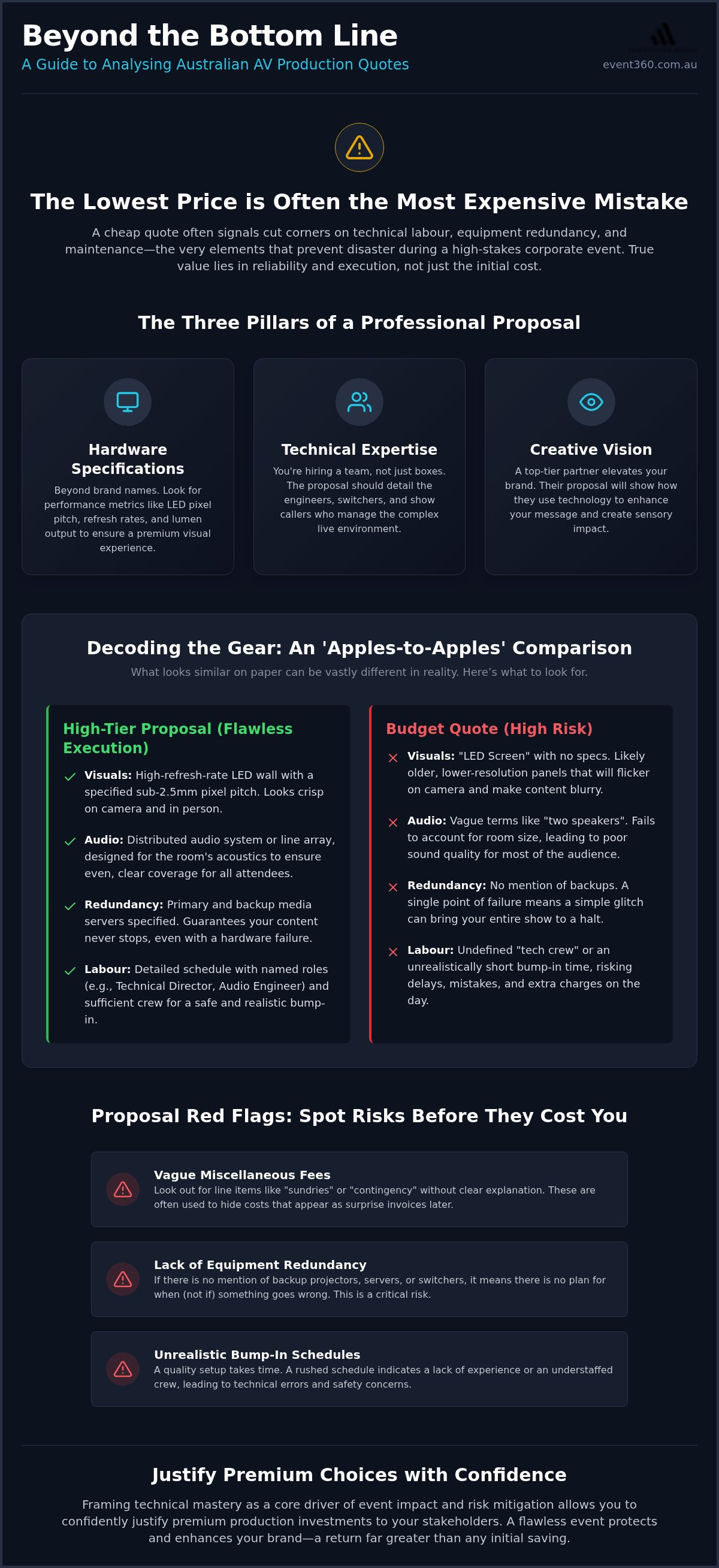
A robust proposal stands on three distinct pillars that guarantee a professional result:
Hardware Specifications: This goes beyond brand names to include performance metrics like LED refresh rates and lumen output.
Technical Expertise: You're paying for the vision switchers and audio engineers who navigate complex live environments with a "can-do" attitude.
Creative Vision: This is how the company intends to elevate your brand message through content integration and sensory impact.
You'll often see massive price gaps when comparing quotes from Australian AV companies. This usually comes down to equipment maintenance and redundancy. High-tier providers include comprehensive redundancy planning, meaning they have back-up media servers ready to go instantly. Additionally, equipment age plays a massive role. Newer, well-serviced gear costs more to maintain but fails less often. Lastly, national logistics across Australia's vast distances impact the bottom line. Transporting delicate LED panels and line-array speakers requires specialised handling and insurance to ensure everything arrives in peak condition.
Decoding the Gear: Spotting the 'Apples to Oranges' Trap
Hardware lists look identical on paper until you dig into the engineering behind them. When you are comparing quotes from Australian AV companies, the visual display specifications are the most common area for "apples to oranges" confusion. One provider might quote a generic LED screen, while another specifies a high-refresh-rate wall with a sub-2.5mm pixel pitch. In 2026, this difference is massive. A lower-quality screen will flicker on camera and blur your detailed slide decks, destroying the professional aesthetic you've worked hard to build.
It is vital to verify suppliers and their equipment maintenance logs to ensure the gear performs as promised on the day. Audio systems present a similar trap. A quote listing "two speakers" tells you nothing about sound pressure levels or even coverage. For a 500-person plenary, you don't just need volume; you need a distributed system or line array that ensures the person in the back row hears the same crisp audio as the person in the front. Technical mastery means designing for the room's acoustics, not just filling space with hardware.
Vision switching and lighting design also separate the high-tier producers from the budget hire shops. A professional backend infrastructure includes primary and backup media servers to ensure your content never stops. Lighting should move beyond a simple atmospheric wash. Dynamic stage lighting that tracks presenters and changes with the mood of the session turns a standard presentation into a memorable brand experience. If you want to see how these elements combine into a tailored production strategy, look for providers who lead with a creative solution rather than a kit list.
Visual Displays: LED Walls vs. Projectors
In 2026, the standard for corporate stages has shifted toward high-nit LED walls that can cut through high-ambient light environments. Projectors often struggle in bright ballrooms, leading to washed-out colours and poor legibility. For a deeper spec analysis on what your event requires, check out our LED Wall Hire: 2026 Buyer’s Guide for Australian Events. We break down resolution requirements that ensure your 4K content actually looks like 4K on stage.
The Hybrid Variable: Comparing Streaming Capabilities
Hybrid events are no longer just a "link only" service. When comparing quotes, look for internet redundancy and failover systems that activate instantly if the venue's primary connection drops. A fully managed interactive hub provides a far superior experience to a simple broadcast. You can find more about these benchmarks in our guide on Mastering the Digital Stage: Professional Live Streaming Services. Reliability in the digital space is non-negotiable for a modern production partner.
The Labour Factor: Analysing Bump-in, Bump-out, and Technical Mastery
Labour is the most volatile variable in any production budget. When you're comparing quotes from Australian AV companies, look beyond the equipment lists and scrutinise the crew allocations. Many providers under-quote labour to appear more competitive on paper, only to hit you with "unforeseen" overtime charges once the show is live. Conversely, some pad their quotes with generic "technician" roles that lack the specific expertise required for complex MICE events. Technical labour is the insurance policy for your event's reputation.
A high-tier production requires a symphony of specialists. You aren't just hiring "staff"; you're engaging Show Callers to manage the show's rhythm, Vision Switchers to orchestrate your LED wall content, and Audio Engineers to ensure every word is heard. Relying on "one-man-band" operators for large-scale conferences is a significant risk. If a single operator is managing audio, vision, and lighting simultaneously, they're one minor glitch away from a total system failure. Professional production houses prioritise redundancy in their human capital just as much as their hardware.
The Australian landscape presents unique challenges regarding penalty rates and overnight schedules. Many major venues require "overnight" bump-ins to accommodate tight turnaround times in 2026. If your quote doesn't explicitly account for these standard industry rates, you're likely looking at a surprise invoice after the event. Meticulous planning ensures that every crew member is fresh, focused, and ready to deliver a flawless performance without the fatigue that leads to errors.
The Invisible Backbone: Onsite Support Fees
Successful events are won in the pre-production phase. Dedicated project management is essential to bridge the gap between your creative vision and the technical execution. When evaluating a proposal, check the ratio of technicians to equipment complexity. A massive LED installation with spatial audio requires a dedicated team, not a skeleton crew. This onsite support ensures that any technical hiccups are resolved instantly, often before the audience even notices a flicker. We take a project management mindset to guide you from initial concepts to final execution.
Logistics and Venue Liaison
Every venue has its own set of technical restrictions, power limitations, and access quirks. A professional partner handles these venue liaisons on your behalf, ensuring that the "Bump-in" timeline is realistic rather than a recipe for disaster. Local venue knowledge, such as that provided by Fruitbowl Events Agency, is incredibly valuable. It helps avoid "access" surcharges and ensures the crew knows exactly where the loading docks are and how to navigate the venue's power grid. This organised authority removes friction. It allows you to focus on your stakeholders while we manage the heavy lifting.
Identifying Red Flags and Hidden Surcharges in AV Proposals
Transparency is the hallmark of a professional production partner. When comparing quotes from Australian AV companies, the presence of a large, unexplained "Miscellaneous" fee is an immediate signal to dig deeper. Every generic line item should be broken down to show exactly what you are paying for, whether it is consumables, specialised insurance, or small hardware components. Vague pricing often hides a lack of preparation or, worse, a buffer for "day-of" surprises that can blow your budget apart. To mitigate these financial risks, many organisers utilise CONFRMD to hold payments securely until all contractual obligations are fulfilled.
Redundancy gaps represent the most dangerous show-stopper in any proposal. You must ask what happens if the primary media server fails or a critical signal processor drops out mid-keynote. A professional 2026-era quote will explicitly list redundant systems for vision switching and playback. Similarly, you should verify if the company owns their equipment or if they are sub-hiring from a third party. Sub-hiring increases the risk of equipment failure and adds a layer of logistical complexity that can lead to delays. Always ensure your partner carries comprehensive Public Liability and professional indemnity insurance to protect your brand from unforeseen site incidents.
If you suspect your current proposals are hiding technical risks, you can request a transparent quote audit from our team to ensure your event is fully protected.
The Venue Commission Trap
Many Australian venues have in-house AV providers who pay high "kickback" fees to the venue for the right to be the preferred supplier. These commissions can inflate your quote by 20 percent or more without adding a single piece of extra gear to your stage. While the convenience of an in-house team is tempting, you often gain more creative freedom and technical mastery by bringing in an external partner. Be sure to ask the venue about "external provider" surcharges, as these are often negotiable if you demonstrate that your chosen partner meets all safety and insurance requirements.
Equipment Redundancy and Safety
Safety is a non-negotiable component of live production. Your quote should account for backup cables, spare LED modules, and redundant power supplies to ensure the show continues regardless of minor hardware glitches. High-tier producers prioritise the safety standards of rigging and stage hire, ensuring every overhead element is double-checked and secured. For a complete list of what to look for in a secure setup, refer to our Guide to Audio Visual Production for Impactful Events. Meticulous planning in these areas provides the peace of mind needed to focus on your audience.
Making the Final Call: Why Event 360 is the Logical Conclusion
Success on the event floor depends on a partner who stays calm when the pressure mounts. While you've spent time comparing quotes from Australian AV companies to find the best technical match, the final decision often comes down to cultural fit. You need a team that doesn't just show up with a truck of gear but arrives with a "can-do" attitude and a deep understanding of your brand's objectives. Event 360 positions itself as a dedicated ally, bridging the gap between high-stakes logistics and creative inspiration.
We believe that hardware and creative content should live under one roof. This integrated approach ensures that your LED wall isn't just a screen, but a dynamic canvas that responds perfectly to the vision switching and audio cues we've meticulously planned. By removing the friction between different suppliers, we eliminate the risk of technical silos. Transparency in our 2026 proposals isn't just a business practice; it's the foundation of a long-term partnership built on trust and predictable outcomes.
The Event 360 Difference
Our commitment to professional execution means we manage the entire technical lifecycle of your event. From the initial site inspection to the final bump-out, we provide an assertive, organised authority that gives you peace of mind. We integrate the highest Audio Visual Australia standards into every project, ensuring your MICE or corporate event is world-class. This focus on technical mastery allows us to transform a standard transaction into a journey of visual impact.
Next Steps for Your 2026 Event
Getting the most accurate quote possible starts with a detailed brief. Tell us about your audience size, your creative goals, and any venue constraints you've already identified. We'll then provide a transparent, no-obligation proposal that breaks down every line item, from LED pixel pitch to technical labour hours. You won't find any hidden "miscellaneous" fees here. We're ready to show you how a high-end producer manages complex logistics with passion and precision. Contact Event 360 for a comprehensive AV proposal today and let's start planning your most successful event yet.
Elevate Your 2026 Production Standards
Navigating the technical landscape of 2026 requires more than a keen eye for budgets; it demands a commitment to flawless execution and technical mastery. You now have the framework to identify hidden risks, from under-quoted labour to critical redundancy gaps in vision switching. High-performance LED wall solutions and specialist MICE event production aren't just line items on a spreadsheet. They're the engine room of your brand's live impact and the key to maintaining stakeholder trust during high-stakes presentations.
The process of comparing quotes from Australian AV companies should always prioritise the certainty of a successful outcome over the lure of the lowest bid. By focusing on equipment maintenance and professional onsite support, you eliminate the friction that often leads to surprise "day-of" invoices. Meticulous planning ensures your technical infrastructure acts as a seamless extension of your creative vision rather than a source of stress.
Secure your technical peace of mind with an Event 360 proposal and let us handle the complex logistics while you focus on your stakeholders. Our team is ready to bring an assertive, "can-do" energy to your next project, ensuring every detail is perfectly executed. Your vision deserves a partner who is as passionate about your success as you are.
Frequently Asked Questions
How do I know if an AV quote is too good to be true?
A quote is likely too good to be true if it omits critical technical labour or equipment redundancy. When comparing quotes from Australian AV companies, a significantly lower price often indicates that the provider isn't accounting for primary and backup media servers or is using a skeleton crew. This creates a high risk of technical failure during your live show. Always demand a line-by-line breakdown to ensure you aren't sacrificing reliability for a smaller bottom line.
What is the standard labour rate for AV technicians in Australia?
Professional audio and lighting technicians in Australia typically charge between $65 and $120 per hour in 2026. These rates often include minimum call-out periods, especially for specialised roles like show callers or vision switchers. While you might find lower rates, they usually represent less experienced staff. Investing in technical mastery ensures your event runs smoothly, as skilled engineers provide the insurance policy your brand's reputation needs during high-stakes corporate keynotes.
Should I use the in-house AV provider or an external company?
Choosing an external production house often provides greater creative freedom and technical mastery compared to in-house providers. While in-house teams offer convenience, their quotes frequently include high venue commissions that inflate costs without adding technical value. An external partner acts as a dedicated ally, focusing entirely on your brand's specific objectives. This partnership approach ensures that your LED wall solutions and audio systems are customised to your creative vision rather than a venue's standard kit.
What are the most common hidden costs in an audio-visual quote?
The most common hidden costs include venue access surcharges, power distribution fees, and technical labour penalty rates for overnight bump-ins. Many providers hide these behind a generic "Miscellaneous" line item. When comparing quotes from Australian AV companies, always ask for a breakdown of transport and rigging expenses. Professional proposals should be transparent, ensuring you don't receive surprise "day-of" invoices for essential items like backup cables, spare LED modules, or specialised insurance coverage.
Why is there a huge price difference for the same LED wall specs?
Price variance usually stems from the quality of the internal components and the maintenance standards of the panels. Two LED walls might share the same pixel pitch, but the more expensive option often features higher refresh rates and superior processing power. This prevents flickering on camera and ensures vibrant colour accuracy. Additionally, premium providers invest in regular calibration and have redundant modules ready on-site, providing the grounded reliability needed for high-resolution corporate stages in 2026.
How much should I budget for 'bump-in' and 'bump-out' labour?
You should typically allocate 15 to 25 percent of your total technical budget to bump-in and bump-out labour. This figure varies based on the complexity of your LED wall solutions and the venue's access restrictions. For 2026 events, you must also account for Australian penalty rates if your schedule requires overnight or weekend work. Meticulous planning ensures your crew has enough time to calibrate equipment properly, removing friction before your first attendee arrives.
Can I negotiate an AV quote without compromising on quality?
You can negotiate by adjusting your event's scope or timing rather than cutting essential technical labour. Reducing the number of breakout rooms or simplifying the lighting design can lower costs without risking the integrity of your main plenary session. Avoid negotiating down the cost of redundancy systems or senior engineers, as these are vital for preventing technical failures. A professional partner will work with you to find efficiencies that maintain the high-energy impact your stakeholders expect.
What technical redundancies should I look for in a professional proposal?
Look for primary and backup media servers, redundant signal processors, and uninterruptible power supplies for critical control gear. A professional proposal for 2026 should also include internet redundancy with an automatic failover system for live streaming. These "show-stoppers" ensure that if a single piece of hardware fails, a secondary system takes over instantly. This level of technical planning provides peace of mind, allowing you to focus on your content and audience.


Comments