%20(1).png)
LED Wall Solutions: The Definitive Comparison for Australian Events in 2026

What if your next event didn't just display content, but physically reshaped the atmosphere of the venue? In the fast-paced world of Australian live production, settling for a standard projection screen often feels like a missed opportunity to truly captivate your audience. Choosing the right led wall solutions shouldn't feel like a gamble against technical jargon. You want a visual setup that's sharp, vibrant, and perfectly scaled to your stage, yet the fear of a grainy image or a budget blowout on technical labour can be daunting.
We understand that you need more than just equipment; you need a technical partner who removes the friction from complex logistics. This definitive guide empowers you to move through the 2026 landscape with absolute confidence. You'll discover how to match pixel pitch to viewing distances, compare the rugged requirements of outdoor displays against high-definition indoor modules, and master a framework for evaluating technical production costs. We're here to turn your creative vision into a seamless reality, ensuring your next event is remembered as a high-impact masterpiece.
Table of Contents
LED Wall Solutions vs. Projection: Making the Right Choice for 2026
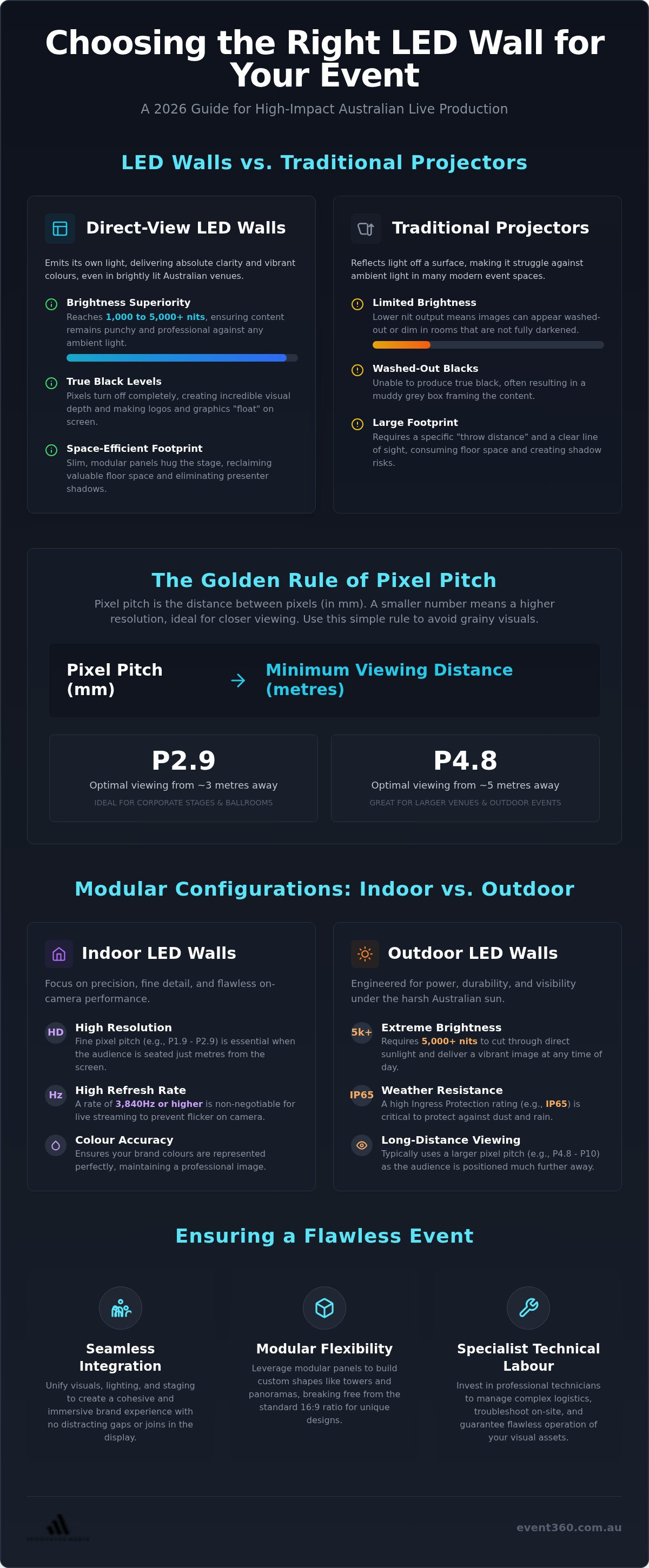
Direct-view LED technology has officially overtaken traditional projection as the primary standard for premium Australian events. While projectors served us well for decades, the move toward led wall solutions is driven by a demand for absolute clarity and reliability in high-stakes environments. Projectors rely on reflecting light off a surface, which means they are constantly fighting against the ambient light of a venue. In contrast, LED panels emit their own light, allowing your content to remain vivid even in glass-walled foyers or sun-drenched convention centres.
Brightness is measured in nits, and the difference is stark. A typical high-end projector might struggle to maintain visibility in a bright room, but LED walls easily reach 1,000 to 5,000 nits, ensuring your brand colours stay punchy and professional. Beyond brightness, LED offers superior "black levels." Since each pixel can simply turn off, you get true, deep blacks that create incredible visual depth. This is a massive win for branding; logos and graphics appear to float on the screen rather than being framed by a muddy, washed-out grey box.
The physical footprint is another significant game-changer. Projectors require a specific "throw distance," often consuming valuable floor space for a projection booth or truss. They also create the risk of presenters casting shadows on the screen when they move. LED panels are slim and modular, hugging the back of the stage to reclaim floor space for more seating or a larger stage area. To understand the core components of these setups, it's helpful to ask, What is a video wall? effectively, it's a grid of panels working as one to deliver a unified visual message.
When Projectors Still Make Sense
Projectors haven't vanished entirely. They remain a practical choice for smaller breakout rooms or low-stakes meetings where the budget is tighter and the lighting is easily controllable. Some older venues also have strict weight-loading limits on their ceilings or floors, making a lightweight projector more viable than a heavy LED array. Additionally, if your creative theme requires a "soft," cinematic look with less aggressive brightness, a high-quality projector can still deliver that specific aesthetic successfully.
The Unrivalled Impact of High-Definition Visuals
In high-ambient light corporate centres, led wall solutions are the only way to ensure your message isn't lost. The modular nature of these screens allows for a completely seamless display, removing the distracting bezels or "grid lines" seen in older multi-monitor setups. Seamless integration in this context means the precision alignment of individual LED modules to create a single, continuous digital canvas that shows no visible gaps or joins to the audience, regardless of how large the screen becomes.
Comparing Modular Configurations: Indoor, Outdoor, and Creative
The modular nature of modern led wall solutions provides an architectural flexibility that traditional displays simply cannot match. Instead of being locked into a fixed aspect ratio, event organisers can now treat visual surfaces as building blocks. This modular display screens framework allows for the creation of massive towers, ultra-wide panoramas, or even scattered digital pillars across a stage. Choosing the right configuration requires a clear understanding of the environmental demands and the physical constraints of your venue. It's about more than just size; it's about how the hardware interacts with the space and the audience.
Indoor LED Walls: Precision and Clarity
For indoor settings like hotel ballrooms or convention centres, the focus shifts to fine detail and colour accuracy. High-resolution panels are essential when your audience is seated within a few metres of the screen. Beyond resolution, the refresh rate is a critical technical specification that often gets overlooked. If you are planning a hybrid event, a high refresh rate, typically 3,840Hz or higher, is non-negotiable to prevent distracting flickering or scan lines appearing on camera. This technical precision is vital when integrating with professional live streaming services, ensuring your remote audience enjoys the same crisp visual experience as those in the room.
Outdoor LED Walls: Power and Weather-Resistance
Outdoor led wall solutions face a different set of challenges, specifically the harsh Australian elements. These panels must feature a high IP (Ingress Protection) rating, such as IP65, to remain operational during a sudden Sydney downpour or a dusty afternoon in Perth. Brightness is also a major factor; outdoor screens require at least 5,000 nits to remain legible against direct sunlight. Safety remains the ultimate priority. Large outdoor screens act like giant sails, so structural engineering and wind-loading calculations are mandatory to comply with national safety standards and ensure the stability of the entire stage setup.
Looking toward 2026, we see a surge in curved and transparent LED technology. Curved panels allow for immersive wraparound environments that draw the audience into the content, while transparent LEDs are becoming a favourite for high-end corporate launches. These creative configurations are heavy and complex, often requiring specialised rigging or reinforced stage hire to manage the weight. If you are planning a complex layout, you can explore our full range of custom configurations at event360.com.au to see how these modules can be adapted to your specific venue.
The Technical Blueprint: Pixel Pitch and Viewing Distance
Mastering the technical blueprint of your visual setup starts with one crucial metric: pixel pitch. This term refers to the distance in millimetres between the centres of two adjacent pixels. Whether you're looking at P1.5, P2.5, or P3.9, this number dictates the resolution and clarity of your display. While it's tempting to assume the smallest pitch is always the superior choice, the reality is more nuanced. Choosing the right led wall solutions requires balancing visual impact with budget efficiency, ensuring you don't pay for density that your audience can't actually see.
The "Golden Rule" of LED design is simple: the pixel pitch in millimetres translates directly to the minimum viewing distance in metres. For example, a P2.5 screen is designed to look crisp from 2.5 metres away. If your front-row guests are 10 metres from the stage, opting for an ultra-fine P1.5 panel is an unnecessary expense that adds no visible value to the attendee experience. The density of the screen should always be dictated by your audience layout; a sprawling gala dinner requires different specifications than an intimate executive boardroom where guests are seated close to the stage.
Calculating Your Ideal Resolution
Your content type is the second major factor in this equation. If your presentation relies on detailed spreadsheets or small text, you need a tighter pitch to maintain legibility across the room. However, for high-energy video playback or abstract motion graphics, a slightly larger pitch often provides a more cost-effective way to achieve massive scale without compromising the "wow" factor. It's about finding the sweet spot where pixel count meets physical dimensions. In the current market, P2.5 has firmly established itself as the corporate event standard because it offers the perfect equilibrium between high-definition clarity and technical reliability for the vast majority of Australian ballroom venues.
Viewing Angles and Audience Experience
Visual comfort isn't just about resolution; it's about the viewing experience from every seat in the house. Modern led wall solutions offer wide viewing angles, typically around 140 to 160 degrees, which means guests at the far edges of the room still see vibrant colours without distortion. However, if you're capturing the event for a digital broadcast, you must consider the "Moire effect." This occurs when the camera's sensor conflicts with the LED's pixel grid, creating distracting wavy patterns on screen. To prevent these common live streaming mistakes, we recommend testing your camera's focal depth and positioning during the bump-in phase to ensure a flawless visual output for both in-person and remote viewers.
Integrating Visuals with Stage and Lighting Design
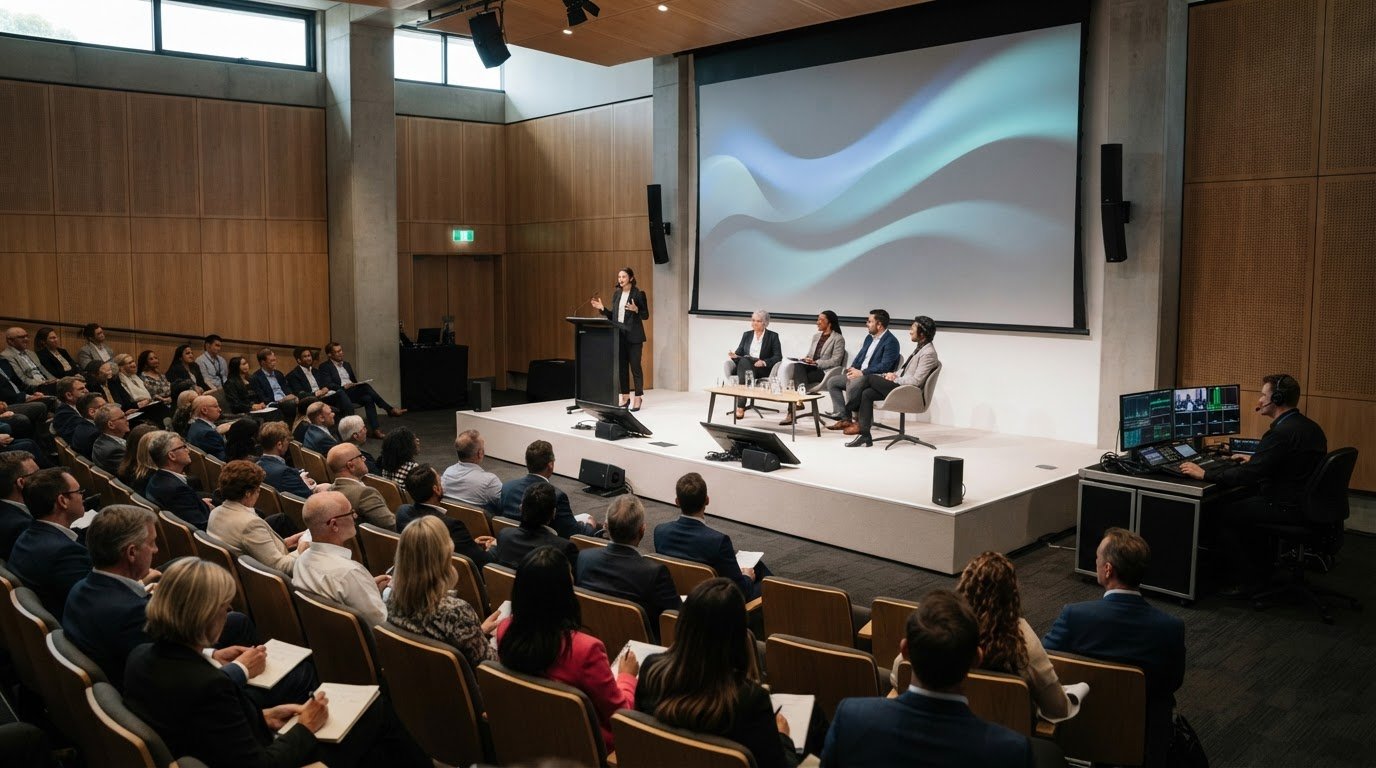
LED walls aren't just standalone screens; they're massive light sources that fundamentally change how you approach event lighting. If your screen is too bright, it'll wash out your stage wash; if it's too dim, the visuals look flat against the room's ambience. Managing "light spill" is essential to maintain the mood of the room and ensure your speakers aren't lost in a digital glow. We treat creative content as a digital extension of the physical stage architecture, transforming a flat surface into a dynamic, multi-dimensional environment that enhances every presentation.
Staging Solutions for LED Walls
LED panels carry significant weight, and a large-scale display can easily exceed 800kg. You've got to ensure your stage hire is rated for these specific loads to prevent structural failure. We offer two primary setups: ground-stacked and flown. Ground-stacking is effective for quick setups in ballrooms, where the wall is built directly on the stage. Flown configurations suspend the wall from rigging points, which opens up floor space and creates a cleaner, more professional look. Both require strict safety protocols, including licensed riggers who follow the National Construction Code (NCC) and the WHS Act 2011 to ensure every modular tower is secure. For a truly immersive feel, we often integrate LED tiles into the stage floor itself, creating 3D effects that make the digital content feel like a physical part of the room.
Content Synchronisation and Calibration
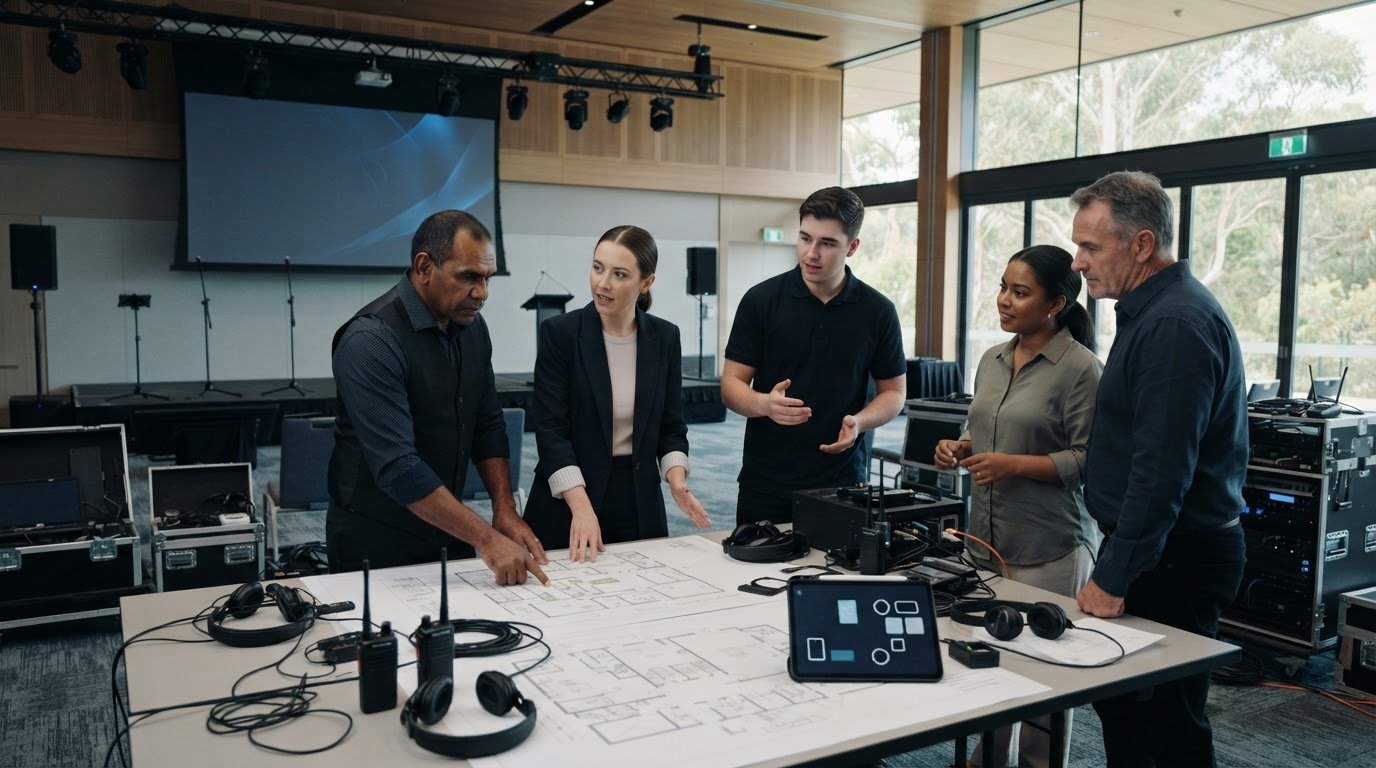
High-resolution visuals need serious processing power behind the scenes. Professional media servers are vital for handling large files without stuttering or lag during a live show. We also focus on meticulous colour balancing across every modular panel. If one panel is even slightly off-shade, your brand consistency suffers and the illusion of a single screen is broken. Our technical labour team manages these nuances in real-time, handling content switching and live adjustments so you don't have to worry about the logistics. This level of precision ensures your visual narrative remains flawless from the first slide to the final curtain.
Ready to build a digital stage that captivates your audience? Partner with Event 360 Pty Ltd for integrated led wall solutions that bring your creative vision to life with technical mastery.
Maximising ROI with Professional Technical Production
Investing in high-end hardware is a logical first step, but equipment hire represents only 50% of the visual success equation. The true return on investment for led wall solutions comes from the technical mastery that happens behind the scenes. You don't just need panels; you need a technical production partner who understands signal flow, power distribution, and the high-pressure environment of a live show. Onsite technical labour is your insurance policy against the unexpected, providing real-time troubleshooting and meticulous operation that ensures your content remains flawless from the opening keynote to the final wrap-up.
When you look to evaluate audio visual companies, look beyond the inventory list. A company's production track record for high-stakes Australian events tells a more compelling story than their spec sheets. You need a team that can manage the technical "heavy lifting" while you focus on your guests. To prepare for a successful 2026 season, use this final checklist before signing your contract:
Pixel Pitch Verification: Ensure the density matches your audience's closest viewing point as discussed in our technical blueprint.
Weight and Rigging: Confirm the venue has approved the structural load for ground-stacked or flown towers.
Redundancy Planning: Check that your provider has backup signal processors and spare modules onsite.
Labour Allocation: Verify that dedicated technicians will be present for the duration of the live event.
The Event 360 "Can-Do" Approach
Our commitment is built on removing friction from the technical planning phase. We operate with a national footprint across Australia, delivering consistent production quality whether you're hosting a corporate MICE event in Brisbane or a major product launch in Perth. We don't just provide gear; we build customised AV packages that integrate seamlessly with your creative vision. Our team takes an assertive, solution-oriented stance on every project, ensuring that complex logistics never stand in the way of your event's impact.
Securing Your Date for 2026
The Australian LED display market is entering a period of rapid expansion, with a projected growth rate of 10.94% according to IMARC Group, which means lead times for complex modular installations are tightening. Early collaboration between your creative and technical teams is the best way to ensure your vision is both spectacular and technically viable. By engaging with us early in the concept phase, we can help you navigate venue restrictions and optimise your budget for maximum visual punch. Don't leave your technical success to the last minute. Organise your LED wall solution with Event 360 today and let our experts handle the intricate details of your next visual masterpiece.
Take Command of Your Event's Visual Identity
Mastering the 2026 event landscape requires more than just high-end gear; it demands a strategic alignment of technology, environment, and expertise. You've seen how the right pixel pitch ensures clarity from the front row to the back of the room, and how modular led wall solutions can physically transform a standard stage into a vibrant, immersive masterpiece. Success isn't just about the brightness of the screen, but the seamless integration of that screen with your lighting, staging, and creative content.
By focusing on the technical "heavy lifting" and the value of specialised onsite labour, you remove the friction that often plagues complex live productions. Whether you are planning a corporate gala or a national tour, having a technical partner with a "can-do" attitude makes all the difference. Event 360 provides national Australian service coverage and expert support to ensure every module is perfectly calibrated and integrated. Partner with Event 360 for high-impact LED wall solutions and let us turn your ambitious creative vision into a flawless reality. Your audience is waiting for something spectacular. Let's build it together.
Frequently Asked Questions
What is the difference between indoor and outdoor LED wall solutions?
Outdoor led wall solutions are engineered with high IP ratings, typically IP65, to withstand Australian rain and dust while offering brightness levels above 5,000 nits to compete with direct sunlight. Indoor panels focus on a much tighter pixel pitch for close-up viewing and don't require heavy weatherproofing. This means indoor screens deliver superior colour depth for ballrooms, whereas outdoor screens prioritise durability and sheer luminous power for festivals or large-scale public activations.
How much does it cost to hire an LED wall for a corporate event in Australia?
Pricing for hiring led wall solutions depends on several variables, including the screen's total square metreage, the pixel pitch required for clarity, and the duration of your event. You must also factor in specialised technical labour for setup and live operation. Since every venue in Australia has unique rigging and power constraints, we recommend requesting a tailored quote that accounts for your specific stage layout and technical production needs.
Does the pixel pitch really matter for a large conference stage?
Pixel pitch is vital because it determines how sharp your content appears to the front row. For a large conference stage where the audience is seated several metres away, a P2.5 or P3.9 pitch often provides the best balance of quality and value. However, if your presentation includes detailed data or small text, a tighter pitch ensures every guest can read the screen without seeing individual pixels, maintaining a professional and high-definition aesthetic.
Can LED walls be used for hybrid events and live streaming?
LED walls are excellent for hybrid events, provided you use panels with a high refresh rate, typically 3,840Hz or above. This prevents the scan lines or flickering that cameras often pick up, ensuring a clean signal for your remote audience. We also focus on colour calibration to match the screen's output with your studio lighting, creating a seamless visual environment that looks just as impressive on a laptop screen as it does in the room.
What technical support is included with an LED wall hire?
Every hire includes specialised technical labour to manage the end-to-end delivery of your visual assets. Our team handles the initial site inspection, structural rigging, and pixel-perfect calibration before the show begins. During the event, a dedicated technician remains onsite to manage content switching and live troubleshooting. This comprehensive support removes the friction of managing complex logistics, allowing you to focus entirely on your presenters and guests.
How long does it take to install a modular LED video wall?
Installation times vary based on the scale and complexity of the configuration. A standard ground-stacked wall for a corporate ballroom can usually be built and calibrated in four to six hours. Larger, flown configurations that require complex rigging and weight-loading assessments may take a full day to install safely. We always include a detailed bump-in schedule in our project management plan to ensure the screen is fully operational well before your first rehearsal.
What are the power requirements for a large-scale LED display?
Large-scale LED displays have significant power demands that usually exceed standard wall outlets. Smaller setups might run on multiple 10-amp circuits, but most professional configurations require 3-phase power to ensure a stable and safe electricity supply. We conduct a thorough power assessment during the planning phase to determine if your venue has the necessary infrastructure or if we need to organise additional distribution boards to support the equipment safely.
Can I create custom shapes like curved or circular LED walls?
Modern modular panels allow us to create a wide range of creative configurations, including curved and angled designs. By using specialised hardware, we can build concave or convex screens that wrap around a stage or follow the architectural curves of a venue. While perfectly circular walls are more complex, we can achieve a similar effect using faceted modular sections, providing a high-impact visual centrepiece that breaks away from the traditional rectangular format.
Comments