
Mastering Hybrid Event AV: A Professional 2026 Guide

A hybrid event is no longer just a physical meeting with a webcam at the back of the room; it's a high-stakes broadcast where your remote audience is just as vital as the one sitting in the front row. If your hybrid event AV setup treats digital attendees as an afterthought, you're not just losing engagement, you're risking your brand's reputation. We agree that nothing drains the energy of a room faster than audio lag or remote participants feeling like second-class citizens while they struggle to hear the main stage.
It's a daunting task to synchronise these two distinct environments, but it doesn't have to be a source of stress. This guide reveals the essential technical framework required to deliver a seamless, broadcast-grade experience that keeps both audiences locked in. From 2026 bandwidth standards for 4K streaming to sophisticated audio mix-minus routing, we'll walk you through the professional strategies that turn technical complexity into a flawless, high-energy production.
Table of Contents
The 2026 Hybrid Event Landscape: Beyond the Basic Stream
The corporate event environment has moved far beyond the "set and forget" livestream. Today, a professional hybrid event AV setup isn't just an add-on; it's the core architecture of a dual-audience strategy. We see a clear shift toward "Experience Equity," where the value delivered to a remote participant matches the energy felt by those on-site. If your digital feed is just a static wide shot of a stage, you're missing the mark. High-end production now requires a broadcast-grade approach that protects your brand reputation by delivering a polished, glitch-free performance to every screen, regardless of location.
Adopting a sophisticated hybrid event model allows organisations to scale their reach across Australia without sacrificing the intimacy of a live gathering. This model demands a technical framework that treats the camera as a primary guest, not just a passive observer. It requires a proactive mindset that anticipates the needs of two distinct groups simultaneously.
The Two-Audience Philosophy
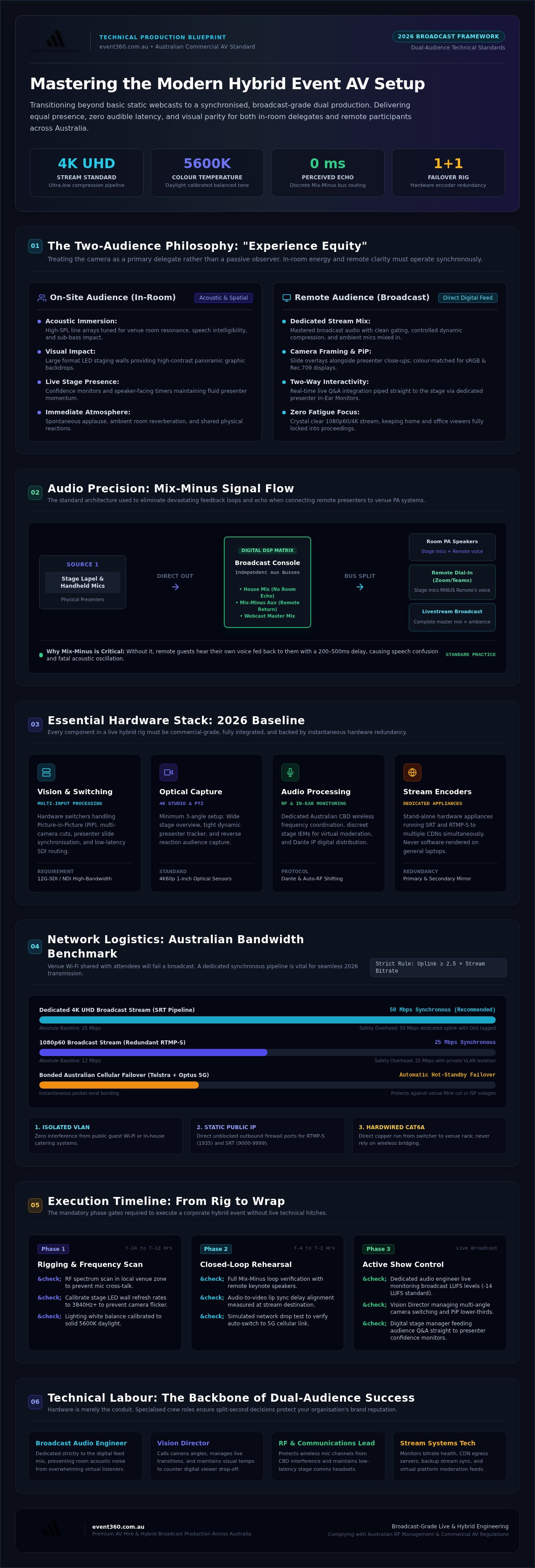
Designing for two audiences means balancing the physical room's impact with the digital viewer's clarity. On-site, your LED walls provide a vibrant backdrop, but on the stream, those same visuals must be colour-corrected and framed for the lens to avoid visual distortion. Audio is even more critical. While the in-room PA system focuses on acoustic coverage, the remote feed requires a dedicated broadcast mix. This separate mix ensures that every speaker is crisp, background noise is suppressed, and the digital audience feels immersed in the room's atmosphere rather than just listening from a distance. We focus on creating a unified atmosphere where the digital and physical spaces feel like one cohesive environment.
Key Objectives for Technical Success
Reliability is the currency of live production. We aim for zero-latency communication, ensuring that when a remote participant asks a question, the interaction with the on-stage speaker is instantaneous. This eliminates the awkward delays that stall momentum and frustrate viewers. Redundancy is your insurance policy. Every critical component of your hybrid event AV setup, from your internet uplink to your vision switchers, needs a fail-safe backup. This "fail-safe" approach ensures the show goes on even if a primary system falters. The hybrid bridge is the technical link that synchronises these two worlds, turning separate audiences into a single, engaged community.
Essential Hardware for a Hybrid Event AV Setup
Achieving a flawless broadcast requires a meticulous selection of hardware that bridges the gap between the physical stage and the digital screen. A professional hybrid event AV setup relies on an integrated ecosystem where every component is chosen for its ability to perform under the pressure of a live environment. We don't just supply gear; we engineer a solution that eliminates technical friction and ensures your message lands with impact across every platform.
Vision and Display Requirements
High-definition vision is the cornerstone of digital engagement. By 2026, 4K cameras have become the non-negotiable baseline for corporate productions, providing the crisp detail necessary for viewers on high-resolution monitors at home. Utilising multi-camera setups allows for dynamic shot changes that keep the digital audience's attention focused. Integrating LED wall hire into your stage design creates a vibrant, high-contrast backdrop that looks just as stunning on camera as it does in person. Modern vision switchers handle the heavy lifting, managing complex Picture-in-Picture feeds that overlay presentation slides with live speaker shots.
Audio Precision for Dual Audiences
Audio is the most common point of failure in a hybrid event AV setup, yet it's the most critical for attendee retention. We implement mix-minus audio routing as a standard practice to prevent the dreaded echo that occurs when remote speakers hear their own voice delayed through the house speakers. This precision requires a dedicated broadcast audio engineer who manages the stream's levels independently of the room's PA system. Managing wireless microphone frequencies is equally vital to avoid signal interference in dense Australian CBD environments. We often equip presenters with in-ear monitoring, allowing them to hear questions from remote participants directly without the need for loud floor monitors.
Lighting must serve two masters. We balance stage visibility for the physical crowd with camera-ready colour temperatures, typically aiming for a consistent 5600K daylight balance to ensure skin tones look natural on screen. Finally, your encoding hardware acts as the gateway. Using dedicated hardware encoders rather than just software ensures a stable, high-bitrate stream that can handle the 10-25 Mbps upload requirements for a smooth 4K broadcast. For more technical insights, you can consult the AVIXA guide to hybrid event production. If you're ready to elevate your next production, our team can help you design a bespoke technical plan.
The Digital Bridge: Connectivity and Interaction
High-spec hardware is only half the battle. The true success of your hybrid event AV setup hinges on the digital bridge: the robust network and interaction layer that binds your physical venue to the global cloud. Without a rock-solid data backbone, even the most expensive 4K cameras will stutter and fail. We treat connectivity as a mission-critical utility, ensuring that every byte of data moves with surgical precision between your on-site speakers and remote participants.
Mission-Critical Connectivity
Never trust shared venue Wi-Fi. For a professional broadcast, we secure dedicated, symmetrical fibre lines with committed bandwidth. In 2026, the standard for a stable 4K stream requires at least 25 Mbps of sustained upload speed. If you're bringing remote presenters onto the main stage LED screens via bidirectional video, that requirement jumps to 50 Mbps or more to ensure hitless performance. Reliability is non-negotiable; therefore, we always deploy a primary line alongside a secondary failover path, such as Low Earth Orbit (LEO) satellite feeds or bonded cellular routers. This dual-path architecture provides the peace of mind that your event stays live even if the venue's primary connection falters. Cybersecurity also takes centre stage, with encrypted media streams and isolated Production VLANs protecting your corporate data from external interference.
Interactive Audience Engagement
Choosing the right platform is the heart of your hybrid event AV setup. We use advanced tools like vMix or Zoom ISO to pull individual remote participants into the broadcast mix, making them feel like they're physically present. A "Virtual Green Room" is essential for briefing remote speakers before they go live, ensuring their audio levels and lighting are perfect. This professional staging area removes the friction of "can you hear me?" moments on the main stage, allowing for a seamless transition into the live programme.
Engagement is a two-way street. We visualise the remote audience for in-person speakers by using "foldback" confidence monitors, allowing them to see digital faces and read real-time chat upvotes. This Harvard Business Review analysis on hybrid engagement suggests that equalising the experience is key to avoiding participant bias. Professional live streaming services have evolved to include gamification, transforming passive viewing into a competitive, high-energy experience through live polling and interactive challenges. By synchronising these elements, you create an environment where every attendee feels like a first-class citizen.
Step-by-Step Checklist: Planning Your Technical Execution
Execution is where the theory of production meets the reality of the venue floor. A successful hybrid event AV setup requires a rigorous project management mindset that starts months before the first guest arrives. We treat every event as a unique technical puzzle, mapping out every cable path and vision cue to eliminate guesswork. By following a structured progression from audit to rehearsal, you turn a complex list of requirements into a polished, high-energy performance that feels effortless to your audience.
The Pre-Production Phase
Success begins with a comprehensive venue technical audit. We assess power distribution, rigging points, and data availability to ensure the space can support your creative vision. Conducting a site inspection with your audio visual production partner is the best way to identify potential bottlenecks early. You should coordinate with venue IT departments at least 6 to 12 weeks in advance to secure firewall clearances and dedicated IP addresses for your encoders. This phase also involves finalising all creative content, from digital lectern graphics to video stings, ensuring they're formatted correctly for both the on-site LED walls and the digital broadcast.
Onsite Setup and Testing
Once on-site, the load-in and rig-check must be methodical and disciplined. We manage the physical build with precision, ensuring all vision and audio paths are secure and redundant. The "Stress Test" is our non-negotiable standard for reliability. We push the stream to its limits by running a full rehearsal with all feeds active, testing the primary and backup internet lines simultaneously to ensure hitless failover. Presenter briefings are equally vital. We walk every speaker through the dual-audience setup, showing them where to look for the camera and how to interact with the remote audience via the stage foldback monitors. This hands-on guidance provides the confidence they need to deliver a stellar performance.
A detailed 'Run of Show' acts as the technical bible for the production. It lists every cue, from lighting transitions to remote participant transitions, ensuring the entire crew is perfectly synchronised. Don't overlook post-event media; we capture high-quality recordings of every camera feed. This allows you to produce polished, on-demand content that extends the life of your event. If you want to ensure your next project is handled with this level of meticulous care, you can enquire about our national production services today.
Why Technical Labour is the Backbone of Your Event
While high-end hardware provides the foundation, it's the technical labour that breathes life into a complex hybrid event AV setup. You can hire the most expensive 4K cameras and LED walls in Australia, but without a skilled crew, they're merely static assets. We view our technical team as the "invisible experts" who ensure reliability and remove friction, allowing you to focus on your presenters rather than the patch panel. In the high-stakes environment of live production, onsite support fees aren't just a line item; they're an investment in event insurance.
The Technical Director (TD) acts as the conductor of this digital orchestra, synchronising the hybrid experience in real time. They manage the flow between the physical room and the digital stream, ensuring every transition is frame-perfect. When the unexpected happens, such as a remote presenter's home connection dropping, it's the expert technicians who handle live troubleshooting before the audience even notices a glitch. This "can-do" attitude is the hallmark of our approach to managing complex logistics for every hybrid event AV setup we produce.
The Essential Technical Team
A professional broadcast requires specialised roles working in perfect harmony. The Vision Mixer is your visual storyteller, cutting between multi-cam feeds to create a dynamic experience for the remote audience that feels like a television production. Meanwhile, the Audio Engineer manages the delicate balance of the house PA and the broadcast mix, ensuring crystal-clear sound for all participants without the risk of feedback or echo. Finally, the Stream Tech remains glued to the monitoring station, tracking encoding health and connectivity to ensure your dedicated uplink remains stable throughout the day.
Partnering for Peace of Mind
Choosing an end-to-end production partner provides a layer of organised authority that fragmented hire simply cannot match. Leading audio visual australia providers add immense value through deep localised knowledge of major venues, understanding the nuances of house rigging and data drops. This expertise allows us to tailor every setup to the specific venue and client needs, providing a sense of order and predictability. By centralising your production, you eliminate the risk of communication gaps between different vendors and ensure a unified creative vision.
We're passionate about turning initial concepts into flawless execution. Our goal is to provide technical peace of mind through expert partnership and meticulous attention to detail. If you're ready to secure a seamless experience for your next gathering, organise a technical consultation with the Event 360 Pty Ltd team today.
Elevate Your Vision for 2026
Success in the modern landscape means moving beyond the basic stream and embracing a dual-audience strategy. Mastering a professional hybrid event AV setup requires a meticulous blend of broadcast-grade hardware, redundant connectivity, and a project management mindset. By focusing on experience equity and technical reliability, you ensure your message carries the same weight for a remote participant as it does for those in the front row.
Event 360 is your dedicated ally in this high-stakes environment. We combine expert MICE specialisation with national corporate coverage to remove the friction from your live production. With our dedicated onsite technical support and bespoke creative content, you can lead your event with total confidence and peace of mind. We're ready to turn your complex logistics into a seamless, high-energy success that reflects your brand's ambition.
Secure your technical success with Event 360’s hybrid production services. Let's work together to create a transformative experience that inspires your audience, no matter where they're watching.
Frequently Asked Questions
What is the difference between a live stream and a professional hybrid event AV setup?
A live stream is typically a one-way broadcast, while a professional hybrid event AV setup creates a bidirectional ecosystem for two distinct audiences. The difference lies in the interaction layer. We use specialised vision switchers and mix-minus audio routing to ensure remote guests can speak to the room in real time. This approach treats the digital audience as first-class citizens, providing them with a high-energy experience that mirrors the physical event's atmosphere.
How much internet bandwidth is required for a 4K hybrid event in 2026?
For a stable 4K broadcast in 2026, we require a dedicated, hardwired upload speed of at least 25 Mbps. If your production involves bidirectional video feeds for remote presenters, we recommend a symmetrical connection with at least 50 Mbps of headroom. We never rely on shared guest Wi-Fi. Our team secures dedicated fibre lines and always deploys a secondary failover path, such as LEO satellite or bonded cellular, to ensure your broadcast remains uninterrupted.
Can we use the venue's existing in-house AV for a hybrid conference?
In-house venue AV is often designed for basic presentations rather than complex broadcasts. While we can sometimes integrate with house speakers, we typically bring in our own broadcast-grade vision mixers, 4K cameras, and encoding hardware. This allows our technicians to maintain total control over the signal chain. Supplementing venue gear with a specialised hybrid event AV setup is the only way to guarantee the professional, glitch-free results that corporate brands expect.
What happens if the internet connection drops during our live stream?
We eliminate the risk of a total broadcast failure by using hitless automated failover systems. Our technical framework includes a primary fibre line and a secondary backup, such as a bonded cellular router. If the primary connection falters, the system switches paths instantly without dropping the stream. We also record all camera feeds locally at the venue. This ensures you have a high-definition master copy available for on-demand content, regardless of any external internet fluctuations.
How do we ensure remote speakers can interact with the in-person audience without delay?
Synchronised interaction requires low-latency protocols and dedicated stage hardware. We provide presenters with in-ear monitors and "foldback" screens so they can see and hear remote participants without the delay associated with standard web conferencing. Our technicians manage a "Virtual Green Room" to test remote connections before talent goes live. This meticulous preparation ensures that conversations between the stage and the digital world happen naturally, maintaining the event's momentum and professional energy.
What are the most common technical mistakes made during hybrid events?
The most common mistakes are relying on shared venue internet and neglecting a dedicated broadcast audio mix. Many organisers assume the room's sound is sufficient for the stream, but remote viewers need a specific mix stripped of echoes and background noise. Poor lighting for the camera and skipping a full "stress test" rehearsal are also frequent pitfalls. We avoid these issues by conducting a rigorous technical audit and treating the digital experience with the same priority as the physical one.
How many technicians are typically required for a standard hybrid setup?
A standard professional production typically requires a team of four specialised technicians to ensure a flawless execution. This crew includes a Technical Director to lead the programme, a Vision Mixer for the multi-cam story, a Broadcast Audio Engineer, and a Stream Technician to monitor connectivity health. For larger MICE events involving complex LED walls or multiple breakout rooms, we scale our technical labour accordingly. Having the right experts onsite provides the peace of mind that every detail is managed.
Does Event 360 provide the streaming platform, or do we need our own?
We are platform-agnostic and can broadcast to Zoom, YouTube, or any bespoke event hub you prefer. Our role is to provide the professional encoding hardware and technical labour required to push high-quality signals to these destinations. We handle the complex routing and integration using tools like vMix or Zoom ISO, allowing you to use the interface your audience is most comfortable with. We focus on the technical execution so you can focus on your content.


Comments