
Mastering Stage and Lighting: A Guide to Integrated Event Production in 2026
- Shanaka Tennekoon
- Aug 6
- 12 min read

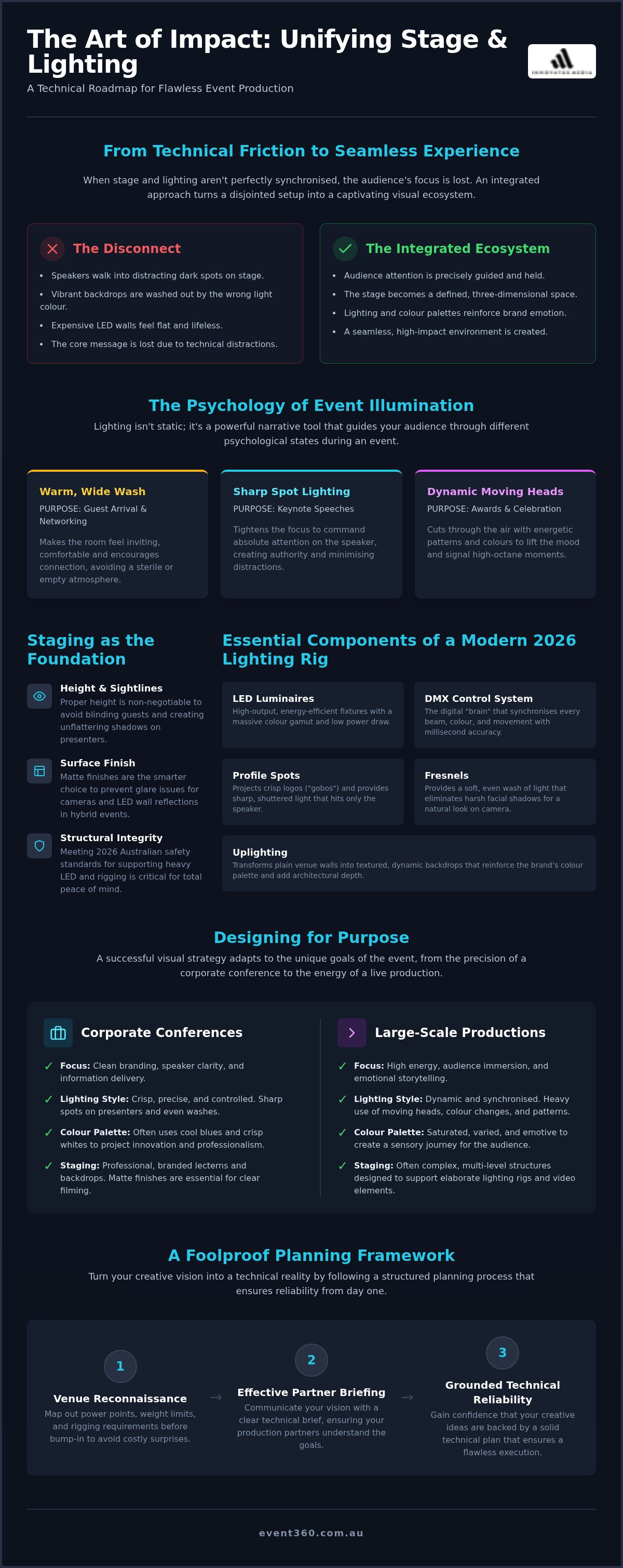
Your stage and lighting shouldn't be treated as separate line items on a budget sheet; they are a singular, living ecosystem that defines whether your audience leans in or switches off. When these two elements aren't perfectly synced, even the most expensive LED walls can feel flat or disjointed. We've all felt that knot in the stomach when a speaker walks into a dark spot or a vibrant backdrop washes out under the wrong colour of light. It's frustrating to invest heavily in production only to see technical friction distract from your core message.
This guide shows you how to bridge that gap, ensuring your next event delivers a seamless, high-impact environment that captivates every guest. You'll learn how to synchronise visuals with structural design, avoid costly equipment mistakes for your venue size, and build a foolproof framework for briefing your production partners. From MICE events to large-scale touring productions, we're giving you the technical roadmap to turn complex logistics into a polished, professional reality that offers total peace of mind.
Table of Contents
Why Integrated Stage and Lighting is Critical for Event Impact
Integrated stage and lighting design is the strategic fusion of physical architecture and optical energy. It's the difference between a standard presentation and a high-impact performance. When these elements work in harmony, they create a visual roadmap for your audience. This synchronisation tells your guests exactly where to look and how to feel without a single word being spoken. It transforms a hollow room into a curated environment where every shadow and beam of light serves a specific purpose.
High-stakes MICE events often fall victim to "Empty Stage Syndrome". This occurs when a brilliant speaker stands on a platform that lacks visual framing. Without proper backlighting or textured backgrounds, the speaker looks like a flat cutout against a dark void. This visual disconnect makes it harder for the audience to stay engaged. Professional integration ensures the stage feels like a defined, three-dimensional space that anchors the speaker and gives them the authority they deserve.
Your lighting colour palette dictates the emotional register of your corporate brand. Cool blues and crisp whites project a sense of innovation and precision. Conversely, amber washes create a space for intimate, collaborative storytelling. By layering these hues and using shadows to create depth, you add a sophisticated quality that keeps eyes glued to the front of the room. It's about moving beyond simple visibility to create a sensory journey that lingers long after the final slide.
The Psychology of Event Illumination
Lighting isn't static; it's a powerful narrative tool. Start with a warm, wide wash during guest arrival to make the room feel inviting rather than sterile. As the keynote begins, tighten the focus with sharp spot lighting to command absolute attention. To lift the energy during an awards segment, introduce moving heads that cut through the air with dynamic patterns. These transitions guide the audience through different psychological states, moving them seamlessly from relaxed networking to high-octane celebration.
To ensure your entertainment matches this visual energy during the party phase, you can discover The R Factor for a premium live band experience.
Staging as the Foundation
The physical platform is the canvas for your stage and lighting setup. Stage height and sightlines are non-negotiable factors that dictate your lighting angles. If the stage is too low, your lights might end up blinding the front row. If it's too high, you'll struggle with unflattering shadows on the presenter's face. Choose your stage finish wisely; a high-gloss black finish looks stunning but creates significant glare issues for cameras and LED wall reflections. Matte finishes are often the smarter choice for professional filming and hybrid events. Finally, always prioritise structural integrity. With 2026 Australian safety standards for temporary structures becoming more rigorous, ensuring your stage can support heavy LED installations and overhead rigging is critical for total peace of mind.
Essential Components of a Modern 2026 Lighting Rig
Building a world-class stage and lighting rig in 2026 requires a shift from simply "illuminating a space" to mastering digital precision. The Australian event industry has moved decisively toward high-output, energy-efficient LED luminaires. These fixtures offer a massive colour gamut and significantly lower power draw, allowing for more ambitious designs even in venues with limited electrical infrastructure. This evolution isn't just about brightness; it's about the granular control that modern technology provides to event organisers.
The nervous system of this setup is the DMX control system. This digital protocol acts as the brain, synchronising every beam, colour change, and movement across the stage. In a professional environment, DMX allows your technical team to pre-programme complex sequences that trigger with millisecond accuracy. This level of automation removes the risk of human error during live cues, ensuring your production remains polished and predictable from the first second to the final applause.
Key Lighting Fixtures for Every Event
Precision matters when selecting your toolkit. Profile spots are essential for projecting crisp logos or "gobos" and providing sharp, shuttered light that hits only the speaker, not the screen behind them. For a natural look on camera, Fresnels provide a soft, even wash that eliminates harsh shadows on faces. To add architectural depth, strategically placed uplighting can transform a plain venue wall into a textured backdrop that reinforces your brand’s colour palette. If you want to ensure your event has that high-end finish, partnering with an expert in audio visual production can help you select the exact mix for your venue size.
A major gap in traditional planning is failing to account for how screens interact with the rig. When you opt for led video wall hire, you aren't just adding a display; you're introducing a massive, dynamic light source. The ambient spill from a high-brightness LED wall can wash out your stage lights if they aren't balanced correctly. Modern rigs treat the LED wall as a primary luminaire, adjusting the colour temperature of the stage spots to match the digital content for a cohesive, professional appearance.
Rigging and Technical Safety
Safety is non-negotiable. Every overhead lighting array depends on the structural integrity of the trussing and rigging. Australian safety standards for temporary installations in 2026 require rigorous load-bearing calculations for every point. Your production partner must account for the combined weight of luminaires, cabling, and LED panels. Clean cable management is also vital; every line must be loomed and secured to prevent trip hazards and maintain a professional aesthetic. This methodical approach to logistics ensures that the creative vision is always supported by grounded, reliable engineering.
Designing for Purpose: Corporate Conferences vs. Concert Staging
Every event has its own unique heartbeat. A corporate summit demands a completely different visual language than a high-energy touring concert. Mastering the stage and lighting for these distinct environments requires a deep understanding of audience psychology and technical precision. It's about choosing the right tools to either fade into the background or take centre stage as a primary storyteller. When these elements are misaligned, the audience feels a subconscious disconnect that can undermine your entire message.
The Corporate Stage: Precision and Branding
Corporate environments prioritise clarity, authority, and professional polish. When we handle MICE event specialisation, the goal is to reinforce brand identity through clean, minimalist lines. We often use gobo projectors to cast sharp company logos across the stage floor or backdrops, turning structural elements into subtle branding opportunities. Lighting must be "broadcast quality" to ensure presenters look their best for live streaming and recording. This means avoiding unflattering shadows and ensuring even coverage across the entire speaking area. Minimalist staging keeps the audience focused on the data-heavy content, ensuring the message isn't lost in visual clutter.
The Concert Stage: Dynamic Visual Storytelling
Concert and touring production is about movement and high-contrast energy. Here, the stage and lighting design becomes a performance in its own right. We synchronise lighting cues with music and creative content, using moving heads and high-intensity strobes to drive the emotional tempo of the show. Haze and smoke effects are essential tools in this space; they provide a medium for light beams to become visible in the air, creating a tangible and immersive atmosphere. Modular staging allows for multi-level performance areas, giving artists the space to move and engage with the crowd from different heights and angles.
Adapting your audio visual production to the venue size is where technical mastery really shines. In a small ballroom, you might use compact LED pars and a low-profile stage to keep the space feeling open and accessible. In a massive exhibition centre, you need high-output luminaires and expansive trussing to fill the volume. Hybrid events add another layer of complexity. You must balance the in-room experience with the camera's specific needs. What looks vibrant to the naked eye can sometimes look washed out on screen. Calibrating brightness and colour temperature for both audiences is essential for a professional finish that offers total peace of mind.
How to Plan Your Stage and Lighting: A Step-by-Step Guide
Successful production starts long before the first truck arrives at the loading dock. It's about shifting from the "what" to the "why". Before selecting a single fixture, define the emotional takeaway for your guests. Are you aiming for an intimate fireside chat or a high-velocity product launch? Once the mood is set, you can begin the methodical process of mapping out your stage and lighting requirements to ensure every technical choice supports your creative goal.
Venue reconnaissance is your insurance policy against last-minute technical glitches. You need to physically map ceiling heights, rigging points, and the exact location of power distribution boards. This data feeds into your technical sketch, a visual blueprint that shows exactly where every platform sits and where every beam will strike. This level of foresight eliminates guesswork, ensuring that the structural design never compromises the visual impact or audience sightlines.
Step 1: Venue and Power Assessment
Calculating total power draw is a critical safety step that many organisers overlook. While modern LED rigs are remarkably efficient, high-output screens and complex moving heads still require a stable, calculated supply to avoid tripped breakers. Identifying "dead spots" in the venue early allows you to plan for additional fill light, ensuring no speaker is left in the dark. Always confirm access times with the venue manager; a tight "bump-in" window requires a larger, more coordinated technical crew to maintain your schedule without compromising quality.
Step 2: Coordinating Visual Assets
Your lighting should never fight your digital content. Aligning your colour palette with the event lighting strategy ensures that on-screen graphics and stage washes feel like a single, cohesive unit. Brief your technical team on the run-of-sheet, highlighting key transitions where the energy needs to shift. If you're integrating LED walls, selecting the right pixel pitch for the audience's viewing distance is vital for a crisp, professional finish that looks as good in person as it does on a live stream.
Budgeting for professional labour is the smartest way to protect your investment. A skilled crew handles the heavy lifting and complex cabling with precision, saving you from the stress of "making it work" on the day. Once the rig is up, the final rehearsal is your chance to test every cue and "look". Seeing the full sequence under show conditions gives you the peace of mind that everything is ready for the first guest. Ready to bring your vision to life with technical mastery? Talk to our experts about your next event production.
Partnering with Event 360 for Flawless Technical Execution
Execution is where the ambitious vision meets the reality of the venue floor. At Event 360, our "can-do" attitude is the engine that transforms complex logistics into seamless audience experiences. We don't just provide equipment; we act as a dedicated ally in the high-stakes environment of live production. By removing technical friction, we allow you to focus on your guests while we manage the intricate details of your stage and lighting setup with grounded, professional authority.
The Event 360 advantage lies in our unique blend of creative vision and technical mastery. We offer end-to-end management that guides your project from the initial conceptual sketch to the final pack-down. This holistic approach ensures that no detail is lost in translation between departments. Whether you are hosting a gala in Sydney or a national roadshow across all major Australian centres, our nationwide support network provides reliable, high-end production services wherever your event takes place.
Our Creative Content and Production Synergy
We believe that visuals should never be static. Our team specialises in creating creative content designed specifically to interact with our lighting rigs. This synergy means that a shift in on-screen colour can trigger a corresponding movement in the room's atmosphere, creating a truly immersive environment. Our onsite technicians are experts at managing live event pressure; they serve as the calm, organised authority behind the scenes. They ensure every cue is hit with precision, maintaining the highest standards of Australian production throughout the entire run-of-sheet.
Next Steps for Your 2026 Event
Every great production begins with a conversation. Our consultation process is designed to help you define your technical requirements without the jargon. We look at your venue size, audience goals, and brand identity to build a framework that works. Following this, we provide customised quotes that reflect your specific event scale, ensuring you have the right gear for the job without wasting budget on unnecessary extras. We are ready to help you move quickly from identifying a need to presenting a world-class solution that offers total peace of mind.
Enquire with Event 360 for your stage and lighting needs and let us turn your next event into a polished, high-impact reality.
Elevate Your Next Event with Technical Mastery
Integrated production is about more than just visibility; it's about creating a transformative journey for your audience. By treating your stage and lighting as a unified ecosystem, you remove the technical friction that often plagues high-stakes live events. We've explored how modern hardware, from energy-efficient LEDs to synchronised DMX controls, provides the precision needed to guide attention and define your brand's emotional register. Whether you're planning a complex MICE summit or a high-energy concert, the key remains a methodical approach to venue reconnaissance and structural safety.
As expert MICE event production specialists, Event 360 offers comprehensive LED wall and lighting integration backed by nationwide technical support for Australian events. We take the stress out of the logistics, ensuring your creative vision is supported by grounded technical reliability from the first concept to the final pack-down. It's time to stop worrying about technical glitches and start focusing on the impact of your message.
Design your high-impact stage and lighting with Event 360. We're ready to partner with you to turn your ambitious ideas into a polished, professional reality that leaves your audience inspired and your team at ease.
Frequently Asked Questions
What is the most important factor in stage and lighting design?
The most important factor is the strategic integration of physical architecture and illumination to guide audience attention. You must ensure that every beam of light serves the narrative of the event rather than just making the room bright. This requires a deep understanding of sightlines and presenter movement to eliminate dark spots and unflattering shadows. When these elements work together, they create a visual roadmap that keeps your guests engaged from start to finish.
How much power does a professional lighting rig require?
Professional lighting rigs require a power supply that matches the scale of your hardware, though modern LED systems have significantly reduced total consumption compared to older tungsten setups. A standard small corporate stage might run off a few dedicated 10-amp circuits, while larger rigs with moving heads and LED walls often require 3-phase power distribution. Always perform a total power draw calculation during the planning phase to avoid any risk of tripping breakers during the show.
Can I use an LED wall as the primary light source for my stage?
You should not use an LED wall as your primary light source because it creates unflattering, flat light and significant glare for presenters. While it provides substantial ambient spill, you still need dedicated profile spots and Fresnels to illuminate speakers and provide three-dimensional depth. Relying solely on an LED wall often results in "Empty Stage Syndrome" where the speaker looks like a dark silhouette against a bright screen, which is distracting for guests.
How long does it take to set up a professional stage and lighting rig?
Setup times vary based on the complexity of your event, but a professional stage and lighting rig typically requires between four and eight hours for a full bump-in. This window includes the physical build of the platforms, overhead rigging, cabling, and the critical programming of lighting cues. Larger touring productions or complex MICE events with massive LED installations can take several days of meticulous technical labour to ensure every detail is perfect before guests arrive.
What is a DMX controller and do I need one for my event?
A DMX controller is the digital brain that allows you to synchronise and automate your lighting movements with millisecond precision. You absolutely need one for any event that requires energy shifts, colour changes, or moving effects. Without a DMX system, your fixtures would remain static or run on pre-set modes that lack the professional polish required for high-end corporate or concert environments. It is the essential tool for creating a truly dynamic visual experience.
How do I ensure my stage lighting looks good on a live stream?
To ensure your lighting looks professional on a live stream, you must prioritise consistent colour temperature and a soft, even wash across the stage. Cameras are far less forgiving than the human eye, so avoiding high-contrast shadows and ensuring the presenter is brighter than the background is vital. We recommend using Fresnels with high Colour Rendering Index (CRI) ratings to make skin tones look natural and vibrant for your remote audience watching at home.
What are the safety requirements for overhead rigging in Australia?
Safety requirements for overhead rigging in Australia are governed by strict standards, including updated 2026 guidelines for temporary structures and state-based Work Health and Safety regulations. All overhead loads must be calculated by a qualified professional to ensure the venue's rigging points or trussing can handle the total weight. It is essential to use certified equipment and licensed riggers to maintain structural integrity and provide total peace of mind for everyone in the room.
Should I hire a separate technician to operate the lighting?
Hiring a dedicated technician is the best way to ensure your stage and lighting production runs without a hitch. While some equipment can be set to automatic modes, a professional operator makes real-time adjustments to follow a speaker's movement or correct for unexpected changes in the room. This technical expertise removes the friction from your shoulders, allowing you to focus on the event's content while we manage the intricate details of the visual execution.


Comments