
Preventing Audio Feedback: 2026 Guide to Flawless Sound

That piercing, high-pitched squeal isn't an act of God or a stroke of bad luck; it's a predictable failure of spatial planning and gain structure that you can mathematically prevent before your first guest arrives. We've all felt that sudden jolt of adrenaline when a keynote speaker steps too close to a foldback wedge, triggering a screech that sends the audience reaching for their ears and your heart into your throat. It's an embarrassing moment that shatters the professional atmosphere and makes your stakeholders question the technical integrity of the entire production.
This 2026 guide empowers you to master the technical and tactical secrets of preventing audio feedback at live events, ensuring your sound remains crystal clear from the opening remarks to the final applause. We've designed this resource to provide peace of mind by helping you organise your signal chain for maximum stability and clarity. We'll dive into the physics of the feedback loop, explore advanced digital suppression software, and reveal the precision mic placement techniques that separate high-end productions from amateur setups. By the end of this article, you'll have the confidence to manage every frequency and deliver a seamless, professional experience for both in-person and hybrid attendees.
Table of Contents
Understanding the Larsen Effect: Why Live Events Suffer from Audio Feedback
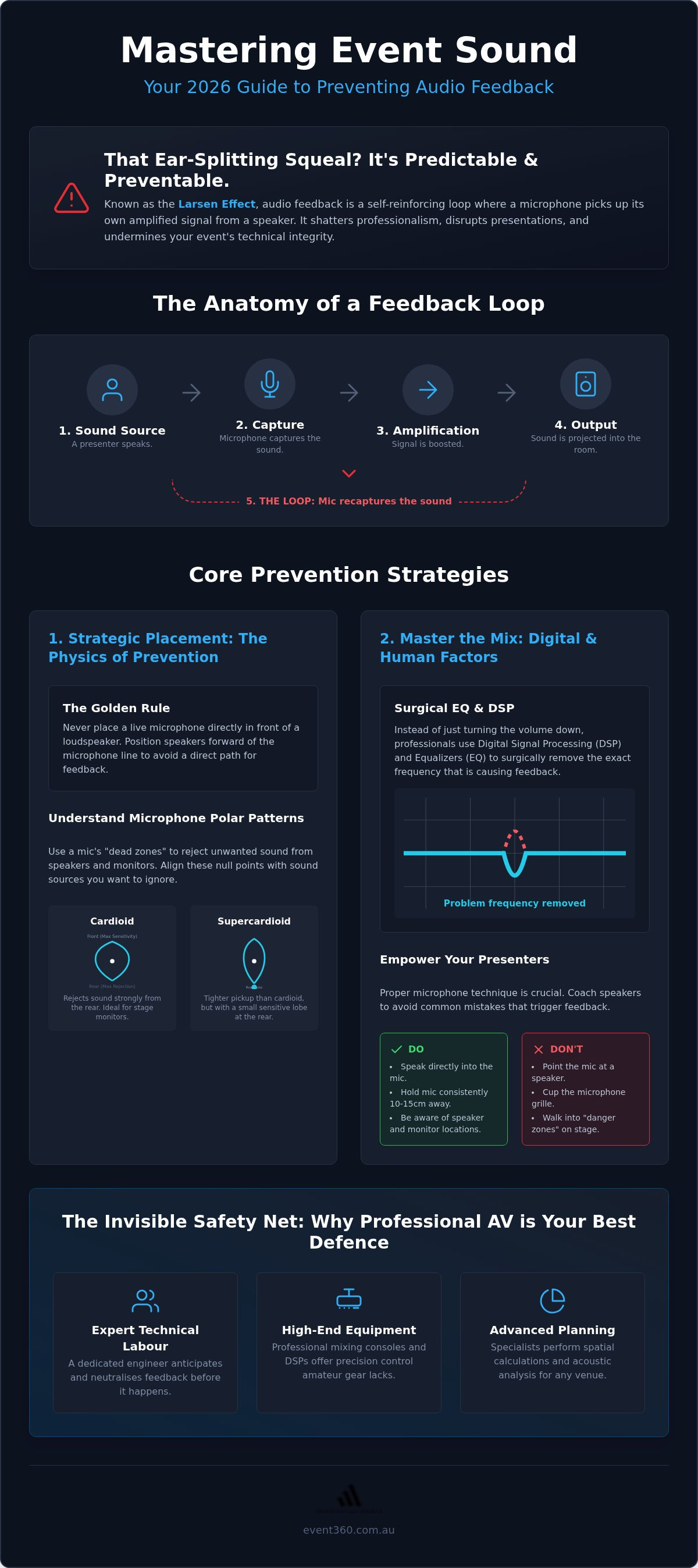
Audio feedback is the ultimate mood killer. Known technically as the Larsen Effect, it's a self-reinforcing loop that occurs when a microphone picks up its own signal from a loudspeaker. This creates a cycle where the sound is amplified over and over until it reaches a deafening, sustained peak. For event organisers, preventing audio feedback at live events is about more than just avoiding a loud noise; it's about protecting the speaker's authority and the event's reputation. When a screech interrupts a keynote, the audience loses focus and the professional polish of your brand takes an immediate hit. It creates an atmosphere of technical instability that can make stakeholders feel uneasy about the production's reliability.
Common triggers for this acoustic nightmare include excessive volume, poor mic technique, or highly reflective surfaces like glass walls and polished floors. That piercing "ringing" sound isn't random. It's actually a specific frequency hitting its physical limit within your specific acoustic environment. If the room naturally resonates at 2kHz, that's exactly where the feedback will strike first. Identifying these problem frequencies is the first step toward a flawless soundscape.
The Anatomy of a Feedback Loop
The feedback process is lightning-fast but follows a predictable path. First, the microphone captures an initial sound. Second, the amplifier boosts that signal. Third, the speaker emits the amplified sound back into the room. Finally, if the mic is positioned poorly, it recaptures that emitted sound and sends it back through the chain. This continues until the system hits the "threshold of oscillation," where the sound becomes an unstable tone. High-pitched squeals usually indicate issues with treble frequencies, while low-end hums often stem from bass-heavy speakers vibrating through the stage floor or the lectern itself.
Why 'Just Turning it Down' Isn't Always the Solution
It's a common misconception that lowering the fader solves everything. In a large conference hall, reducing volume often means the people in the back rows can't hear the presentation, which is a major failure for hybrid and MICE events. The real challenge is managing "gain before feedback," which is the maximum volume a system can reach before it becomes unstable. Achieving this balance requires sophisticated equipment and expert calibration rather than just a heavy hand on the volume slider. This is why professional audio visual production is essential for large-scale venues. A dedicated engineer doesn't just turn knobs; they surgically remove problem frequencies to ensure the audio remains loud, clear, and perfectly stable throughout the entire event.
The Physics of Prevention: Strategic Placement of Microphones and Speakers
Mastering the physical environment is your first line of defence. The absolute golden rule of sound reinforcement is simple: never place a live microphone directly in front of a loudspeaker. While this sounds elementary, complex stage designs and narrow Australian MICE venues often force equipment into tight quarters. Success in preventing audio feedback at live events relies on understanding the "dead zones" of your equipment. Every microphone has a polar pattern that dictates where it picks up sound and, more importantly, where it ignores it. Cardioid microphones reject sound from the rear, while supercardioid models have an even tighter pickup area but a small "lobe" of sensitivity directly behind them. Aligning these null points with your speakers creates a physical barrier that stops the feedback loop before it starts.
We also utilise the Inverse Square Law to maintain system stability. In acoustic terms, every time you double the distance between a sound source (the speaker) and the receiver (the microphone), the sound pressure level drops by approximately 6dB. By organising your stage layout to maximise this distance, you significantly increase your gain-before-feedback. Partnering with a specialist in Audio Visual Production ensures these complex spatial calculations are handled long before your first guest arrives, providing a reliable foundation for crystal-clear sound.
Speaker Geometry and Room Acoustics
Positioning front-of-house (FOH) speakers requires precision. They should always be placed forward of the stage line, projecting sound away from the microphones. In modern Australian venues featuring extensive glass partitions or polished concrete, "slap-back" echo is a major risk. This occurs when sound hits a hard surface and bounces directly back into the microphones on stage. We mitigate this by angling speakers slightly downwards and using stage monitors or In-Ear Monitors (IEMs). IEMs are the ultimate feedback-killer because they deliver sound directly to the presenter's ears, allowing us to turn off floor wedges entirely and remove significant noise from the stage environment.
Choosing the Right Microphone for the Job
Not all microphones are created equal for high-stakes environments. Lapel or lavalier microphones are often the highest risk for feedback because they sit relatively far from the speaker's mouth, requiring more gain to achieve an audible volume. For superior stability, head-worn microphones are the preferred choice for 2026 corporate productions. They maintain a consistent, close distance to the sound source, allowing for high-gain performance without the screech. For audience Q&A, handheld microphones remain the safest bet, provided the user doesn't point them toward the ceiling speakers while waiting for a response. Choosing the right tool for the specific room dynamic is essential for a friction-free experience.
Master the Mix: Digital Signal Processing and EQ Techniques
Once you've optimised your physical stage layout, the battle for flawless sound moves into the digital domain. Precision equaliser (EQ) adjustments are the most powerful tools in a technician's arsenal for preventing audio feedback at live events. Before the doors open, our engineers perform a process known as "ringing out the room." We intentionally push the system to the point of feedback to identify exactly which frequencies are unstable in the space. Using surgical Parametric EQs, we "notch out" these specific problem frequencies with extreme precision, leaving the rest of the vocal tone untouched and natural.
Graphic Equalisers (GEQ) provide a broader overview of the room's response, while High-Pass Filters (HPF) serve as a critical safety net. By cutting out unnecessary low-frequency rumble below 100Hz, we remove the "mud" that often triggers low-end feedback loops. Modern digital consoles also feature automatic feedback suppressors that act as an invisible shield, instantly deploying narrow filters the moment a potential squeal is detected. This technical mastery ensures that your audio remains crisp and intelligible, even in acoustically challenging environments.
The Art of Gain Staging
Stable audio starts at the preamp. Many feedback issues arise from poor gain staging, where a microphone is set to be overly sensitive. It's vital to understand the distinction between gain (input sensitivity) and volume (the fader level). We focus on setting appropriate input levels to ensure a healthy signal-to-noise ratio, which is a hallmark of professional av hire solutions. By keeping gains conservative and utilising the system's headroom, we create a more resilient audio environment that resists oscillation even when a presenter moves unexpectedly.
Modern Digital Safeguards
The 2026 era of live production brings sophisticated AI-driven algorithms into the mix. We leverage "Duggan" auto-mixing technology, which automatically lowers the gain on inactive microphones in real-time. If you have a panel of five speakers, the system ensures only the active voice is prominent, drastically reducing the total amount of open gain and the risk of loops. Real-time frequency analysers (RTA) allow our technicians to visually monitor the audio spectrum, spotting a building frequency spike before it becomes audible to your audience. Combined with digital limiters that prevent sudden volume surges, these safeguards provide a multi-layered defence for your event's soundscape.
Taming the Stage: Managing Presenters and Audience Q&A Zones
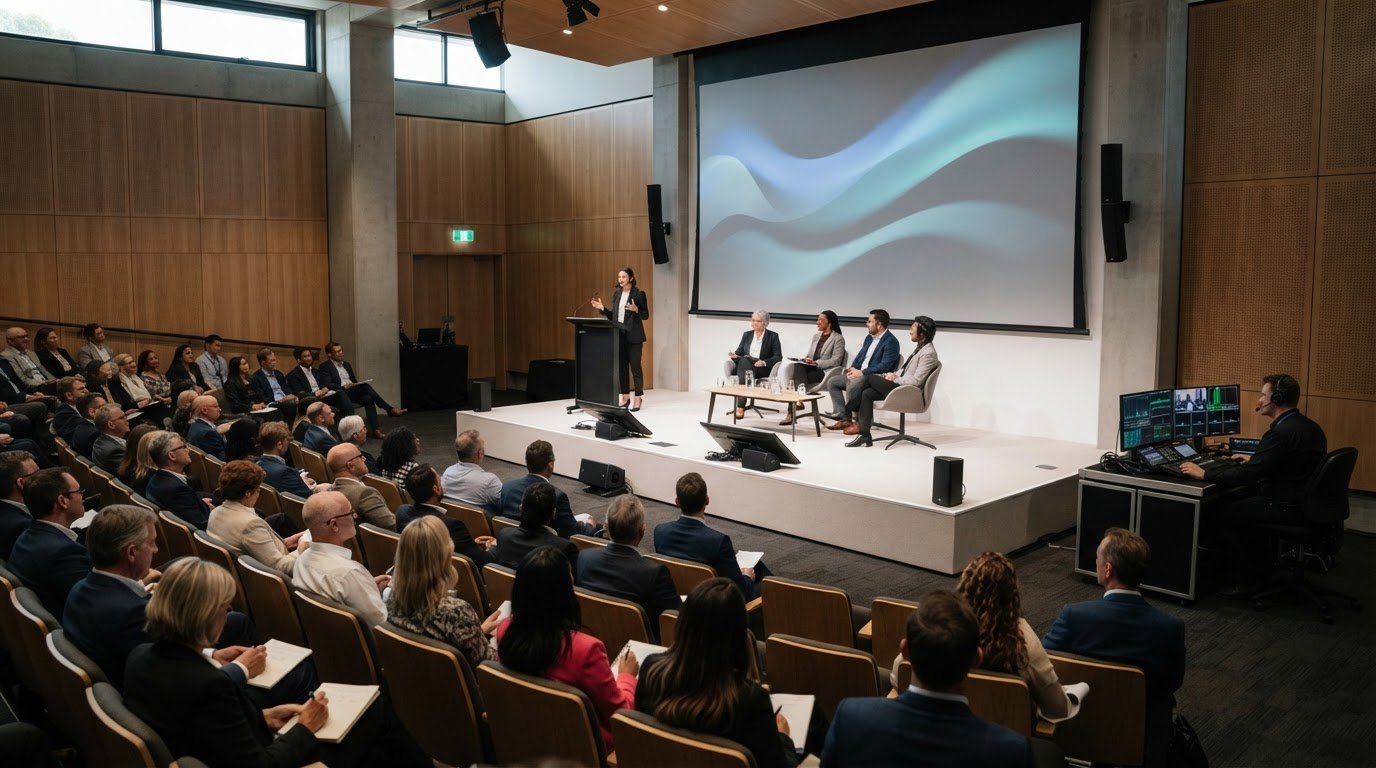
Technical mastery is only half the battle; the other half is managing the human element on stage. Even the most sophisticated digital suppression system can struggle if a presenter unknowingly creates the perfect conditions for a loop. Preventing audio feedback at live events requires clear communication with your speakers before they step into the spotlight. A roaming presenter wearing a lapel microphone is a high-risk variable. If they wander too close to a speaker stack or stand directly beneath a ceiling speaker while engaging with the front row, the risk of a sudden screech increases exponentially. We establish strict "No-Go Zones" during the site inspection, ensuring the stage layout keeps sensitive inputs far away from the primary sound projection.
Educating presenters on basic mic technique is a simple yet transformative step. We often teach the "chin-to-chest" rule for handheld microphones, ensuring the capsule stays close to the mouth to maintain a high signal level. Crucially, we advise speakers never to "cup" the microphone capsule. This common habit, often seen in music performances, turns a directional cardioid microphone into an omnidirectional one, effectively inviting every speaker in the room to bleed into the signal. By managing these small physical behaviours, we create a much wider margin for error in the mix.
Presenter Training and Rehearsals
Professional sound checks are non-negotiable for a friction-free event. This rehearsal gives the speaker a chance to hear their own voice through the monitor wedges, which reduces the natural urge to pull the microphone away from their face. We also take this time to organise lapel mic placement, clipping them to a central, stable point on the clothing. This prevents the microphone from swinging or rubbing against jewellery and fabric, which can create distracting noise and force the engineer to adjust gain levels mid-speech. If you want to ensure your speakers are supported by a team that manages every human and technical detail, explore our Audio Visual Production services for your next plenary session.
Controlling the Audience Q&A
Roving microphones in a large ballroom are notorious for triggering feedback. We mitigate this by mapping out "safe zones" for Q&A runners, ensuring they don't hold a live mic directly under a PA cluster. For high-energy corporate sessions, throwable "catch-box" microphones are a brilliant 2026 solution, as they automatically mute while in the air. Regardless of the hardware, our technicians "ride the fader" for every audience question. This means the microphone is only truly live for the seconds it is being spoken into, instantly cutting the gain the moment the person finishes. In boardroom settings, we often deploy "push-to-talk" systems, which ensure only one mic is active at a time, effectively eliminating the risk of open-mic feedback loops.
The Invisible Safety Net: Why Professional AV Production is Your Best Defence
Relying on venue-supplied "in-house" sound systems is one of the most common risks event organisers take in the high-stakes world of corporate production. While built-in speakers are fine for background music, they often lack the flexibility and power required for crystal-clear keynote speeches. These systems are typically fixed in place, meaning they can't be adjusted to account for specific stage layouts or the unique acoustic challenges of your event. Preventing audio feedback at live events requires a bespoke approach where every speaker angle and microphone frequency is tailored to the room's specific geometry. This is where the value of expert technical labour becomes your greatest asset. Having a dedicated engineer at the console ensures that your audio is actively managed rather than just left to chance.
For those managing hybrid event solutions, the technical requirements are even more complex. A feedback loop doesn't just disrupt the room; it can cause massive volume spikes on a live stream, potentially damaging the experience for thousands of remote attendees. We act as your invisible experts, handling the intricate logistics and technical heavy lifting so you can focus on your guests. By removing the friction of technical uncertainty, we provide the peace of mind that comes from knowing every frequency is under total control.
The Event 360 Approach to Flawless Sound
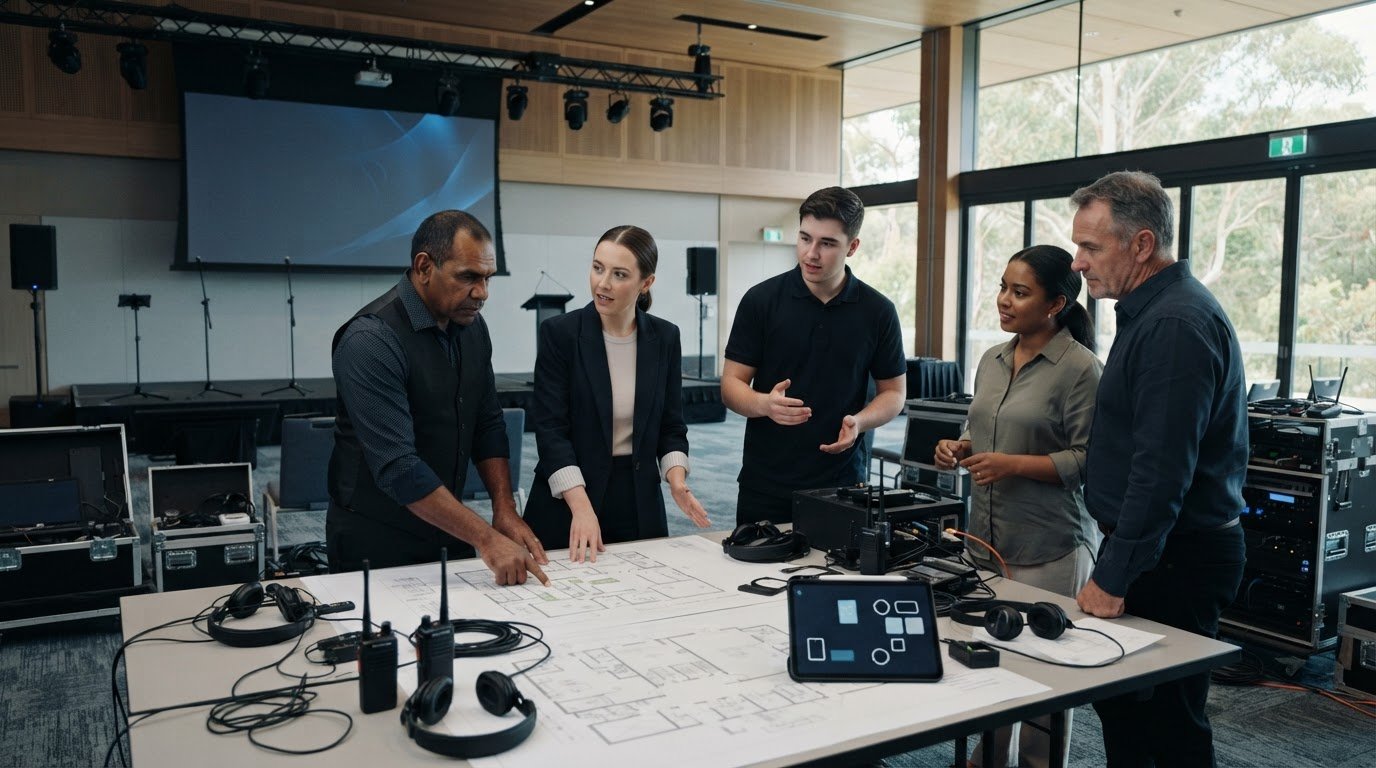
Our process begins long before the first microphone is switched on. We conduct thorough pre-event site surveys to identify acoustic "red flags" in Australian venues, such as excessive glass, low ceilings, or problematic alcoves. We deploy premium, high-headroom sound systems that naturally resist feedback by delivering clear audio at lower gain levels. Our onsite support teams are trained to react in milliseconds to any audio anomaly, ensuring that if a presenter makes an unexpected move, the system remains stable and the sound stays perfect. We don't just provide equipment; we provide a managed environment where technical failure isn't an option.
Investing in Experience over Equipment Alone
A great engineer can make a basic system sound incredible, but a novice with a million-dollar rig can still struggle with a simple feedback loop. We believe that technical mastery is a creative endeavour. Our team brings a "can-do" attitude to every project, solving potential feedback issues through creative staging and the seamless integration of lighting and sound. We treat every event as a partnership, acting as a dedicated ally to ensure your message is heard without interruption. If you're ready to elevate your production and eliminate technical anxiety, contact Event 360 to organise your next high-impact event and experience the difference that professional expertise makes.
Elevate Your Production with Precision Sound
Achieving a flawless soundscape requires a sophisticated blend of physical precision and digital mastery. By prioritising strategic spatial layouts and leveraging the latest AI-driven mixing algorithms, you transform your audio from a potential liability into a professional asset. Mastering the technical nuances of preventing audio feedback at live events ensures your keynote speakers remain authoritative and your audience stays fully engaged, whether they're in the ballroom or joining via a hybrid link.
Don't leave your reputation to chance with inadequate venue gear or unmanaged frequencies. As specialists in high-stakes MICE and corporate events, we provide the expert technical labour and high-end equipment hire needed to remove all friction from your production. With our national Australian coverage and dedicated onsite support, you can step onto the stage with total confidence. Ensure your next event is heard perfectly with Event 360. We're ready to partner with you to deliver a seamless, high-impact experience that resonates long after the final microphone's switched off.
Frequently Asked Questions
What is the most common cause of audio feedback at corporate events?
The most frequent cause is improper gain structure combined with poor microphone placement relative to the loudspeakers. When a technician pushes the volume too high to compensate for a quiet presenter, the system often enters a self-reinforcing loop. This occurs most often in corporate settings when lapel microphones are used too close to front-of-house speakers. Managing these physical variables is the foundation of preventing audio feedback at live events and ensuring a professional sound.
Can a specific type of microphone prevent feedback entirely?
No microphone can eliminate feedback entirely; however, head-worn microphones are significantly more stable than lapel alternatives. Because the capsule stays at a fixed, close distance to the speaker's mouth, the system requires less gain to achieve clear volume. This reduces the risk of picking up ambient sound from the speakers. While cardioid and supercardioid patterns offer excellent off-axis rejection, even the best hardware requires a skilled engineer to manage the room's unique resonance.
How do I stop feedback when a presenter walks into the audience?
Stopping feedback during audience interaction requires active fader management and pre-defined safe zones. If a presenter roams into the audience, they often pass directly under overhead speaker clusters, which triggers a loop. Our technicians "ride the faders" in real-time, instantly dipping the volume if a presenter approaches a high-risk area. We also utilise digital auto-mixers that lower the gain of inactive microphones, providing an extra layer of protection during dynamic Q&A sessions.
Is it possible to remove feedback from a live stream recording after the fact?
Removing a screech from a recorded live stream is technically possible using spectral editing software, but it's rarely a perfect fix. While digital tools can notch out the offending frequency, the process often leaves a noticeable hole in the audio quality, making the speech sound thin or unnatural. It's far more effective to focus on preventing audio feedback at live events during the initial capture. Prevention ensures your archive remains professional and clear.
Why does my microphone squeal even when I'm standing far away from the speakers?
Feedback can occur far from speakers due to room reflections or excessive system gain. Hard surfaces like glass partitions or polished concrete bounce sound waves back into the microphone, creating a loop even at a distance. This is often exacerbated by over-sensitive gain settings on the mixing console. Professional technicians mitigate this by using parametric equalisers to surgically remove the specific frequencies that are resonating with the room's unique shape and various surface materials.
What should I do immediately if feedback starts during a live speech?
If feedback begins, the technician must immediately pull back the fader on the offending channel to break the loop. Presenters should avoid "cupping" the microphone or pointing it toward speakers, as this instantly changes the pickup pattern and triggers a squeal. The best immediate response is a calm, slight adjustment of the speaker's position. Having an onsite technical team ensures these micro-adjustments happen in milliseconds, often before the audience even notices the issue.
How much does professional technical support help in preventing audio issues?
Professional technical support is the most effective way to guarantee flawless audio. Our engineers provide onsite support that includes ringing out the room before guests arrive and managing complex digital suppression software during the show. Beyond just providing equipment, a dedicated technician understands the physics of the venue and can react to variables like crowd noise. This proactive management removes friction for organisers and ensures a seamless experience for all stakeholders.
Does the shape of the room affect how much feedback I get?
The shape and materials of a room directly influence feedback stability. Parallel hard walls and low ceilings create standing waves and reflections that trap sound, making the system more prone to squealing. Circular or oddly shaped rooms can also create hot spots where sound converges. We conduct pre-event site surveys to identify these acoustic red flags. This allows us to customise speaker placement and EQ settings to suit the specific geometry of any Australian venue.
Comments