
Questions to Ask Your Event AV Provider: The 2026 Essential Checklist

Technical gear is a commodity, but a true technical partnership is the only thing standing between a standing ovation and a silent microphone. We've all felt that familiar knot of anxiety when a keynote speaker walks on stage, hoping the LED wall won't flicker and the audio won't crackle. It's an exhausting way to manage a high-stakes production. To strip away the confusion of complex quotes and technical jargon, you need a strategic set of questions to ask your event AV provider that reveal their true operational depth.
You already know that a flawless show requires more than just hiring boxes of equipment; it demands a team that anticipates every possible friction point. This 2026 essential checklist empowers you to master your next technical briefing with total authority. We'll provide a clear framework for evaluating partners, from scrutinising signal redundancy to understanding the latest NDI 6 protocol standards. By following this guide, you'll gain the confidence to lead your team toward a seamless, high-impact event experience that leaves your attendees inspired and your budget intact.
Table of Contents
Evaluating Experience and Sector Specialisation
Technical expertise isn't a one-size-fits-all service. A team that excels at a high-energy outdoor concert might struggle with the rigid timelines and intricate signal paths of a multi-day corporate conference. When refining your shortlist, the most critical questions to ask your event AV provider should focus on their specific experience with your event format. You need to know if they've managed the high-pressure environment of a national plenary session or the nuanced atmosphere of a black-tie gala. Experience in these distinct sectors dictates how a team handles commercial audiovisual systems and technical labour under pressure.
Success in the Australian MICE sector requires a project management mindset. Ask for specific examples where they've managed complex, multi-room breakout sessions across large convention centres. A provider should be able to describe a time they overcame a significant technical hurdle, like a last-minute presenter change or a signal failure, without the audience ever noticing. This level of transparency proves they aren't just equipment hire companies; they're proactive partners who understand that technical gear is only as good as the team operating it.
Sector-Specific Expertise: MICE, Corporate, and Concerts
Does your provider truly grasp the unique flow of a corporate MICE programme? High-stakes corporate launches require dedicated project managers who understand that a three-minute delay can derail an entire day's schedule. If your event includes a live performance, verify their history with touring-grade concert production. You want a team that can transition seamlessly from a professional keynote to a high-impact musical act, ensuring the audio and lighting designs reflect the shift in energy. This versatility is essential for modern events that blend business with entertainment.
Venue Familiarity and Site Visit Protocols
Local knowledge is a powerful asset in live production. Inquire about their history with your chosen venue across Australia. A provider who knows the loading dock quirks and power limitations of a specific ballroom can prevent costly delays during the bump-in phase. They should commit to a formal site inspection to assess rigging points and acoustic challenges well before the event date. This proactive approach ensures that every piece of technology is optimised for the physical space, removing friction and providing you with much-needed peace of mind. It's about turning a potentially difficult venue into a perfect stage for your message.
Digging Into Technical Capability and Equipment Standards
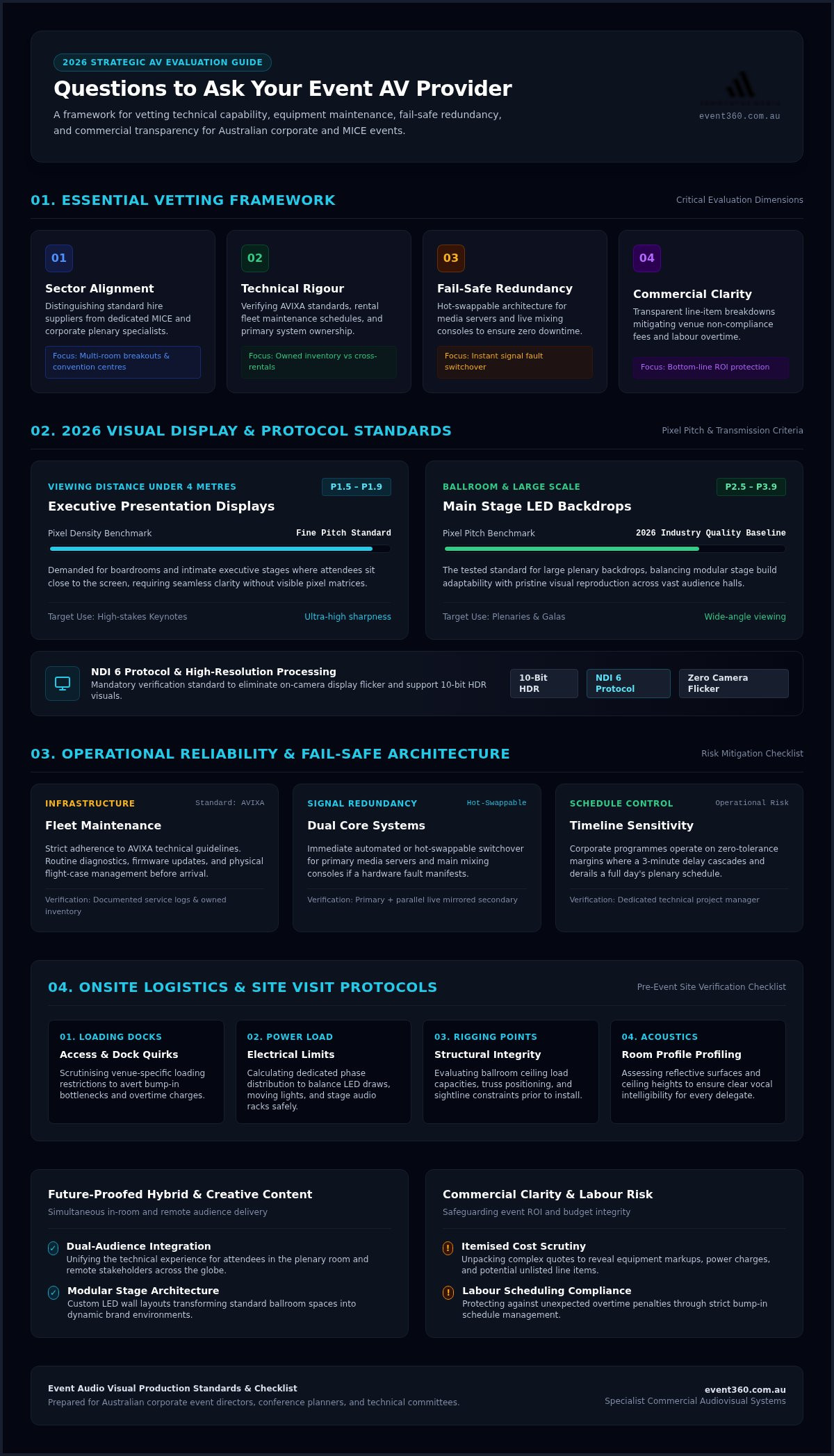
Shiny boxes don't deliver events; reliable, well-maintained systems do. You need to know that every piece of gear in the rack is road-tested and ready for the rigours of a live show. When formulating your questions to ask your event AV provider, start with the maintenance schedule of their rental fleet. Professional providers adhere to strict AVIXA technical standards to ensure system performance remains peak throughout the year. Ask if they own their inventory or rely on third-party cross-rentals. Owning the gear means they control the quality, the firmware updates, and the physical condition of every flight case.
Redundancy is your insurance policy against technical failure. Inquire about their backup plans for critical components like primary media servers and audio consoles. A high-end partner will always have a hot-swappable backup ready to take over instantly if a fault occurs. This level of preparation is the hallmark of truly integrated audio visual production, where sound, light, and vision work in a synchronised, fail-safe ecosystem. If you want to see how this technical mastery translates to your stage, consider how our LED wall solutions create a solid foundation for any event.
LED Wall and Visual Display Specifications
Visual impact hinges on clarity and precision. For executive presentation setups, verify if they use fine pixel pitch LED, typically ranging from P1.5 to P1.9 for viewing distances under four metres. For larger ballroom backdrops, a P2.5 to P3.9 standard is the 2026 benchmark for quality. Ensure they use high-resolution processing and modern protocols like NDI 6 to eliminate camera flicker and support 10-bit HDR visuals. Modular LED solutions allow for creative, non-standard stage designs that can transform a standard room into an immersive brand experience.
Audio Clarity and Lighting Design Integration
Crisp audio is non-negotiable for audience engagement. Ask how they guarantee consistent sound coverage across every seat, preventing dead zones in the back of the room. Modern shows should utilise digital consoles and networked audio, such as Dante AoIP, for maximum reliability and signal integrity. Lighting shouldn't be an afterthought; it must be integrated to enhance your creative content and brand colours. A well-designed lighting plot ensures your speakers look great on camera while adding depth and energy to the physical space. This holistic approach removes technical friction and keeps the focus where it belongs: on your message.
Navigating Onsite Logistics and Technical Labour
High-end equipment is useless without a skilled crew to drive it. The most critical questions to ask your event AV provider involve the human element behind the faders. You need to verify the qualifications of the onsite team and ensure they have the stamina for high-pressure corporate calls. A professional partner should provide a detailed bump-in and bump-out schedule that aligns perfectly with your venue's loading dock restrictions and safety mandates. This level of planning follows OSHA safety management guidelines to protect both the crew and your attendees during complex builds.
Communication is the heartbeat of a live show. Ask how many dedicated technicians will be at the front-of-house during the plenary. You want to see a clear internal communication protocol where audio, visual, and lighting teams are linked via a dedicated comms system. This ensures that every cue is hit with precision, from the opening sting to the final exit music. It's about removing friction so you can focus on the stage rather than the logistics.
The Quality of Onsite Technical Labour
Staffing models vary wildly in the production world. Ask if the technicians are full-time staff or casual contractors; full-time teams often bring a deeper level of accountability and brand alignment. For complex sequences, inquire about the presence of a dedicated Show Caller or Technical Director. These roles are essential for managing the high-stakes environment of a live production, especially when you need to handle last-minute presenter changes or media updates on the fly. A proactive team won't just wait for instructions; they'll anticipate your needs before you even voice them.
Bump-in, Bump-out, and Troubleshooting Workflows
Tight venue turnarounds are a reality of the Australian MICE industry. Your provider must demonstrate a logical, step-by-step process for managing a technical failure mid-event. They should organise their logistics to maximise every minute of access time, ensuring the stage is ready for rehearsal well before the doors open. When evaluating their resilience, specific questions to ask your event AV provider should target their reaction speed. Their primary troubleshooting protocol involves identifying the point of failure, switching to the redundant signal path immediately, and isolating the fault without interrupting the show flow. This meticulous approach provides the peace of mind required for high-stakes corporate environments.
Transparency in Pricing and Risk Management
Budget blowouts are the single biggest source of anxiety for event planners. To protect your bottom line, the most vital questions to ask your event AV provider must focus on pricing transparency and risk mitigation. Demand a fully itemised quote that breaks down equipment, labour, and logistics into clear line items. This allows you to spot potential hidden costs before they become invoice surprises. Ensure your av hire package explicitly includes necessary rigging and power distribution fees, as these are often overlooked in preliminary estimates.
Labour usually accounts for 30% to 50% of your total AV bill. Professional Australian providers operate on standard 10-hour show calls; anything beyond this typically triggers overtime rates at 1.5 times the hourly cost. Ask for a clear definition of their overtime triggers and turnaround penalties. You also need to understand their cancellation policy. Most professional contracts require a 25% to 50% non-refundable deposit, with tiered fees if you cancel within 60 days of the load-in. Clarifying how they handle scope creep ensures that mid-event requests don't derail your financial planning.
Identifying Hidden Costs and Cross-Rental Fees
Are transport, delivery, and specialised plant hire like scissor lifts included in the initial quote? Some providers omit these to make their headline figure look more attractive. Inquire about venue-imposed technical fees, such as patch-in charges or dock supervision costs. If you need last-minute equipment onsite, ask how those additions are billed. A proactive partner will have a pre-agreed rate card for onsite additions to keep the process friction-free. This level of detail prevents the "bill shock" that often follows a complex production.
Safety Standards and Insurance Compliance
Safety is non-negotiable in live production. Verify that your provider can supply a comprehensive Safe Work Method Statement (SWMS) for the entire build. Their Public Liability Insurance should meet the requirements of large Australian venues, often requiring a minimum of $20,000,000 for high-stakes corporate environments involving rigging. Additionally, ensure all electrical items are Test and Tagged according to current Australian Standards. This level of compliance isn't just about ticking boxes; it's about ensuring the safety of every person in the room. For a partner that prioritises both safety and transparency, request a detailed production consultation today.
Future-Proofing with Creative Content and Hybrid Solutions
Modern events aren't just viewed; they're experienced across physical and digital dimensions. As we move through 2026, the line between a live plenary and a broadcast studio continues to blur, requiring a partner who can navigate both with ease. When finalising your questions to ask your event AV provider, you must look beyond the physical gear and probe their ability to craft a digital narrative. A true partner doesn't just display your slides; they transform your brand into a high-energy visual journey that captivates every attendee, regardless of their location.
Engagement in a hybrid world requires more than a simple camera feed. You need to understand how your provider bridges the gap between the room and the remote viewer. Inquire about their use of interactive technologies like live polling and real-time Q&A integration that allow remote participants to influence the live session. This creates a unified experience rather than two separate events. To ensure this connection remains unbreakable, ask about their redundancy for live streaming internet, specifically the use of bonded cellular or secondary fibre lines to prevent a single point of failure from silencing your broadcast.
Integrating Creative Content and Digital Media
Visual impact is often won or lost in the pre-production phase. Ask your provider if they can assist with the design of wide-format screen graphics and high-impact opening stings that set the tone for your event. They must be able to manage complex aspect ratios across various LED surfaces and projection zones without distorting your brand assets. By time-coding your creative stings to the lighting console, our team ensures every visual transition is punctuated by a perfectly synchronised wash of colour that amplifies the emotional impact of your brand. This level of technical synergy removes the friction between creative vision and technical execution.
Robust Hybrid Event and Live Streaming Setups
Delivering a broadcast-quality stream requires a sophisticated signal path and a dedicated digital crew. Ask your provider what platforms they recommend for hosting virtual audiences and how they manage two-way communication between remote speakers and the live room. For 2026, look for providers utilizing NDI 6 protocols, which provide native 10-bit HDR support and integrated WAN connectivity for seamless remote speaker integration. Your provider should demonstrate experience with broadcast-grade camera switching, ensuring the remote audience receives a polished, multi-camera programme that feels like a professional television production. These questions to ask your event AV provider will reveal if they have the technical mastery to future-proof your next high-stakes project.
Secure Your Event’s Success with Technical Mastery
Choosing a technical partner is the most consequential decision you'll make during the planning phase. By using this checklist of questions to ask your event AV provider, you've shifted from simply hiring gear to building a robust, fail-safe production strategy. You now have the framework to evaluate labour quality, redundancy protocols, and the integration of creative content that truly moves an audience. It's about moving beyond the technical jargon to find an ally who understands the high stakes of live production.
Event 360 is dedicated to this level of precision. We specialise in high-impact corporate MICE with a national production capability that spans across Australia. Our in-house LED and creative content experts don't just manage equipment; we design immersive environments that remove friction and provide absolute peace of mind. We know that technical labour is the backbone of every successful show, and our proactive teams are ready to transform your vision into a seamless reality. Partner with Event 360 for your next high-stakes production and lead your team with total confidence. Your stage is waiting, and we're ready to help you own it.
Frequently Asked Questions
How far in advance should I book my AV provider for a large Australian event?
Secure your technical partner at least six to twelve months before your event date. Large-scale Australian MICE projects require significant lead times for technical design, equipment allocation, and labour scheduling. Booking early ensures you get the best technical directors and the latest LED inventory. It also allows your provider to conduct thorough site visits and venue negotiations before the calendar fills up, providing you with absolute peace of mind.
What are the most common hidden costs in an AV production quote?
Hidden costs often include transport, specialised plant hire like scissor lifts, and venue-imposed patch fees. You might also see unexpected charges for power distribution and rigging liaison fees if they aren't itemised early. Always look for these details when preparing your questions to ask your event AV provider. Clarifying these line items during the quoting phase prevents the bill shock that often occurs during the final reconciliation.
Do I really need a dedicated technical director for a corporate conference?
A dedicated Technical Director is essential for any event with multiple presenters or complex show cues. While a lead technician manages gear, a TD manages the entire production flow and synchronises audio, lighting, and vision teams. They act as your primary point of contact, making split-second decisions during live sessions to ensure a flawless experience. This role removes the friction of managing technical details yourself and ensures every cue is hit with precision.
What happens if the internet fails during my live stream?
Robust streaming setups rely on primary and secondary internet paths to prevent total failure. We utilise bonded cellular solutions that combine multiple 4G and 5G networks to create a fail-safe connection. If the venue's hardline drops, the system switches instantly to the backup without the remote audience noticing a glitch. This level of redundancy is a non-negotiable standard for professional hybrid event solutions and ensures continuous engagement for every remote attendee.
Can my AV provider work with the existing equipment at the venue?
External providers can integrate with house systems, but they often prefer using their own verified inventory for critical paths. Venue gear may have unknown maintenance histories or outdated firmware that creates technical friction. If you use house sound or rigging, your provider will likely charge a patch fee to manage the interface. They'll conduct a site visit to assess if the venue's infrastructure meets the high standards required for your specific production.
What is the difference between pixel pitch and resolution for LED walls?
Pixel pitch measures the distance between the centres of two pixels in millimetres. A smaller pitch, such as P1.5, delivers higher density and sharper images for close viewing. Resolution represents the total number of pixels across the whole surface. When considering questions to ask your event AV provider, focus on how the pitch suits your audience's viewing distance to ensure flicker-free, broadcast-quality visuals for both cameras and attendees.
How do I ensure my presenters are comfortable with the onsite technology?
Schedule dedicated technical rehearsals for every speaker well before the doors open. We provide comfort monitors and digital timers to help presenters track their progress without turning their backs on the audience. A professional stage manager will walk them through microphone technique and slide clicker operation. This proactive preparation builds speaker confidence and ensures the technical elements support their delivery rather than distracting from the message.
What safety certifications should I ask to see from an AV company?
Request a comprehensive Safe Work Method Statement (SWMS) and proof of Public Liability Insurance, typically at a $20 million threshold for national venues. All electrical equipment must carry current Test and Tag labels according to Australian Standards. If your event involves suspended gear, verify that the rigging is performed by qualified professionals. These documents prove your partner prioritises safety and compliance as much as creative impact and technical mastery.


Comments