
Sound System for 500 People: 2026 Professional Guide

Why is it that a sound system that rocks a 100-person wedding often falls completely silent by the time you reach the back of a 500-seat plenary session? It is a frustrating reality for many organisers who realise too late that scaling up involves more than just turning up the volume. We understand that the fear of "dead zones" or a piercing microphone feedback loop during a critical keynote is enough to rattle even the most seasoned professional. Getting the sound system requirements for 500 people right is about precision, not just power; it is the difference between a restless audience and a captivated one.
This guide will help you master the technical specifications and hardware needs required to deliver crystal-clear audio, ensuring every guest hears every word. We will explore the shift from standard point-source speakers to sophisticated line arrays, decode technical jargon like SPL, and explain why expert technical labour is your best insurance against glitches. By the end, you will have a clear roadmap to organise a flawless audio experience that projects confidence and authority, leaving no room for technical failure.
Table of Contents
Scaling Up: Why 500 Guests Require a Professional Audio Strategy
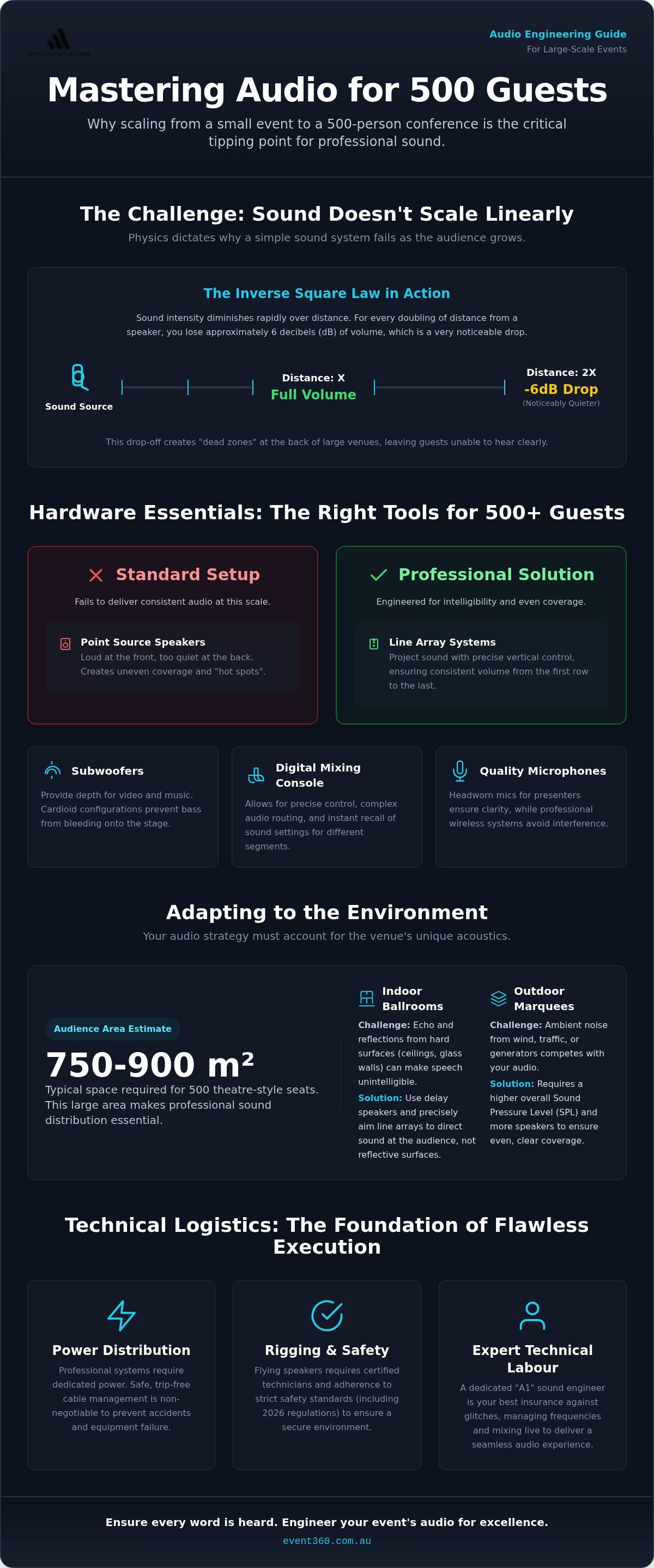
Physics dictates the success of your event long before the first guest arrives. The Inverse Square Law is a fundamental principle of acoustics that explains why sound intensity drops significantly as it travels. Simply put, every time you double the distance from a speaker, you lose about six decibels of volume. For a small meeting, this is manageable; however, once you scale to a crowd of 500, the distance between the stage and the back row creates a massive technical hurdle. Standard point source speakers often fail at this tipping point because they lack the "throw" required to reach the back of the room without deafening the guests in the front row.
Designing a setup that meets the sound system requirements for 500 people is about achieving a consistent Sound Pressure Level (SPL) across the entire venue. When audio is patchy or inconsistent, guests disengage almost instantly. This disengagement has a direct psychological impact; poor audio suggests a lack of professional polish and can diminish the perceived value of your brand. Our goal is to ensure that the guest in the very last row receives the same high-fidelity experience as the VIPs at the front.
The Difference Between Volume and Intelligibility
Loudness is a blunt instrument, while intelligibility is a surgical one. In high-stakes corporate environments, being "loud" is rarely the objective. Instead, every syllable of a keynote must be crisp and clear. Professional audio visual production prioritises the "presence" frequencies of the human voice, typically between 2kHz and 4kHz. We manage venue reflections by directing sound specifically at the audience, rather than letting it bounce off hard ballroom ceilings or glass walls, which can turn a clear speech into an unintelligible mess.
Mapping the Audience Area
A crowd of 500 seated in a theatre-style arrangement typically requires between 750 and 900 square metres of floor space. In these expansive Australian exhibition halls or hotel ballrooms, "dead zones" are a constant threat. A professional Sound reinforcement system for this scale often incorporates delay speakers. These are secondary speakers placed halfway down the room, electronically timed so the audio reaches the back at the exact same moment as the sound from the main stage. This meticulous planning ensures the sound system requirements for 500 people are met with uniform clarity, regardless of the room's depth or configuration.
Essential Hardware: Sound System Requirements for 500 People
Selecting the right gear is where theory meets reality. Delivering the sound system requirements for 500 people necessitates a move away from basic portable units toward modular, high-performance components. Line arrays are the gold standard for a crowd of this size. These systems offer superior vertical control, allowing us to project sound to the back of the room while keeping the volume comfortable for those in the front row. While high-output point source speakers can work in narrow spaces, they often struggle to maintain the uniform coverage required for larger audiences.
Subwoofers provide the necessary depth for video content and walk-up music, but they must be balanced carefully. We often utilise cardioid configurations to ensure the bass stays in the audience area and doesn't bleed back onto the stage, which can distract your presenters. Modern av hire relies exclusively on digital mixing consoles. These desks allow for precise scene recall and complex routing that analog boards simply cannot match. Maintaining audio levels according to OSHA noise exposure standards ensures a safe, comfortable environment for your guests without sacrificing impact.
Microphone Selection for Clarity
For a 500-person audience, microphone choice is paramount. Headworn microphones are the preferred choice for keynote speakers because they maintain a consistent distance from the source, regardless of how much the presenter moves. Handheld microphones are essential for Q&A sessions, yet they require active monitoring. In Australia, managing the wireless spectrum is increasingly complex due to 2026 RF regulations. This is why we provide a dedicated "A1" sound engineer to monitor frequencies and mix the show live, ensuring no dropouts occur. If you need a partner to manage these complexities, our team can organise a custom audio design for your next event.
Digital Signal Processing (DSP)
Digital Signal Processing acts as the invisible hand that polishes your audio in real time. We use DSP to "tune" the system to the specific acoustics of the room, using precise EQ to notch out frequencies that might cause feedback when a presenter walks in front of a speaker. DSP is the digital brain that protects the hardware while ensuring the output remains crystal clear for every attendee. By managing these intricate details, we remove the friction that often plagues large-scale productions.
Venue Dynamics: Adapting Sound Systems for Different Environments
Every venue possesses a unique acoustic fingerprint that dictates how audio behaves. When you gather 500 people in a single space, the physical presence of the audience actually changes the room's properties. In acoustics, we refer to "Room Gain" and the absorptive quality of a crowd. An empty ballroom might ring with a hollow echo, yet once those 500 seats are filled, the bodies act as natural sound dampeners. This shift means meeting the sound system requirements for 500 people involves more than just a static setup; it requires a design that accounts for the room's transformation from sound-check to showtime.
Indoor ballrooms with high ceilings present a significant challenge with reverberation. Conversely, outdoor marquees suffer from a complete lack of natural sound reinforcement, as there are no walls to reflect audio back to the listeners. In these open-air environments, you need more raw power to overcome ambient wind or traffic noise. Regardless of the setting, maintaining a safe and clear environment is vital. We prioritise Hearing Loss Prevention in Live Entertainment by ensuring that our designs deliver clarity at safe decibel levels, protecting your guests' ears while ensuring they don't miss a single word of the programme.
Acoustic Challenges of Large-Scale MICE Events
Modern Australian convention centres often feature stunning glass walls and polished hard floors. While visually impressive, these surfaces are acoustic nightmares that cause "slap-back" echo. We combat this by using directional speaker arrays that point sound away from reflective surfaces and directly at the audience. We also factor in the "noise floor" of the venue. Large-scale air conditioning systems in exhibition halls can be surprisingly loud, often requiring us to boost the mid-range frequencies of a speaker's voice just to maintain intelligibility during quiet keynote segments. Integrating high-end audio visual australia gear allows us to tune the system to these specific environmental quirks.
Hybrid Considerations for 500+ Guests
In 2026, a 500-person event is rarely contained within four walls. Most large-scale corporate gatherings now require seamless live streaming services to reach a global audience. The sound system requirements for 500 people in a hybrid context include managing two separate audio mixes: one for the room and one for the stream. We also manage the critical issue of audio latency. When a remote presenter appears on massive led wall hire displays, their voice must be perfectly synced with the visual to avoid a jarring experience. We use "mix-minus" routing to ensure the remote speaker doesn't hear a delayed version of their own voice echoing back through the room's PA system, removing friction for everyone involved.
Technical Logistics: Power, Positioning, and Rigging Safety
Success in large-scale event production lives in the details that your audience never sees. While the hardware is vital, the execution of sound system requirements for 500 people hinges on robust technical logistics. A system designed for this capacity draws significant wattage, often necessitating dedicated 3-phase power circuits to ensure the audio doesn't clip or fail during high-energy moments. We calculate these loads meticulously during the pre-production phase to prevent site-wide power outages that could derail your entire schedule.
Positioning is equally critical for both safety and performance. When we fly speakers above a crowd, we follow strict rigging protocols that exceed standard requirements. Every point is weight-rated and secured by certified professionals. This isn't just about acoustics; it is about the physical safety of every guest in the room. A structured "bump-in" timeline is mandatory for an audience of 500, allowing our team to manage cable runs with precision. We use high-visibility cable ramps and professional-grade adhesive to ensure a seamless, trip-free environment that maintains the high-end aesthetic of your event.
Australian Safety Standards for AV
Compliance is the backbone of our operational strategy. In Australia, every piece of hired equipment must undergo rigorous Test and Tag procedures to meet electrical safety standards. During the setup phase, our team manages Work Health and Safety (WHS) with assertive authority, ensuring that the heavy lifting and high-altitude rigging don't pose a risk to venue staff or early-arrival guests. We treat safety as a creative constraint that guarantees a flawless outcome. If you want to ensure your next production meets these exacting Australian standards, you can partner with our technical experts to manage every detail.
The Role of Technical Labour
Attempting a "dry hire" for a crowd of 500 is a high-stakes gamble that rarely pays off. The complexity of modern digital signal routing and wireless frequency management requires an onsite engineer who can adapt to real-time changes. There is a fundamental difference between a setup crew and a show operator; the former builds the system, while the latter breathes life into it. Professional technical labour is the insurance policy for your event’s reputation. Our technicians act as your "Invisible Experts," removing friction and providing the peace of mind that allows you to focus on your guests while we manage the intricate details behind the scenes.
The Event 360 Advantage: Engineering Audio Excellence
To further enhance the energy of your event, you can discover Easy Cee Entertainment for professional emcee and DJ services that complement your technical audio setup.
Engineering audio excellence is the final layer of a successful production. It is not just about the gear; it is about the vision to integrate it into a seamless, high-stakes environment. At Event 360, we don't just provide speakers. We architect an immersive atmosphere where every technical element works in harmony. Meeting the sound system requirements for 500 people is a complex puzzle that we solve through a combination of technical mastery and a relentless "can-do" attitude. We remove the friction from your planning process by serving as your dedicated technical ally. This ensures that your audio strategy perfectly complements other production layers like lighting and led wall hire.
Our approach ensures that your creative content is delivered with studio-grade precision, transforming a simple presentation into a powerful brand experience. We thrive on complexity and treat every challenge as an opportunity to innovate. By positioning ourselves as your collaborative partner, we provide the peace of mind that comes from knowing every detail is managed by meticulous, passion-driven experts who are focused on one thing: a flawless final outcome.
MICE Specialisation and Local Venue Expertise
Navigating the unique technical quirks of major Australian event venues requires deep localised knowledge. Whether it is managing the specific power grids of a heritage-listed ballroom or the acoustic reflections of a modern glass-fronted convention centre, our team has the experience to execute without compromise. We adopt a meticulous project-based mindset, guiding you from initial concepts to the final standing ovation. This end-to-end management ensures that the technical backbone of your event remains invisible, allowing your message to take centre stage with absolute clarity.
Ready to Organise Your 500-Person Event?
Success begins with a professional AV consultation early in the planning phase. By involving us from the start, we can identify potential pitfalls and optimise your budget for maximum impact. We handle the intricate details, from frequency coordination to rigging safety, so you can focus entirely on your guests. Our commitment is to provide the grounded reliability you need for a flawless execution while meeting the specific sound system requirements for 500 people. Contact Event 360 for a custom audio production quote today.
Deliver Flawless Audio for Your Next 500-Person Production
Mastering the sound system requirements for 500 people is the definitive step between a standard gathering and a world-class event. You now understand that success relies on shifting from raw volume to crystal-clear intelligibility, choosing the right line array hardware, and respecting the complex acoustics of Australian convention spaces. Technical excellence isn't just about the gear; it's about the precision of the engineers who manage every frequency and safety protocol behind the scenes. By prioritising professional logistics and expert labour, you ensure your message resonates with every single attendee.
As specialists in MICE and large-scale corporate events, we provide the grounded reliability and creative vision required for high-stakes productions. Our team delivers comprehensive AV, lighting, and LED wall solutions, backed by expert technical labour for national Australian events that removes friction and provides total peace of mind. We're ready to transform your technical challenges into a seamless, impactful journey. Partner with Event 360 for Flawless Audio Production and let us help you achieve a final outcome that exceeds every expectation. Your audience is waiting to hear what you have to say.
Frequently Asked Questions
How many speakers do I actually need for a crowd of 500 people?
A typical setup involves two to four main high-output speakers and at least two subwoofers to ensure full-range clarity. If the room is particularly deep or shaped irregularly, we add delay speakers halfway down the venue to maintain consistent volume. This approach prevents the front row from being overwhelmed while ensuring the back row hears every word. The specific sound system requirements for 500 people depend heavily on the room's square meterage and seating layout.
Is a line array system necessary for a 500-person corporate conference?
A line array isn't strictly mandatory, but it is often the superior choice for large-scale MICE events. These systems provide exceptional vertical control, allowing sound to travel further with less volume drop-off compared to traditional speakers. If your venue has high ceilings or a very deep floor plan, a line array delivers the uniform audio coverage required for a professional result. For smaller or narrower ballrooms, high-output point source speakers can still provide excellent results for your guests.
What are the power requirements for a professional 500-person sound system?
High-wattage audio systems for large crowds require stable, dedicated power circuits to prevent clipping or total failure. We generally utilise 3-phase power to handle the significant draw of multiple amplifiers, subwoofers, and digital consoles. Standard domestic wall sockets are rarely sufficient for a professional rig of this scale. Our technical team calculates the total electrical load during the planning phase to ensure the venue's infrastructure can support your production without any risk of unexpected outages.
Can I use wireless microphones for a 500-person event without interference?
Yes, provided you use professional-grade hardware and active frequency management. In the crowded Australian wireless landscape of 2026, simply turning on a mic isn't enough. We use digital wireless systems that operate in safe frequency bands and employ a dedicated technician to monitor the RF environment in real time. This proactive management prevents dropouts caused by mobile phones, local Wi-Fi, or other nearby events, ensuring your presenters remain heard with absolute clarity throughout the programme.
Do I need a sound engineer on-site for the duration of the event?
Having a professional "A1" sound engineer on-site is essential for an event of this magnitude. While a setup crew handles the physical build, the operator manages the live mix, adjusts levels for different speakers, and monitors for potential feedback. This onsite support is your insurance policy against the unexpected. Our engineers provide the technical mastery and "can-do" attitude needed to handle real-time changes, giving you the peace of mind to focus entirely on your guests.
What happens if the sound system fails during a live presentation?
We build redundancy into every high-stakes production to ensure your event continues without a hitch. Our digital mixing consoles allow for instant scene recall, and we often have backup microphones and signal paths ready to go at a moment's notice. If a technical glitch occurs, our onsite engineers are trained to diagnose and resolve the issue invisibly. This meticulous preparation is how we remove friction and maintain a flawless experience for your 500-person audience, regardless of complexity.
How does venue size affect the cost of sound system hire for 500 guests?
Venue dimensions directly influence the amount of equipment and technical labour required for a successful setup. A massive exhibition hall requires more speakers and longer cable runs than a compact hotel ballroom, even if the guest count remains at 500. Larger spaces also necessitate more complex rigging and longer "bump-in" times for our crew. We customise each audio design to suit the specific environment, ensuring you only pay for the gear and expertise your venue actually needs.
Should I hire speakers and subwoofers separately or as a package?
Hiring your audio equipment as a cohesive package is always the best strategy for professional results. When speakers and subwoofers are designed to work together, they can be tuned as a single system via Digital Signal Processing (DSP). This ensures a balanced "colour" to the sound and prevents the low-end from overwhelming the vocal frequencies. Our integrated packages also simplify the logistics of power and cabling, creating a more efficient and reliable technical setup for your event.


Comments