
Using Projection Mapping in Events: The 2026 Technical and Creative Guide

What if the structural constraints of your venue weren't logistical obstacles, but the ultimate creative canvas? When successfully using projection mapping in events, static architectural features transform into fluid, high-impact visual narratives that immerse audiences and elevate brand storytelling.
Yet, bringing these visual spectacles to life can feel intimidating. Between ambient light interference, intricate surface textures, delicate edge-blending calibration, and deciding whether to deploy modular LED walls instead, the fear of technical missteps or compromised production schedules is completely understandable.
You don't have to risk unexpected surprises. This technical and creative guide gives you the proven blueprint to master how to plan, design, and execute immersive projection mapping for corporate and live events across Australia. We will walk you through the end-to-end workflow, from precision 3D surface scanning and projector specification to real-time media server alignment and custom content creation that guarantees absolute confidence on show day.
Table of Contents
What Is Projection Mapping and How Does It Transform Event Spaces?
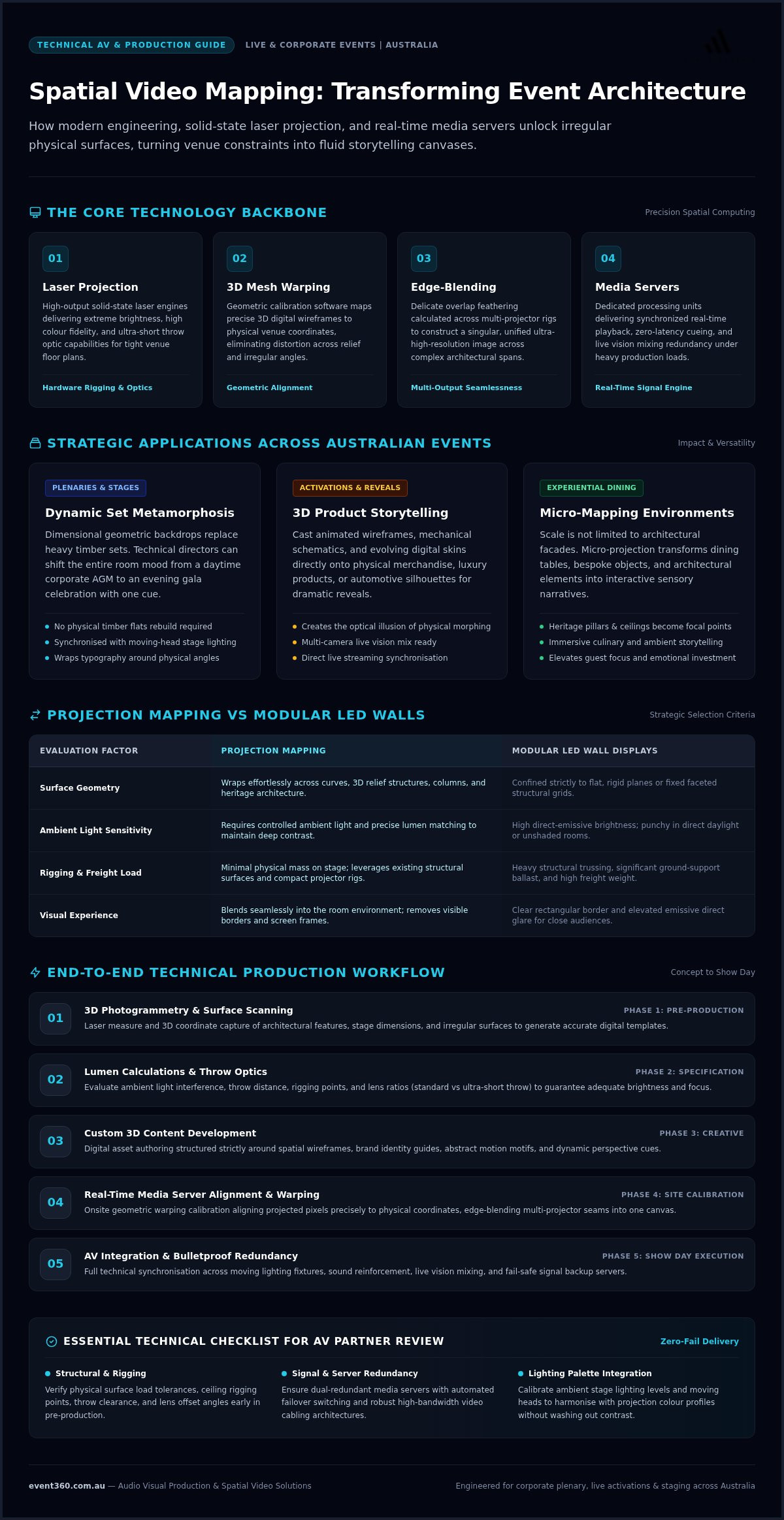
Static screens frame an image; spatial augmented reality frees it entirely. At its technical core, projection mapping uses specialised software and optical hardware to project visual content directly onto irregular, three-dimensional physical structures rather than conventional flat surfaces. Instead of forcing an audience to stare at an isolated rectangle, technicians map pixels across relief walls, architectural columns, stage sets, or manufactured products.
This optical transformation alters the entire room dynamic. When using projection mapping in events, passive attendees become active participants inside an immersive visual environment, driving measurable lifts in audience focus and emotional investment.
The Core Technology Behind Spatial Video Mapping
Executing this visual shift requires a synchronized technical backbone. Modern productions rely on solid-state laser projectors that generate immense brightness and colour precision, paired with ultra-short throw lenses when floor space is tight.
Behind the hardware, dedicated media servers process high-resolution video outputs in real time. Geometric calibration software maps 3D wireframes directly to physical coordinates, enabling seamless edge-blending and real-time mesh warping. This mathematical alignment ensures that visuals wrap around complex corners and irregular surfaces without distortion, maintaining pristine visual geometry from every audience viewpoint.
Why Event Planners Are Moving Beyond Flat Displays
Rigid physical stage builds often constrain creative ambition while driving up freight and labour demands. Thoughtfully using projection mapping in events allows producers to instantly redesign a room between morning plenary sessions and evening gala awards without shifting a single timber flat.
Architectural quirks like heritage pillars, curved ceilings, and proscenium arches stop being sightline obstacles; they become high-impact focal points. Achieving this level of seamless visual storytelling requires synchronisation across your entire technical ecosystem. Integrating custom digital assets alongside precision lighting and sound reinforcement through unified audio visual production guarantees that every spatial transition hits with theatrical precision and absolute reliability.
Key Applications: Using Projection Mapping Across Modern Events
Transforming a room into an engaging brand environment requires balancing tailored visual design with specialised hardware. When strategically using projection mapping in events, structural geometry ceases to be static scenery and becomes a living storytelling canvas.
Stage Design and Keynote Presentation Backdrops
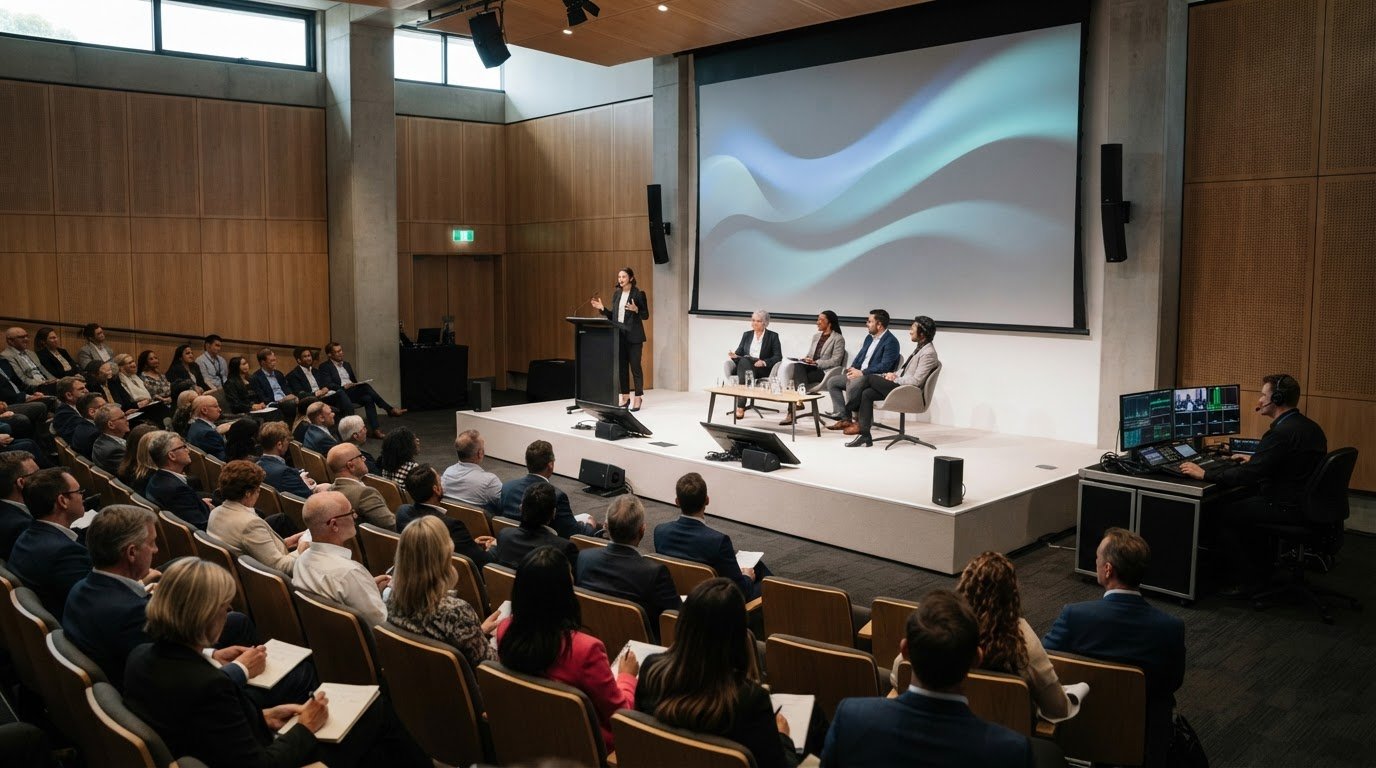
Modern corporate plenary sessions thrive on agility. Replacing heavy timber backdrops with dimensional geometric set pieces allows technical directors to project crisp typography, abstract brand motifs, and presentation graphics that wrap precisely around physical angles.
A single stage setup easily shifts moods. With one media cue, formal daytime AGM presentations transition into an energetic evening awards celebration, synchronised with moving-head stage lights calibrated to match the projection palette.
Product Launches and Brand Storytelling Activations
Unveiling high-value merchandise demands theatrical drama. Instead of static displays, optical mapping allows you to cast dynamic digital skins, animated wireframes, and internal mechanical schematics directly onto physical cars, industrial machinery, or luxury goods.
As documented in spatial computing overviews on wikipedia.org, this alignment creates the optical illusion that the physical object itself is morphing. Pairing this reveal with multi-camera vision mixing and professional live streaming services guarantees remote viewers experience the exact same reveal as guests in the room.
Immersive Dining and Interactive Sensory Environments
Impact isn't solely about massive architectural scale; micro-mapping delivers intimate magic. Mapping animated culinary narratives and ambient landscapes directly onto banquet tables turns a routine conference dinner into an unforgettable multi-sensory journey.
Interactive registration counters and entrance tunnels can react to delegate movements using motion sensors, inviting active exploration from the moment attendees arrive. Delivering these complex visual illusions requires uniting custom animation with calibrated optical hardware; collaborating with the production team at Event 360 ensures your creative vision and technical staging align seamlessly on show day.
Projection Mapping vs LED Wall Displays: How to Choose
Deciding between spatial projection and direct-view modular displays shapes your entire production footprint. While both technologies deliver vivid visual messaging, they solve fundamentally different creative and physical staging challenges.
Direct-view LED screens excel at brute luminance, firing light straight into the audience. Spatial projection reflects light off physical architecture, creating depth and seamless optical illusions. Understanding your venue's environmental boundaries ensures you pick the right tool for the room.
Evaluating Ambient Light and Venue Environments
Ambient lighting is the ultimate deciding factor. For exhibition halls with uncontrollable daylight or outdoor stages, direct-view panels sourced through professional LED wall hire punch through bright environments effortlessly due to their intense nit ratings.
Conversely, controlled indoor venues with dimmable house lighting unlock the true power of projection. When ambient lux levels are managed, projectors deliver deep, cinematic contrast ratios without emitting the harsh pixel glare common to high-pitch screens. Research on visual ergonomics and ocular strain indexed on nih.gov highlights how softer, diffused reflected light provides comfortable viewing over extended conference sessions.
Spatial Versatility and Surface Geometry
Physical venue constraints often dictate your rigging reality. LED tiles require heavy ground-support frames or substantial ceiling rigging points capable of bearing tonnes of modular weight. Older heritage venues or ballrooms with limited roof load capacities simply cannot accommodate expansive LED structures.
This is where using projection mapping in events becomes a game changer:
Minimal structural load: Projectors fly from distant truss points or discreet floor mounts, requiring zero heavy framing against the display surface.
Organic, non-linear forms: Curved prosceniums, spherical sculptures, and complex relief walls can't fit square LED panels, but video warping maps onto them effortlessly.
Architectural camouflage: The projection surface remains a clean, physical design feature when powered down, avoiding unsightly black walls of inactive electronic tiles.
If your goal is razor-sharp data presentation in a brightly lit room, LED is unmatched. But when your creative brief demands transforming venue architecture into living art, using projection mapping in events provides unparalleled creative freedom.
Step-by-Step Technical Execution: From Concept to Show Day
Flawless spatial projection requires an uncompromising engineering methodology. Successfully using projection mapping in events isn't simply about loading video files into playback software; it demands a structured, multi-stage pipeline that bridges real-world physics with bespoke digital design.
Site Surveys, Photogrammetry, and Hardware Specification
Everything starts with dimensional precision. Production teams conduct detailed site surveys using LiDAR laser scanning and photogrammetry to generate millimetre-accurate 3D digital wireframes of the target environment.
Optical engineers calculate throw ratios, focal lengths, and projector mounting angles to ensure unhindered sightlines while eliminating presenter shadows across the presentation area. Simultaneously, technicians specify laser projectors with optimal ANSI lumens to overcome surface light absorption, ensuring vivid visual punch across timber, fabric, or masonry substrates.
Content Creation and Motion Design Alignment
With the physical wireframe locked down, animators build custom creative content directly over the digital UV map. Instead of standard flat video, designers engineer dynamic depth extrusions, shadow play, and optical perspective tricks that turn structural contours into fluid narrative devices.
Motion assets are rendered in uncompressed, high-performance codecs to preserve 60-frame-per-second stability across multi-channel media server outputs. Brand assets, animated typography, and visual pacing are tested directly against the virtual 3D environment well before bumping into the venue.
Onsite Rigging, Warping, and Multi-Projector Blending
During venue setup, technical crews secure projection hardware onto certified rigging points and run primary and backup uncompressed fibre-optic signal paths. Specialised media servers output alignment grids across the physical architecture to calibrate geometric warping down to the individual pixel.
Skilled operators fine-tune edge-blending overlap zones, balance colour temperature across all lenses, and eliminate visual seams between displays. When using projection mapping in events with high brand stakes, running rigorous cue-to-cue rehearsals ensures automated failovers and lighting cues trigger with split-second reliability. To guarantee total peace of mind for your live activation, partner with Event 360 for end-to-end technical production and precision execution nationwide.
Partnering with Audio Visual Specialists for Flawless Delivery
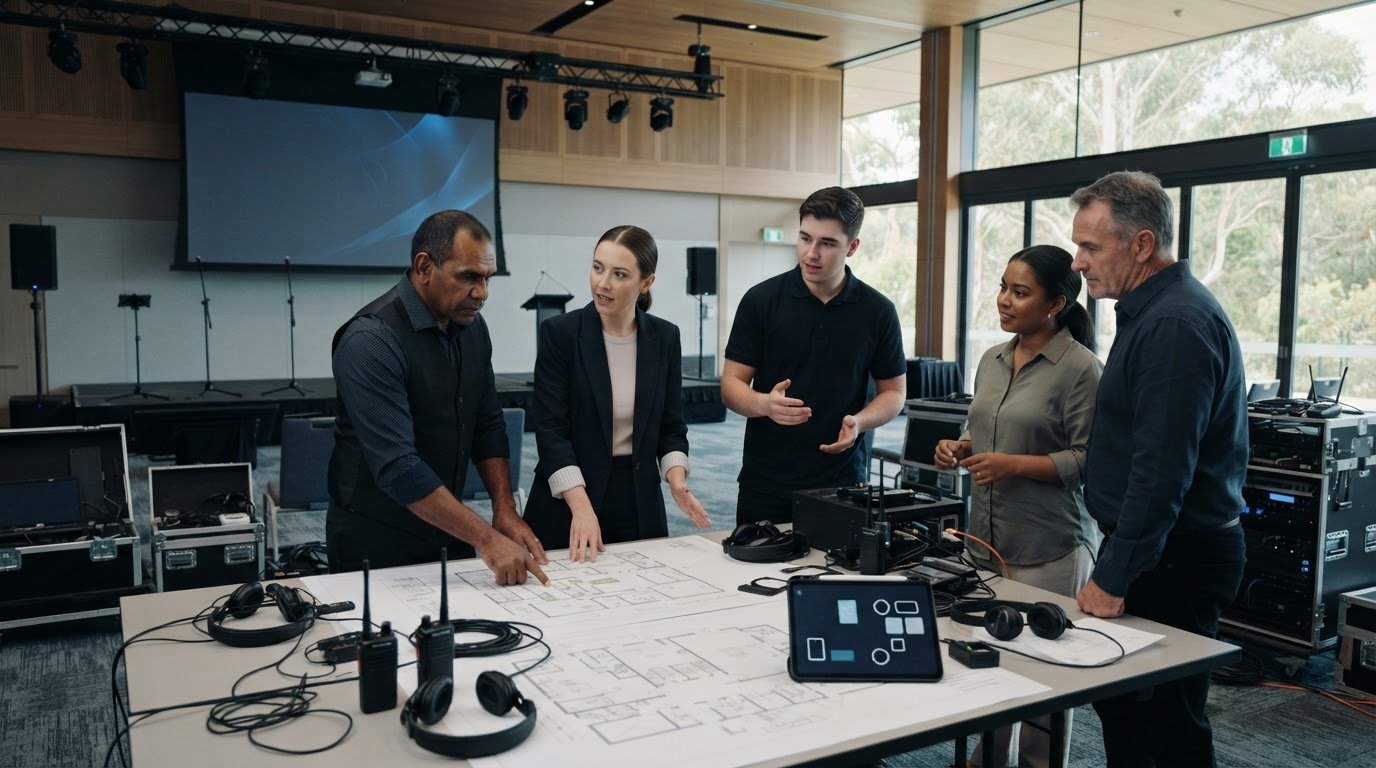
Spatial projection sits at the crossroads of architectural engineering, bespoke 3D motion design, and real-time vision mixing. Separating these disciplines across multiple independent vendors introduces friction, increases miscommunication risks, and leaves edge-blending calibration vulnerable on show day.
Partnering with a multidisciplinary production specialist eliminates these vulnerabilities. When using projection mapping in events, having a unified technical team ensures your physical surfaces, creative assets, and optical hardware are engineered together from day one.
Critical Questions to Qualify Your AV Production Partner
Before commissioning a production team, organisers should rigorously audit their technical capabilities and operational safeguards:
End-to-end integration: Does the team develop custom creative content in-house, or do they rely on third-party animators unfamiliar with projector throw ratios and surface UV mapping?
Hardware redundancy: What fail-safe measures protect live playback? Insist on dual-redundant media servers with hot-swappable failover switches and parallel fibre-optic runs.
Structural rigging compliance: Can the provider deliver certified rigging plots that adhere strictly to Australian venue safety and overhead load limits?
Reviewing prospective partners against established AV hire Australia criteria ensures you benchmark equipment quality, lens selections, and technical staffing against national industry standards.
The Value of Unified Technical Direction and Onsite Support
Live production leaves zero room for trial and error. Siloed departments often result in lighting rigs washing out projected surfaces or audio cues falling out of sync with visual motion design. A unified technical director aligns audio, lighting, and video systems into a synchronised cue stack, elevating a presentation into a cohesive theatrical show.
Dedicated onsite media server operators monitor thermal stability, manage convergence grids, and make real-time adjustments if physical staging shifts during rehearsals. This hands-on expertise guarantees calm, reliable execution from initial site scanning through to final pack-down.
When using projection mapping in events where brand reputation is on the line, total technical reassurance is non-negotiable. Learn how Event 360 delivers turnkey audio visual Australia production services nationwide, combining cutting-edge projection technology with proactive planning to turn ambitious creative concepts into seamless live realities.
Transform Your Event Canvas with Optical Precision
Spatial projection bridges the gap between physical architecture and immersive digital storytelling. Successfully using projection mapping in events comes down to disciplined engineering from day one: capturing millimetre-accurate 3D surface geometry, managing ambient room light, and building custom animations that play naturally across dimensional contours.
Achieving this level of theatrical impact doesn't have to be daunting. Uniting end-to-end creative content and technical production under one roof eliminates guesswork and protects your brand reputation on show day. Supported by an extensive national equipment inventory of high-lumen laser projectors and advanced media servers, our dedicated production technicians deliver flawless onsite alignment, robust signal redundancy, and calm execution from concept to bump-out.
Ready to transform structural boundaries into breathtaking live environments? Elevate your next event with Event 360 and give your audience an unforgettable visual experience.
Frequently Asked Questions
Can you use projection mapping in venues with high ambient light or windows?
Yes, but it requires careful light control or exceptionally high-output laser hardware. While direct sunlight washes out projected contrast, professional production teams combat ambient bleed by installing temporary blackout drapes or pairing high-lumen laser projectors with short-throw lenses. If an atrium or outdoor daylight cannot be dimmed, modular LED walls represent the superior technical alternative for uncompromised visual clarity.
What kind of surfaces work best for architectural and stage projection mapping?
Matte, light-coloured, and non-reflective surfaces deliver the highest optical fidelity and contrast. White, light grey, or neutral architectural finishes like timber, plasterboard, and masonry reflect light evenly without distortion. Glossy, dark, or mirrored materials absorb light or generate distracting specular glare. Technicians mitigate tricky surfaces during site photogrammetry by adjusting media server colour maps or applying temporary matte wraps to irregular physical set pieces.
How much lead time is typically required to design and produce mapped content?
Most custom projection mapping projects require four to eight weeks of lead time from initial site scanning to show day. Complex activations involving bespoke 3D animation, photogrammetry scanning, and multi-surface UV unwrapping demand dedicated development phases. Rushing content creation risks geometric alignment errors onsite, whereas adequate preparation allows creative animators and AV engineers to test renders in virtual wireframes well before bumping into the venue.
Is projection mapping more expensive than hiring an LED video wall?
Total costs depend heavily on surface scale and venue geometry rather than hardware alone. Direct-view LED screens become costlier across massive surface areas due to transport freight, heavy ground support, and structural rigging labour. Conversely, successfully using projection mapping in events over expansive architectural surfaces can be more economical because fewer physical units cover wider dimensions. Detailed site inspections clarify which visual solution best respects your production budget.
Can presenters stand in front of mapped projection surfaces without casting shadows?
Yes, presenters can move across mapped stages without casting shadows when projectors are rigged at steep overhead angles or fitted with ultra-short-throw lenses. Strategic projector positioning elevates the optical beam above walking paths, keeping light focused strictly on physical backdrop surfaces. Production designers can also map specific black zones around the podium or speaking area, ensuring speakers remain cleanly illuminated by stage key lights rather than video spill.
What happens if a projector bulb or laser light engine fails during a live event?
Professional live event productions mitigate failure by deploying dual-stacked projection hardware and hot-swappable backup systems. Modern solid-state laser projectors use redundant diode banks, meaning an individual diode failure merely drops overall brightness slightly rather than killing the entire picture. Dedicated media servers run automated failover feeds through parallel fibre-optic lines, allowing onsite technicians to switch inputs instantly without the audience noticing any visual interruption.
Can projection mapping be integrated into hybrid events and live streams?
Absolutely, spatial mapping integrates smoothly into hybrid broadcasts when camera angles and projector refresh rates are matched. When using projection mapping in events with live streaming components, technicians synchronise projector refresh rates with broadcast camera shutter speeds to eliminate visible scan lines and flickering. Dedicated vision switchers capture clean program feeds directly from media servers, allowing remote audiences to view dynamic motion graphics alongside panoramic venue shots.
Comments